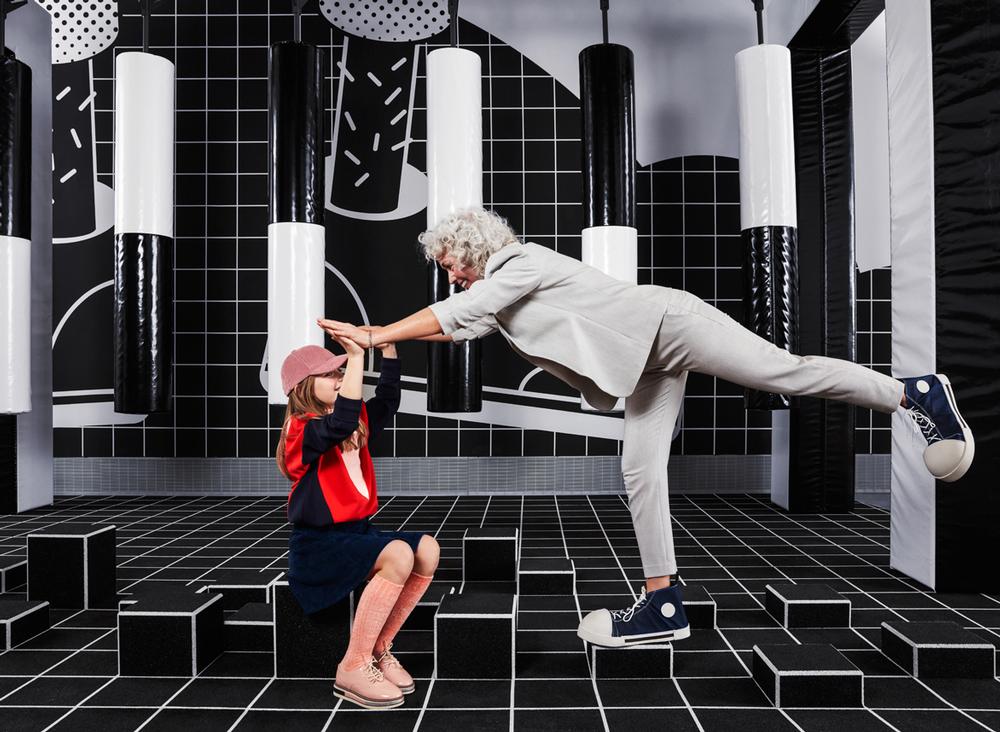
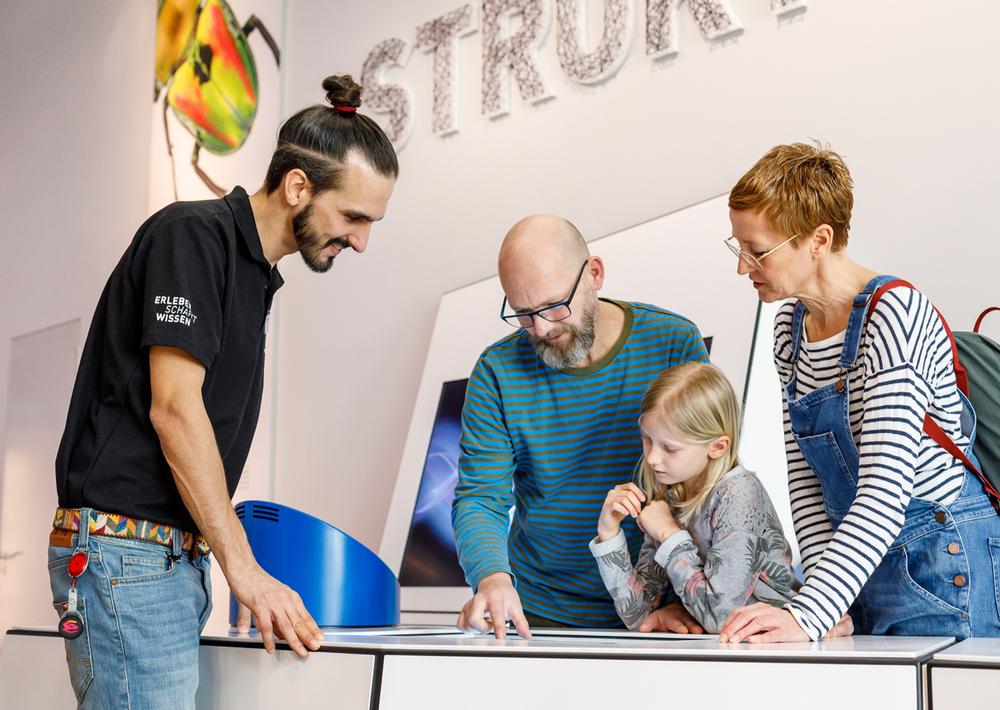
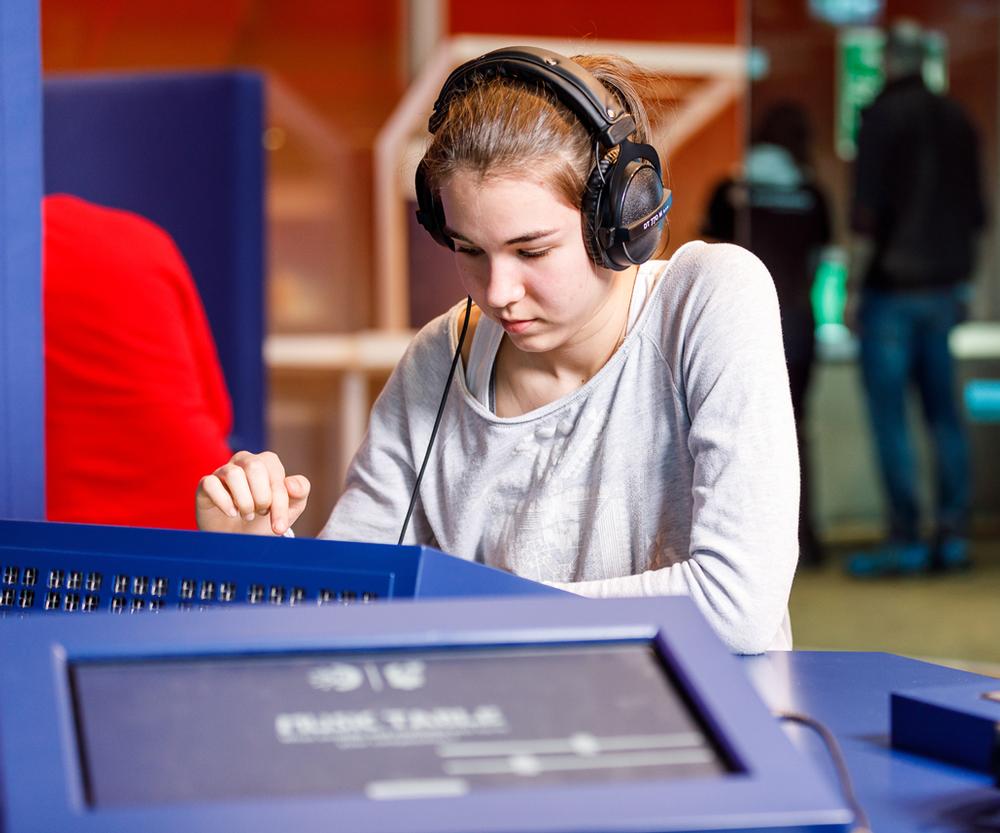
How does it feel to be in the eye of the storm? What would your body look like if it turned into ice? Experiencing science with all the senses is what Experimenta is all about. Tom Anstey spoke to Wolfgang Hansch about one of Germany’s premier science institutions
By Tom Anstey | Published in Attractions Management 2019 issue 2
Heilbronn – a city on the Neckar River in southwest Germany better known for its wine making industry – might not be the first place that springs to mind when you think of elite learning centres for STEM subjects.
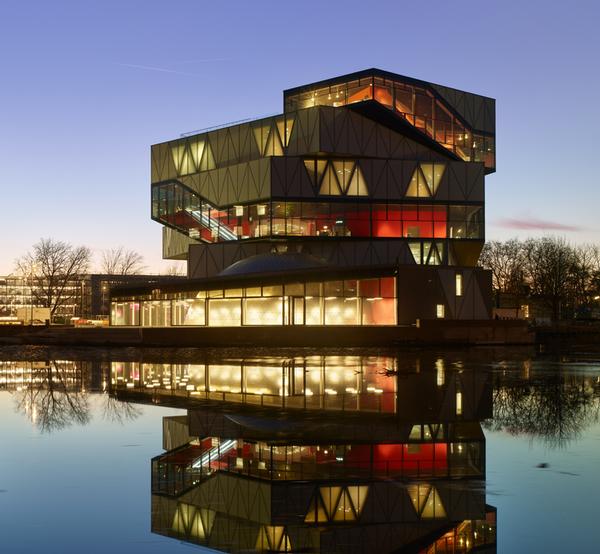
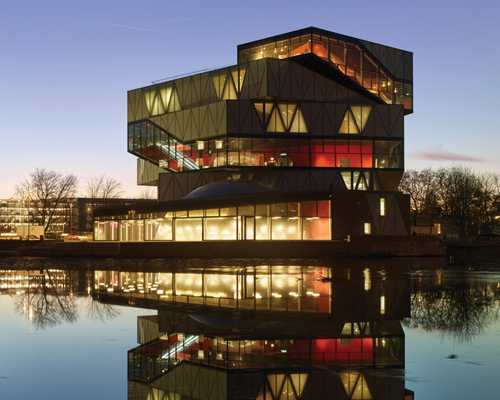
But the city is in fact home to the country’s largest science centre, which has recently undergone a major transformation, with four new permanent exhibition galleries set across 3,200sq m adding new facilities to the 25,000sq m site.
Years in the making The idea to open a science centre in the city was first concieved in 2005. To make the vision a reality, the city turned to a man already familiar with it, Wolfgang Hansch. Originally director of the Natural History Museum of Heilbronn from 1994 up until his appointment as managing director of Experimenta in 2005, Hansch was given the task of establishing a brand new science centre in the city, developing a former storehouse into the first iteration of Experimenta.
The attraction became a reality in November 2009 when it opened with the creed of “Discover Experience and Understand Science”.
“By 2012 our visitor numbers were exceeding expectations by far,” says Hansch. “That’s when we started talking about an expansion of the site, eventually deciding on an entirely new development to better serve the public.”
Backed by the Dieter Schwarz Foundation, a non-profit investment arm of supermarket giant Lidl, the centre broke ground on its expansion by Berlin-based architects Sauerbruch Hutton in 2016. In July 2017, the site closed completely so it could undergo a full transformation, with new exhibits, reimagined spaces and a new building. It reopened on 31 March, complete with a dome theatre, an observatory and workshop spaces.
All Aboard While the science centre was closed for redevelopment, Hansch and his team came up with a novel way of continuing to serve the population – converting an oil tanker into a floating science centre.
Called the MS Experimenta, the vessel is 105m long and offers more than 500sq m of interactive attractions. Opened in January 2018, a number of primary and secondary school courses are offered onboard the vessel, with schools accommodated inside two labs and an open workshop area. The floating attraction also offers a series of interactive exhibits for visitors, while there are areas for open workshops.
Its first year was a huge success, with 30,492 visitors in 2018. This success led to MS Experimenta taking a trip to Stuttgart, ahead of a nationwide tour.
Between 17 April and 16 October 2019, the ship will be anchored in Heilbronn to coincide with the Federal Garden Show with content tailored towards the event.
“When we first decided to launch the ship, it was set to be a permanent offer for Experimenta,” says Hansch. “It was such a great success however that we’ve decided to anchor it in large cities all over Germany going forward starting in 2020.”
A world class offering Following the three-and-a-half year redevelopment, which included the new galleries, renovation of the old storehouse and refurbishment of the MS Experimenta, Hansch believes the science centre now offers one of the premium experiences in Europe, if not the world.
“We have three main offers on site,” he says. “First, there are our galleries, where you can use different exhibits from biology, chemistry, physics and so on. Second, we have our Discovery World with its well-equipped labs. Finally, we have the Science Dome. These are our primary offerings. We also have an observatory on the roof and a small theatre for teenagers aged 5- to 10-years-old. This variety is extraordinary. For science centres in Germany, I think it’s a new step in their development.
“This is the largest science centre in Germany. The most important point, however, is our extraordinary lineup of exhibitions. It’s not just that we’re the biggest, but also that we have the best content anywhere on the Continent.”
Nobel goals The centre is targetting 250,000 visitors a year, an ambitious goal for a city with a population of 125,000 people. But what’s even more ambitious is Hansch’s ultimate goal, inspiring one of Experimenta’s visitors to take science’s most coveted prize.
“We want to become a science centre where the visitors have fun and where they can learn about science and technology,” he says. “My dream is that, in 20 or 30 years, we have a Nobel prize winner, whose first step in science was making a visit to Experimenta.”
The galleries
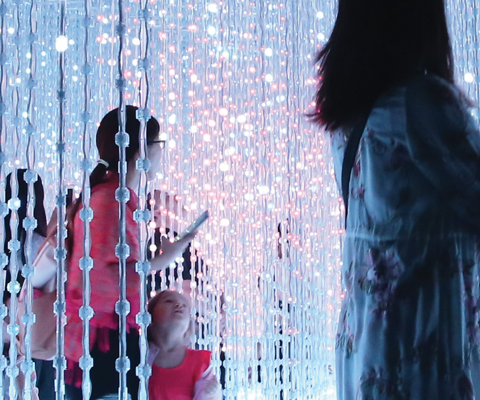
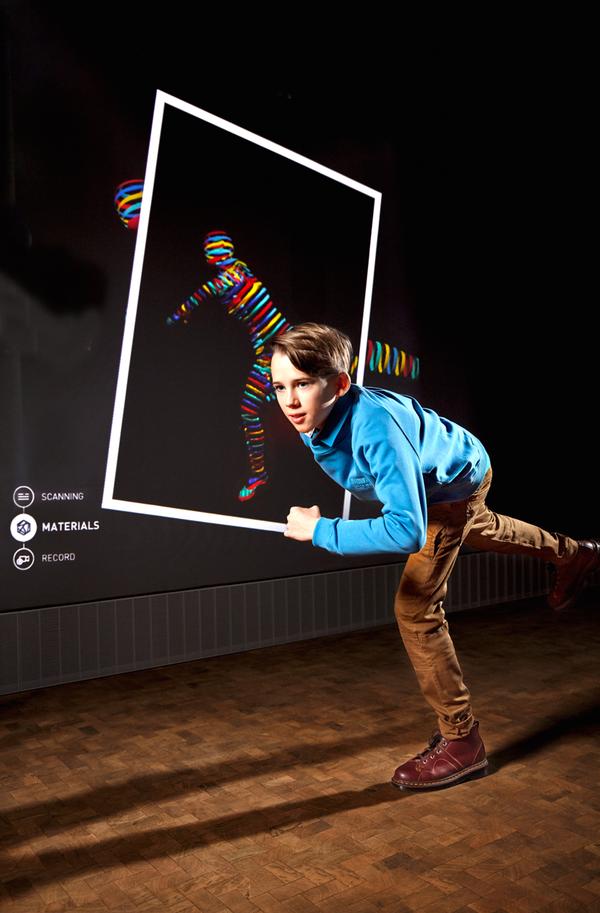
Experimenta opens up a world of scientific knowledge with 275 interactive exhibits set over four new galleries
Two of the four permanent galleries were created by Dutch experience specialist NorthernLight, with the remaining two produced by Hüttinger and designed by Berlin company Triad and Stuttgart firm Milla and Partner respectively.
“We worked with around 50 people, including engineers, robotics, designers and more,” says NorthernLight co-founder and director, Steven Schaeken.
“It’s one of the best projects I’ve worked on in my 20 years in the field. Experimenta helped to get some of the most innovative thinking out of our heads.”
The NorthernLight-designed galleries – Nature of Things and World View – took three-and-a-half years to create. The former is based on matter and explores five elements of everyday matter, how light affects matter, the structure of matter and organic matter – while the latter allows visitors to make and do things on given topics from computer science to robotics.
Experimenta opens up a world of scientific knowledge with 275 interactive exhibits set over four new galleries
“With the Nature of Things gallery, our thoughts were that lots of the modern world is built around immaterial things so we wanted to focus on the world through its physical qualities,” says Schaeken.
“The concept we had at the beginning for World View, however, was kind of an atelier. We wanted a learning centre-cum-makers centre. We assembled this with stand-alone, hands-on exhibits and then designed a yellow snake that connects them all throughout the gallery.”
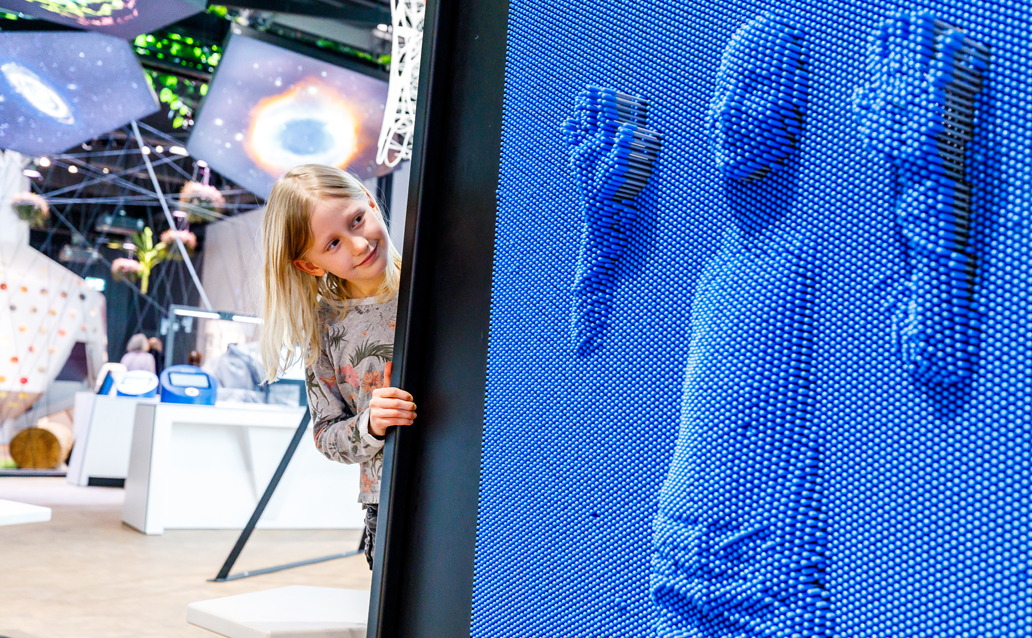
The third gallery KopfSachen, asks how complex and diverse man perceives the world with his senses. The final gallery, Metabolism, shows how the inner workings of things makes the invisible visible.
The institution promotes a wide range of future-oriented ideas
The Science Dome
Thomas Gellermann, head of Special Projects, Kraftwerk
Perhaps the most significant and high-tech part of the reimagined Experimenta is its Science Dome.
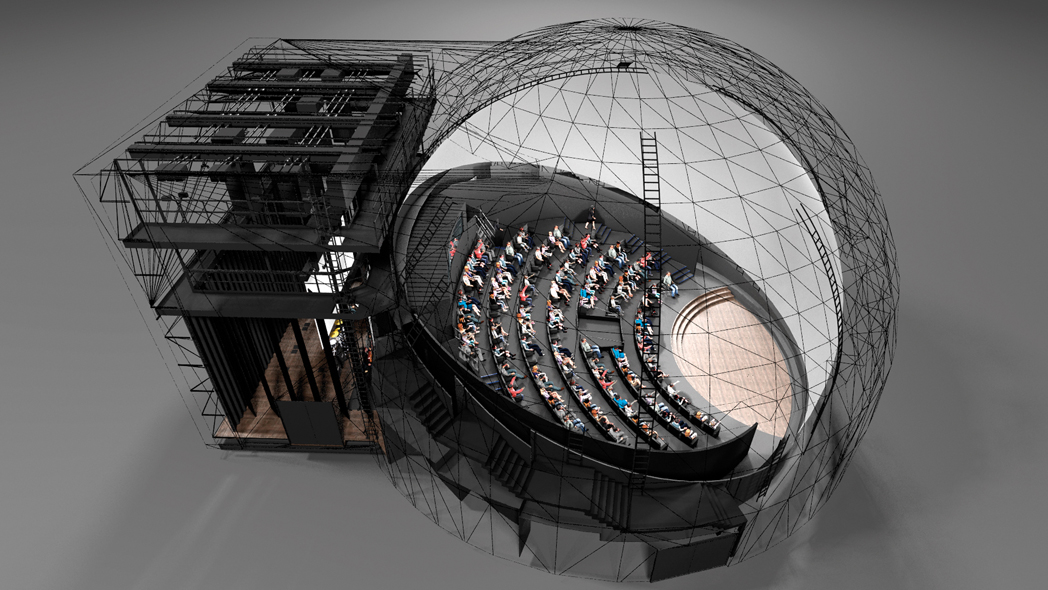
Created by Austrian company Kraftwerk and US manufacturer Spitz, the high tech experience space combines a traditional planetarium with a full dome system and a performance stage. Inside, the audience sits on a rotating platform that can be turned 180 degrees, with special technology to stage lectures, digital cinema performances and theatre productions. The dome also offers full 360-degree projection using six Barco projectors. One innovative element is a water curtain.
Kraftwerk was responsible for the technical design and detailed planning of the Science Dome. It also handled everything from the implementation, programming and commissioning of AV right down to the seats.
"We came up with an idea to combine a planetarium or a full dome system together with the stage scenario to enhance the multipurpose venue"
“Despite the new building being quite large, space was limited due to its location on an island in the Neckar river,” says Thomas Gellermann, head of Special Projects at Kraftwerk.
“There was an extensive wish list of different venues and scenarios that Experimenta wanted to include and integrating them all in one area was a challenge. Soon, we came up with an idea to combine a planetarium or a full dome system together with the stage scenario to enhance the multipurpose venue while still allowing it to be located in one space. This was the birth of a highly innovative installation.”
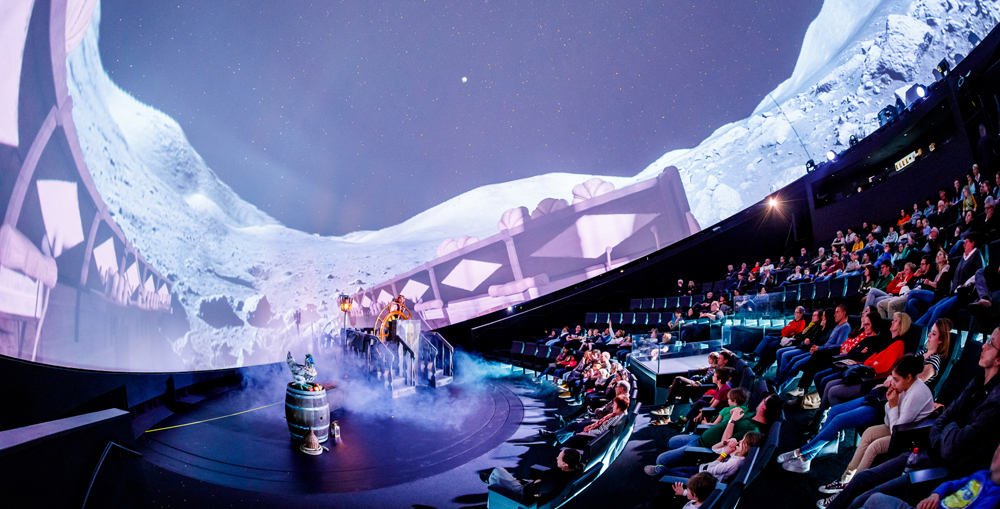
With the combination of planetarium and theatre, visitors can travel virtually into space or experience exciting experimental shows
Who did what?
Galleries: NorthernLight, Hüttinger, Triad, Milla and Partner
Exhibition design and production: Jochen Hunger, Ligneolus, Hüttinger
Construction: Drees & Sommer
Architects: Sauerbruch Hutton Berlin
Science Dome: Kraftwerk Living Technologies, Spitz
People profile: Vitali Klitschko
With the help of Europa Park, the multi-time boxing champion turned politician dreams up theme park plan for Kyiv, Ukraine
Rides: Art Attack
We look at major ride openings at
visitor attractions across the globe
Top team: Made in China
The birthplace of William
Shakespeare will be recreated at
the home of China’s most famous
playwright. We speak to the team
behind the ambitious project
Promotional feature: Animalive - Lights, camera, action!
Animalive is a premier manufacturer of interactive animation products.
Its founder, Ali Kord, explains how its recent joint venture will
take the company’s award-winning products to the next level
Museums: Day out at the museum
The Network of European Museum
Organisations has launched a Political
Internships scheme. We speak to
the programme’s creator about what
this could mean for museums
Promotional feature: Red Raion - Building a new IP
Red Raion, the CGI studio specialised in media based attractions, has
collaborated with Unlimited Leisure Holdings to create a new 4D movie, which
will be presented at Unlimited Snow’s newest park
Show report: Global Appeal
TEA Summit and SATE Europe
Christine Kerr reports from the TEA’s
Summit, Thea Awards and SATE Europe
Interview: Pure Imagication
Adlabs Imagica is India’s largest
theme park destination. Its joint
CEO speaks to Kath Hudson
How does it feel to be in the eye of the storm? What would your body look like if it turned into ice? Experiencing science with all the senses is what Experimenta is all about. Tom Anstey spoke to Wolfgang Hansch about one of Germany’s premier science institutions
By Tom Anstey | Published in Attractions Management 2019 issue 2
Heilbronn – a city on the Neckar River in southwest Germany better known for its wine making industry – might not be the first place that springs to mind when you think of elite learning centres for STEM subjects.
But the city is in fact home to the country’s largest science centre, which has recently undergone a major transformation, with four new permanent exhibition galleries set across 3,200sq m adding new facilities to the 25,000sq m site.
Years in the making The idea to open a science centre in the city was first concieved in 2005. To make the vision a reality, the city turned to a man already familiar with it, Wolfgang Hansch. Originally director of the Natural History Museum of Heilbronn from 1994 up until his appointment as managing director of Experimenta in 2005, Hansch was given the task of establishing a brand new science centre in the city, developing a former storehouse into the first iteration of Experimenta.
The attraction became a reality in November 2009 when it opened with the creed of “Discover Experience and Understand Science”.
“By 2012 our visitor numbers were exceeding expectations by far,” says Hansch. “That’s when we started talking about an expansion of the site, eventually deciding on an entirely new development to better serve the public.”
Backed by the Dieter Schwarz Foundation, a non-profit investment arm of supermarket giant Lidl, the centre broke ground on its expansion by Berlin-based architects Sauerbruch Hutton in 2016. In July 2017, the site closed completely so it could undergo a full transformation, with new exhibits, reimagined spaces and a new building. It reopened on 31 March, complete with a dome theatre, an observatory and workshop spaces.
All Aboard While the science centre was closed for redevelopment, Hansch and his team came up with a novel way of continuing to serve the population – converting an oil tanker into a floating science centre.
Called the MS Experimenta, the vessel is 105m long and offers more than 500sq m of interactive attractions. Opened in January 2018, a number of primary and secondary school courses are offered onboard the vessel, with schools accommodated inside two labs and an open workshop area. The floating attraction also offers a series of interactive exhibits for visitors, while there are areas for open workshops.
Its first year was a huge success, with 30,492 visitors in 2018. This success led to MS Experimenta taking a trip to Stuttgart, ahead of a nationwide tour.
Between 17 April and 16 October 2019, the ship will be anchored in Heilbronn to coincide with the Federal Garden Show with content tailored towards the event.
“When we first decided to launch the ship, it was set to be a permanent offer for Experimenta,” says Hansch. “It was such a great success however that we’ve decided to anchor it in large cities all over Germany going forward starting in 2020.”
A world class offering Following the three-and-a-half year redevelopment, which included the new galleries, renovation of the old storehouse and refurbishment of the MS Experimenta, Hansch believes the science centre now offers one of the premium experiences in Europe, if not the world.
“We have three main offers on site,” he says. “First, there are our galleries, where you can use different exhibits from biology, chemistry, physics and so on. Second, we have our Discovery World with its well-equipped labs. Finally, we have the Science Dome. These are our primary offerings. We also have an observatory on the roof and a small theatre for teenagers aged 5- to 10-years-old. This variety is extraordinary. For science centres in Germany, I think it’s a new step in their development.
“This is the largest science centre in Germany. The most important point, however, is our extraordinary lineup of exhibitions. It’s not just that we’re the biggest, but also that we have the best content anywhere on the Continent.”
Nobel goals The centre is targetting 250,000 visitors a year, an ambitious goal for a city with a population of 125,000 people. But what’s even more ambitious is Hansch’s ultimate goal, inspiring one of Experimenta’s visitors to take science’s most coveted prize.
“We want to become a science centre where the visitors have fun and where they can learn about science and technology,” he says. “My dream is that, in 20 or 30 years, we have a Nobel prize winner, whose first step in science was making a visit to Experimenta.”
The galleries
Experimenta opens up a world of scientific knowledge with 275 interactive exhibits set over four new galleries
Two of the four permanent galleries were created by Dutch experience specialist NorthernLight, with the remaining two produced by Hüttinger and designed by Berlin company Triad and Stuttgart firm Milla and Partner respectively.
“We worked with around 50 people, including engineers, robotics, designers and more,” says NorthernLight co-founder and director, Steven Schaeken.
“It’s one of the best projects I’ve worked on in my 20 years in the field. Experimenta helped to get some of the most innovative thinking out of our heads.”
The NorthernLight-designed galleries – Nature of Things and World View – took three-and-a-half years to create. The former is based on matter and explores five elements of everyday matter, how light affects matter, the structure of matter and organic matter – while the latter allows visitors to make and do things on given topics from computer science to robotics.
Experimenta opens up a world of scientific knowledge with 275 interactive exhibits set over four new galleries
“With the Nature of Things gallery, our thoughts were that lots of the modern world is built around immaterial things so we wanted to focus on the world through its physical qualities,” says Schaeken.
“The concept we had at the beginning for World View, however, was kind of an atelier. We wanted a learning centre-cum-makers centre. We assembled this with stand-alone, hands-on exhibits and then designed a yellow snake that connects them all throughout the gallery.”
The third gallery KopfSachen, asks how complex and diverse man perceives the world with his senses. The final gallery, Metabolism, shows how the inner workings of things makes the invisible visible.
The institution promotes a wide range of future-oriented ideas
The Science Dome
Thomas Gellermann, head of Special Projects, Kraftwerk
Perhaps the most significant and high-tech part of the reimagined Experimenta is its Science Dome.
Created by Austrian company Kraftwerk and US manufacturer Spitz, the high tech experience space combines a traditional planetarium with a full dome system and a performance stage. Inside, the audience sits on a rotating platform that can be turned 180 degrees, with special technology to stage lectures, digital cinema performances and theatre productions. The dome also offers full 360-degree projection using six Barco projectors. One innovative element is a water curtain.
Kraftwerk was responsible for the technical design and detailed planning of the Science Dome. It also handled everything from the implementation, programming and commissioning of AV right down to the seats.
"We came up with an idea to combine a planetarium or a full dome system together with the stage scenario to enhance the multipurpose venue"
“Despite the new building being quite large, space was limited due to its location on an island in the Neckar river,” says Thomas Gellermann, head of Special Projects at Kraftwerk.
“There was an extensive wish list of different venues and scenarios that Experimenta wanted to include and integrating them all in one area was a challenge. Soon, we came up with an idea to combine a planetarium or a full dome system together with the stage scenario to enhance the multipurpose venue while still allowing it to be located in one space. This was the birth of a highly innovative installation.”
With the combination of planetarium and theatre, visitors can travel virtually into space or experience exciting experimental shows
Who did what?
Galleries: NorthernLight, Hüttinger, Triad, Milla and Partner
Exhibition design and production: Jochen Hunger, Ligneolus, Hüttinger
Construction: Drees & Sommer
Architects: Sauerbruch Hutton Berlin
Science Dome: Kraftwerk Living Technologies, Spitz
People profile: Vitali Klitschko
With the help of Europa Park, the multi-time boxing champion turned politician dreams up theme park plan for Kyiv, Ukraine
Rides: Art Attack
We look at major ride openings at
visitor attractions across the globe
Top team: Made in China
The birthplace of William
Shakespeare will be recreated at
the home of China’s most famous
playwright. We speak to the team
behind the ambitious project
Promotional feature: Animalive - Lights, camera, action!
Animalive is a premier manufacturer of interactive animation products.
Its founder, Ali Kord, explains how its recent joint venture will
take the company’s award-winning products to the next level
Museums: Day out at the museum
The Network of European Museum
Organisations has launched a Political
Internships scheme. We speak to
the programme’s creator about what
this could mean for museums
Promotional feature: Red Raion - Building a new IP
Red Raion, the CGI studio specialised in media based attractions, has
collaborated with Unlimited Leisure Holdings to create a new 4D movie, which
will be presented at Unlimited Snow’s newest park
Show report: Global Appeal
TEA Summit and SATE Europe
Christine Kerr reports from the TEA’s
Summit, Thea Awards and SATE Europe
Interview: Pure Imagication
Adlabs Imagica is India’s largest
theme park destination. Its joint
CEO speaks to Kath Hudson
OMA has completed a major transformation of New York's New Museum, creating a larger
cultural campus that combines expanded exhibition spaces with learning, performance,
hospitality and public programming.
A US$50 million (£44.2 million, €51.2 million) transformation of Chicago's historic McCormick
Mansion has created a new destination that combines live magic, immersive theatre, dining and
private membership under one roof.
The Montana Historical Society has officially celebrated the opening of its new Montana
Heritage
Center, a US$107 million (£79 million, €92 million) destination that combines immersive
storytelling with cutting-edge audiovisual technology to bring the sta
San Antonio Zoo has reported a US$283 million economic impact for 2025, following a decade-
long transformation programme that has seen almost US$200 million invested into the Texas
attraction.
Plans for the AU$180 million redevelopment of Reef HQ Aquarium in Townsville, Australia, are
progressing, with the project set to transform the attraction into a global centre for reef
education and conservation.
Abu Dhabi-based investment firm Mubadala Capital has made a binding, fully financed
€1 billion
offer to acquire Pierre and Vacances SA, the European holiday resort operator behind the
continental European Center Parcs business.
Disney has reaffirmed its commitment to investing US$30 billion in its US parks and cruise
business by 2033, using new America250 celebrations to underline the role its attractions play
in supporting jobs, tourism and economic growth.
Expo 2030 Riyadh is being planned as a permanent visitor destination, with organisers
confirming the six-million-square-metre site will become a Global Village after the event closes.
The owner of one of Australia's best-known waterparks has acquired a major competitor,
creating a new attractions business spanning two of the country's largest visitor destinations.
The Toverland theme park in the Netherlands has announced a €98m expansion programme
that will add a resort, new attractions and staff facilities as it pursues plans to become a multi-
day destination.
+ More news
COMPANY PROFILES
Sally Corporation Our services include: Dark ride design & build; Redevelopment of existing attractions; High-quality [more...]
Clip 'n Climb Clip ‘n Climb currently offers facility owners and
investors more than 40 colourful and unique
Cha [more...]