Why are people with disabilities still being let down by poorly designed spaces? Ensuring spaces are accessible for all shouldn’t be an afterthought, it should be part of the creative design process, says Magali Robathan
By Magali Robathan | Published in CLADmag 2020 issue 1
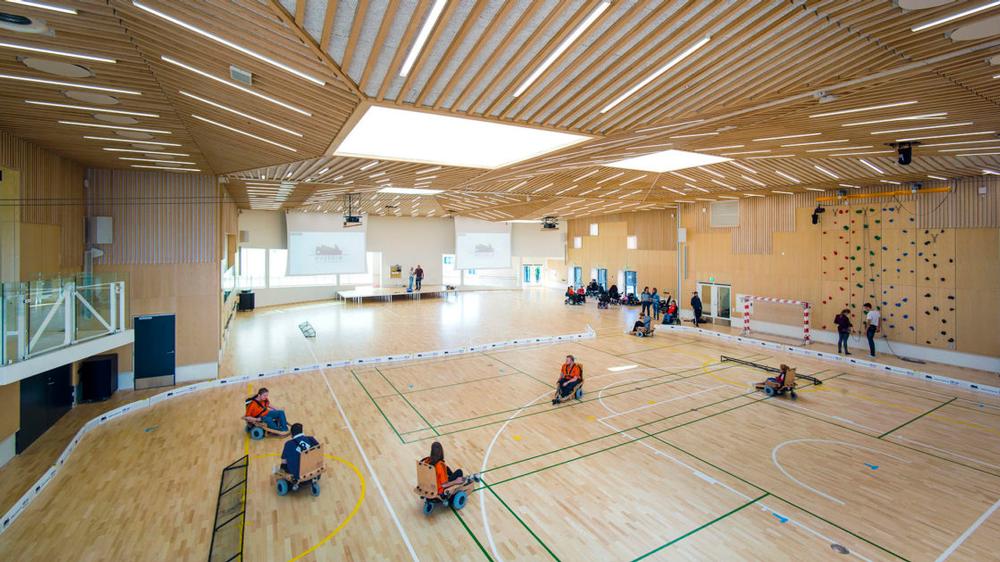
AART’s Musholm holiday sports and conference centre in Denmark
In 2017, artist Christopher Samuels was made technically homeless and forced to accept emergency accommodation in an inaccessible hotel room. “I couldn’t navigate around the bed in my wheelchair,” he told CLAD (see page 76). “I couldn’t get into the bed, I couldn’t use the dressing table. I couldn’t shut the bathroom door, or use the toilet or shower.”
This experience stayed with Samuels, and when art commissioning programme Unlimited put out a call for submissions to design a guestroom for an innovative arts-led hotel in Blackpool, UK, he knew what he wanted to do.
Art Bnb features 19 guestrooms-come-art installations, designed by different artists to get guests thinking.
Samuels’ room has been designed to be deliberately frustrating to use – the bed is surrounded by a high ‘lip’ that guests have to climb over, the bathroom door doesn’t shut, the television can only be viewed in the mirror and the shower gel dispenser is upside down.
“I wanted to make people experience the reality of what it’s like to be disabled: the frustrations of having to navigate a space which isn’t designed for them,” explains Samuels.
Unfortunately, Samuels’ experience is far from unusual. Twenty years on from the introduction of the Americans with Disabilities Act in the US and 15 years on from the introduction of the Disability Discrimination Act in the UK, poorly designed spaces are still a reality for many.
Recently, a lawsuit was filed against the new Stephen Holl-designed Hunters Point Library in New York, with disability rights advocates arguing that the building was “designed and built with a total disregard for adults and children with mobility disabilities”.
Heatherwick’s Vessel also attracted protests and a complaint by the United States Department for Justice alleging that much of the structure was not compliant with the Americans with Disabilities Act. Accessibility has now been improved at Vessel, and changes have been made to Hunters Point Library, but the question remains – why aren’t all users being considered at the design stage?
The Musholm holiday sports and conference centre in Korsor, Denmark, has won a host of awards for the 2015 redesign of the original site. The AART-designed venue features 24 fully accessible hotel rooms, a climbing wall suitable for wheelchair users, a relaxation room for people with difficulty concentrating, and a 100m athletics and wheelchair racing track leading up to a sky lounge.
Making spaces accessible shouldn’t be an add-on or an afterthought; it should be an integral part of the design process. It’s about the relationship between people and space; about engaging with how different bodies will use a space. Most of all, it’s about creativity, and that, after all, is what designers and architects are good at.
Why are people with disabilities still being let down by poorly designed spaces? Ensuring spaces are accessible for all shouldn’t be an afterthought, it should be part of the creative design process, says Magali Robathan
By Magali Robathan | Published in CLADmag 2020 issue 1
AART’s Musholm holiday sports and conference centre in Denmark
In 2017, artist Christopher Samuels was made technically homeless and forced to accept emergency accommodation in an inaccessible hotel room. “I couldn’t navigate around the bed in my wheelchair,” he told CLAD (see page 76). “I couldn’t get into the bed, I couldn’t use the dressing table. I couldn’t shut the bathroom door, or use the toilet or shower.”
This experience stayed with Samuels, and when art commissioning programme Unlimited put out a call for submissions to design a guestroom for an innovative arts-led hotel in Blackpool, UK, he knew what he wanted to do.
Art Bnb features 19 guestrooms-come-art installations, designed by different artists to get guests thinking.
Samuels’ room has been designed to be deliberately frustrating to use – the bed is surrounded by a high ‘lip’ that guests have to climb over, the bathroom door doesn’t shut, the television can only be viewed in the mirror and the shower gel dispenser is upside down.
“I wanted to make people experience the reality of what it’s like to be disabled: the frustrations of having to navigate a space which isn’t designed for them,” explains Samuels.
Unfortunately, Samuels’ experience is far from unusual. Twenty years on from the introduction of the Americans with Disabilities Act in the US and 15 years on from the introduction of the Disability Discrimination Act in the UK, poorly designed spaces are still a reality for many.
Recently, a lawsuit was filed against the new Stephen Holl-designed Hunters Point Library in New York, with disability rights advocates arguing that the building was “designed and built with a total disregard for adults and children with mobility disabilities”.
Heatherwick’s Vessel also attracted protests and a complaint by the United States Department for Justice alleging that much of the structure was not compliant with the Americans with Disabilities Act. Accessibility has now been improved at Vessel, and changes have been made to Hunters Point Library, but the question remains – why aren’t all users being considered at the design stage?
The Musholm holiday sports and conference centre in Korsor, Denmark, has won a host of awards for the 2015 redesign of the original site. The AART-designed venue features 24 fully accessible hotel rooms, a climbing wall suitable for wheelchair users, a relaxation room for people with difficulty concentrating, and a 100m athletics and wheelchair racing track leading up to a sky lounge.
Making spaces accessible shouldn’t be an add-on or an afterthought; it should be an integral part of the design process. It’s about the relationship between people and space; about engaging with how different bodies will use a space. Most of all, it’s about creativity, and that, after all, is what designers and architects are good at.
London Museum will open four new food and drink destinations when it launches its new home
at Smithfield on 28 November, making hospitality a central part of the visitor experience at one
of the capital's biggest cultural openings of the year.
OMA has completed a major transformation of New York's New Museum, creating a larger
cultural campus that combines expanded exhibition spaces with learning, performance,
hospitality and public programming.
A US$50 million (£44.2 million, €51.2 million) transformation of Chicago's historic McCormick
Mansion has created a new destination that combines live magic, immersive theatre, dining and
private membership under one roof.
The Montana Historical Society has officially celebrated the opening of its new Montana
Heritage
Center, a US$107 million (£79 million, €92 million) destination that combines immersive
storytelling with cutting-edge audiovisual technology to bring the sta
San Antonio Zoo has reported a US$283 million economic impact for 2025, following a decade-
long transformation programme that has seen almost US$200 million invested into the Texas
attraction.
Plans for the AU$180 million redevelopment of Reef HQ Aquarium in Townsville, Australia, are
progressing, with the project set to transform the attraction into a global centre for reef
education and conservation.
Abu Dhabi-based investment firm Mubadala Capital has made a binding, fully financed
€1 billion
offer to acquire Pierre and Vacances SA, the European holiday resort operator behind the
continental European Center Parcs business.
Disney has reaffirmed its commitment to investing US$30 billion in its US parks and cruise
business by 2033, using new America250 celebrations to underline the role its attractions play
in supporting jobs, tourism and economic growth.
Expo 2030 Riyadh is being planned as a permanent visitor destination, with organisers
confirming the six-million-square-metre site will become a Global Village after the event closes.
The owner of one of Australia's best-known waterparks has acquired a major competitor,
creating a new attractions business spanning two of the country's largest visitor destinations.