64% of women say they prefer clubs that offer a variety of workouts / photo: ndab creativity/shutterstock
Consumers and wellness brands have been surveyed to understand how the industry has shifted over the past year and a half and more importantly, where it’s headed in the months to come.
The data gathered has been published in two studies: the Mindbody 2021 US Consumer Survey which was compiled from 1,232 responses and the Mindbody 2021 US Business Study, which received 1,200 responses.
“For fitness operators, knowledge is innovation waiting to happen,” says Mindbody CEO, Josh McCarter. “We hope these data points help inform operators’ business strategy, at a time that calls for you to adapt more rapidly than ever.”
Consumers are open
to trying out something new in their routines
52 per cent of respondents shared that they’re more open to new workouts than they were before the pandemic.
In the US, some consumers are reluctant to return
Some consumers are still reluctant to return to the studio. The top five reasons are cited as feeling uncomfortable knowing not all attendees are vaccinated (29 per cent), not being comfortable near others (24 per cent), not being vaccinated yet (23 per cent), feeling too intimidated because they are out of shape/gained weight (19 per cent) and having established a new at-home virtual routine (17 per cent).
Cost and location matter to consumers, but they’re not everything
When it comes to choosing a fitness business, US consumers still cite location (37 per cent) and cost (36 per cent) as top considerations – and when motivating people to return, 37 per cent credit lower costs as a winning strategy. Unsurprisingly, cleanliness has also emerged as a key factor.
When it comes to other important factors, consumers also cite atmosphere (30 per cent), the time of classes (26 per cent), the variety of classes (25 per cent) and reputation (23 per cent), as well as instructors (23 per cent) and amenities (22 per cent).
The trend for
bookings is upwards
Researchers found that studio bookings are recovering in the US. While the volume continues to vary considerably by state, the overall trend line for bookings is heading toward pre-pandemic levels and once restrictions were lifted or relaxed, state-by-state, pent-up consumer demand was, and continues to be, the driver for recovery.
Offering workout variety is a big advantage
69 per cent of men and 64 per cent of women stated they prefer a fitness studio or gym which have a variety of workout types available.
Men are working out more than women, both in-person and virtually
59 per cent of men are attending in-person classes compared with 40 per cent of women in the US. Furthermore, 52 per cent of men are attending in-person classes at boutique studios versus 37 per cent of women.
As we see virtual fitness continue in popularity, men in the US are also attending virtual classes significantly more than women (59 per cent versus 43 per cent of women).
The industry is clear about the challenges it’s facing
Franchise organisations state their top three obstacles to growth as learning how to more effectively optimise their business (45 per cent), getting new/more customers (45 per cent), and ‘keeping, engaging and retaining existing customers' (43 per cent).
Similarly, non-franchise organisations reported that their largest roadblocks are getting new/more customers (54 per cent), learning how to more effectively optimise their business (42 per cent) and optimising their use of technology and software (39 per cent).
Reinstating growth is a vital part of recovery
31 per cent of business owners said their goal is to maintain the business for the foreseeable future and 44 per cent say they’re ready to start growing again.
Diversifying services is key
88 per cent of fitness businesses have already added something besides fitness classes or training sessions to their roster of services. The top five supplemental services are wellness (45 per cent), nutrition (40 per cent), massage therapy (36 per cent), physical therapy (35 per cent) and meditation (31 per cent).
Technology continues to become more fundamental to success
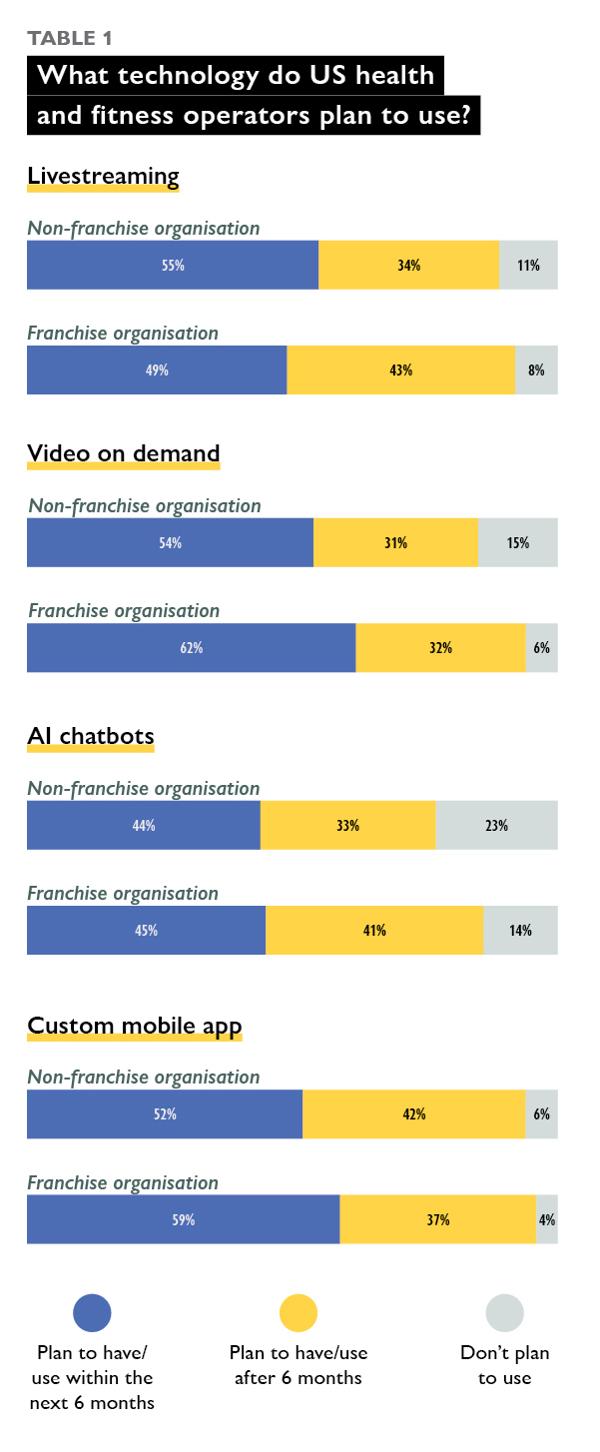
The majority of franchise and non-franchise businesses have implemented, or plan to implement the following tech: livestreaming, video on demand, custom mobile apps and AI chatbots.
Drilling into the numbers (Table 1) shows a difference of approach to technology between non-franchise and franchise operators, with a total of 86 per cent of non-franchise operators using or planning to use livestreaming and a higher number – 92 per cent – of franchise operators going down this road.
Video on demand is also more popular with franchise businesses, with 85 per cent of non-franchise operators using or planning to use it, vs 94 per cent of franchise operators.
The opposite is true of custom mobile apps, with 94 per cent of non-franchise operators using or planning to use them vs 86 per cent of franchise operators.
The adoption of AI is further behind the curve, showing the potential for growth in this area. Again franchises showed greater interest, with only 77 per cent of non-franchise operators saying they are using or planning to use AI chatbots, against 86 per cent of franchise owners.
An opportunity to reimagine one of the UK’s most recognisable towers has been formally
opened by Rivington Hark, as St Johns Beacon invites operators and partners to shape its
next phase. [more...]
64% of women say they prefer clubs that offer a variety of workouts / photo: ndab creativity/shutterstock
Consumers and wellness brands have been surveyed to understand how the industry has shifted over the past year and a half and more importantly, where it’s headed in the months to come.
The data gathered has been published in two studies: the Mindbody 2021 US Consumer Survey which was compiled from 1,232 responses and the Mindbody 2021 US Business Study, which received 1,200 responses.
“For fitness operators, knowledge is innovation waiting to happen,” says Mindbody CEO, Josh McCarter. “We hope these data points help inform operators’ business strategy, at a time that calls for you to adapt more rapidly than ever.”
Consumers are open
to trying out something new in their routines
52 per cent of respondents shared that they’re more open to new workouts than they were before the pandemic.
In the US, some consumers are reluctant to return
Some consumers are still reluctant to return to the studio. The top five reasons are cited as feeling uncomfortable knowing not all attendees are vaccinated (29 per cent), not being comfortable near others (24 per cent), not being vaccinated yet (23 per cent), feeling too intimidated because they are out of shape/gained weight (19 per cent) and having established a new at-home virtual routine (17 per cent).
Cost and location matter to consumers, but they’re not everything
When it comes to choosing a fitness business, US consumers still cite location (37 per cent) and cost (36 per cent) as top considerations – and when motivating people to return, 37 per cent credit lower costs as a winning strategy. Unsurprisingly, cleanliness has also emerged as a key factor.
When it comes to other important factors, consumers also cite atmosphere (30 per cent), the time of classes (26 per cent), the variety of classes (25 per cent) and reputation (23 per cent), as well as instructors (23 per cent) and amenities (22 per cent).
The trend for
bookings is upwards
Researchers found that studio bookings are recovering in the US. While the volume continues to vary considerably by state, the overall trend line for bookings is heading toward pre-pandemic levels and once restrictions were lifted or relaxed, state-by-state, pent-up consumer demand was, and continues to be, the driver for recovery.
Offering workout variety is a big advantage
69 per cent of men and 64 per cent of women stated they prefer a fitness studio or gym which have a variety of workout types available.
Men are working out more than women, both in-person and virtually
59 per cent of men are attending in-person classes compared with 40 per cent of women in the US. Furthermore, 52 per cent of men are attending in-person classes at boutique studios versus 37 per cent of women.
As we see virtual fitness continue in popularity, men in the US are also attending virtual classes significantly more than women (59 per cent versus 43 per cent of women).
The industry is clear about the challenges it’s facing
Franchise organisations state their top three obstacles to growth as learning how to more effectively optimise their business (45 per cent), getting new/more customers (45 per cent), and ‘keeping, engaging and retaining existing customers' (43 per cent).
Similarly, non-franchise organisations reported that their largest roadblocks are getting new/more customers (54 per cent), learning how to more effectively optimise their business (42 per cent) and optimising their use of technology and software (39 per cent).
Reinstating growth is a vital part of recovery
31 per cent of business owners said their goal is to maintain the business for the foreseeable future and 44 per cent say they’re ready to start growing again.
Diversifying services is key
88 per cent of fitness businesses have already added something besides fitness classes or training sessions to their roster of services. The top five supplemental services are wellness (45 per cent), nutrition (40 per cent), massage therapy (36 per cent), physical therapy (35 per cent) and meditation (31 per cent).
Technology continues to become more fundamental to success
The majority of franchise and non-franchise businesses have implemented, or plan to implement the following tech: livestreaming, video on demand, custom mobile apps and AI chatbots.
Drilling into the numbers (Table 1) shows a difference of approach to technology between non-franchise and franchise operators, with a total of 86 per cent of non-franchise operators using or planning to use livestreaming and a higher number – 92 per cent – of franchise operators going down this road.
Video on demand is also more popular with franchise businesses, with 85 per cent of non-franchise operators using or planning to use it, vs 94 per cent of franchise operators.
The opposite is true of custom mobile apps, with 94 per cent of non-franchise operators using or planning to use them vs 86 per cent of franchise operators.
The adoption of AI is further behind the curve, showing the potential for growth in this area. Again franchises showed greater interest, with only 77 per cent of non-franchise operators saying they are using or planning to use AI chatbots, against 86 per cent of franchise owners.
A new immersive attraction designed to transport visitors into the final hours of ancient Pompeii
is preparing to open near the world-famous archaeological site in southern Italy.
Experience design company, BRC Imagination Arts, has completed a transition that sees founder
Bob Rogers pass ownership of the business to four long-serving senior executives, while
remaining actively involved with the company.
Movie Park Germany has opened a new Paramount Pictures-themed attraction as part of its 30th
anniversary celebrations, using immersive storytelling and adaptive reuse to reinforce the park’s
longstanding “Hollywood in Germany” positioning.
Therme Manchester’s 28-acre development, which will include interconnected glass pavilions
that measure 65,000sq m, will be the largest bathing and wellbeing attraction in the world once
complete, according to prof David Russell, CEO of Therme UK.
Efteling has opened Hooghmoed, a new family drop tower designed to broaden the appeal of its
recently launched Sirene Island themed area and introduce younger visitors to thrill attractions.
A proposed Puy du Fou development near Bicester and Universal Destinations and Experiences’
planned resort in Bedford are emerging as part of a wider transformation of the Oxford–
Cambridge Growth Corridor into a major centre for UK leisure and tourism inv
Shedd Aquarium has opened the Immersion Theater developed in partnership with SimEx-
Iwerks, as part of a wider strategy to enhance the guest experience and create additional
revenue opportunities.
The UK government has announced a temporary reduction in VAT on visitor attractions and
children’s meals as part of a summer cost-of-living support package designed to stimulate the
visitor economy and encourage family days out.
As designer Yinka Ilori prepares for his first solo gallery show in London, he speaks exclusively
to CLADmag about his mission to spread joy, the power of play, and his bold approach to using
colour (including the colours you won’t see in his work).
The government of Thailand is exploring plans for a THB300bn (£6.3bn, US$8.3bn)
entertainment complex in the country’s Eastern Economic Corridor (EEC), with officials
proposing a large-scale theme park and sports destination as part of a broader tourism and
economic development strategy.
An opportunity to reimagine one of the UK’s most recognisable towers has been formally
opened by Rivington Hark, as St Johns Beacon invites operators and partners to shape its
next phase. [more...]