Could ‘breathable’
electronics pave
the way for the
next generation of
wearable tech?
A new ultra-thin, stretchable electronic material that allows a product to “breathe” could have the potential to help create more functional wearable tech.
Created by a team of engineering researchers at North Carolina State University (NCSU), the as-yet-unnamed material combines a stretchable polymer film with silver nanowires, making it flexible but highly conductive.
Allows sweat to evaporate Being gas permeable, the material allows sweat and organic compounds to evaporate from the skin – making it more comfortable for users, especially for long-term wear.
Designed specifically to be used in wearable tech solutions, the product is only a few micrometers thick – allowing for better contact with the skin and giving the electronics a better “signal-to-noise ratio”.
“The resulting film shows an excellent combination of electric conductivity, optical transmittance and water-vapor permeability,” said Yong Zhu, professor of mechanical and aerospace engineering at NCSU.
“The gas permeability is the big advance over earlier stretchable electronics – and because the silver nanowires are embedded just below the surface of the polymer, the material also exhibits excellent stability in the presence of sweat and after long-term wear.”
To demonstrate its potential for use in wearables, researchers tested prototypes for two representative applications:
The first prototype consisted of skin-mountable, dry electrodes for use as electrophysiologic sensors. These have multiple potential applications, such as measuring electrocardiography (ECG) and electromyography (EMG) signals.
“The sensors were able to record signals with excellent quality, on a par with commercially available electrodes,” Zhu says.
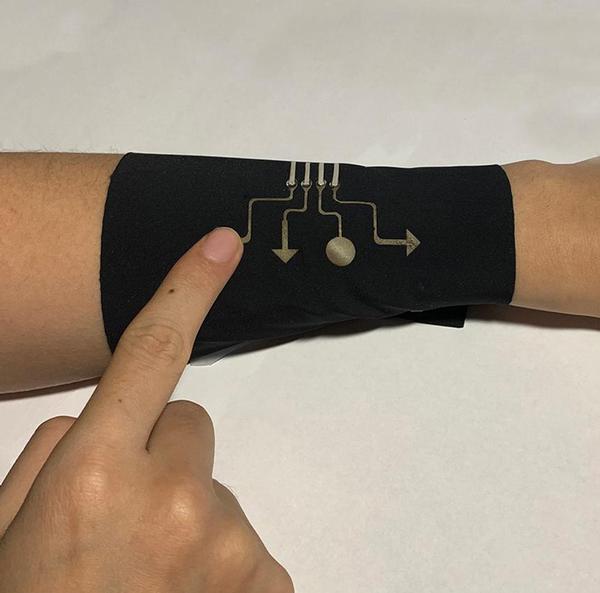
Human:machine interface The second prototype demonstrated textile-integrated touch-sensing for human-machine interfaces. The authors used a wearable textile sleeve integrated with the porous electrodes to play computer games, such as Tetris.
“If we want to develop wearable sensors or user interfaces that can be worn for a significant period of time, we need gas-permeable electronic materials,” Zhu added. “So this is a significant step forward.”
An opportunity to reimagine one of the UK’s most recognisable towers has been formally
opened by Rivington Hark, as St Johns Beacon invites operators and partners to shape its
next phase. [more...]
Could ‘breathable’
electronics pave
the way for the
next generation of
wearable tech?
A new ultra-thin, stretchable electronic material that allows a product to “breathe” could have the potential to help create more functional wearable tech.
Created by a team of engineering researchers at North Carolina State University (NCSU), the as-yet-unnamed material combines a stretchable polymer film with silver nanowires, making it flexible but highly conductive.
Allows sweat to evaporate Being gas permeable, the material allows sweat and organic compounds to evaporate from the skin – making it more comfortable for users, especially for long-term wear.
Designed specifically to be used in wearable tech solutions, the product is only a few micrometers thick – allowing for better contact with the skin and giving the electronics a better “signal-to-noise ratio”.
“The resulting film shows an excellent combination of electric conductivity, optical transmittance and water-vapor permeability,” said Yong Zhu, professor of mechanical and aerospace engineering at NCSU.
“The gas permeability is the big advance over earlier stretchable electronics – and because the silver nanowires are embedded just below the surface of the polymer, the material also exhibits excellent stability in the presence of sweat and after long-term wear.”
To demonstrate its potential for use in wearables, researchers tested prototypes for two representative applications:
The first prototype consisted of skin-mountable, dry electrodes for use as electrophysiologic sensors. These have multiple potential applications, such as measuring electrocardiography (ECG) and electromyography (EMG) signals.
“The sensors were able to record signals with excellent quality, on a par with commercially available electrodes,” Zhu says.
Human:machine interface The second prototype demonstrated textile-integrated touch-sensing for human-machine interfaces. The authors used a wearable textile sleeve integrated with the porous electrodes to play computer games, such as Tetris.
“If we want to develop wearable sensors or user interfaces that can be worn for a significant period of time, we need gas-permeable electronic materials,” Zhu added. “So this is a significant step forward.”
Hotel de France, located on the British Isle of Jersey, has created a wellness retreat package
that includes a hot yoga session that will take place in Jersey Zoo’s butterfly sanctuary.
A new immersive attraction designed to transport visitors into the final hours of ancient Pompeii
is preparing to open near the world-famous archaeological site in southern Italy.
Experience design company, BRC Imagination Arts, has completed a transition that sees founder
Bob Rogers pass ownership of the business to four long-serving senior executives, while
remaining actively involved with the company.
Movie Park Germany has opened a new Paramount Pictures-themed attraction as part of its 30th
anniversary celebrations, using immersive storytelling and adaptive reuse to reinforce the park’s
longstanding “Hollywood in Germany” positioning.
Therme Manchester’s 28-acre development, which will include interconnected glass pavilions
that measure 65,000sq m, will be the largest bathing and wellbeing attraction in the world once
complete, according to prof David Russell, CEO of Therme UK.
Efteling has opened Hooghmoed, a new family drop tower designed to broaden the appeal of its
recently launched Sirene Island themed area and introduce younger visitors to thrill attractions.
A proposed Puy du Fou development near Bicester and Universal Destinations and Experiences’
planned resort in Bedford are emerging as part of a wider transformation of the Oxford–
Cambridge Growth Corridor into a major centre for UK leisure and tourism inv
Shedd Aquarium has opened the Immersion Theater developed in partnership with SimEx-
Iwerks, as part of a wider strategy to enhance the guest experience and create additional
revenue opportunities.
The UK government has announced a temporary reduction in VAT on visitor attractions and
children’s meals as part of a summer cost-of-living support package designed to stimulate the
visitor economy and encourage family days out.
As designer Yinka Ilori prepares for his first solo gallery show in London, he speaks exclusively
to CLADmag about his mission to spread joy, the power of play, and his bold approach to using
colour (including the colours you won’t see in his work).
The government of Thailand is exploring plans for a THB300bn (£6.3bn, US$8.3bn)
entertainment complex in the country’s Eastern Economic Corridor (EEC), with officials
proposing a large-scale theme park and sports destination as part of a broader tourism and
economic development strategy.
+ More news
COMPANY PROFILES
Alterface Alterface’s Creative Division team is
seasoned in concept and ride development,
as well as storyte [more...]
QubicaAMF UK QubicaAMF is the largest and most
innovative bowling equipment provider with
600 employees worldwi [more...]
Simworx Ltd The company was initially established
in 1997. Terry Monkton and Andrew
Roberts are the key stakeh [more...]
An opportunity to reimagine one of the UK’s most recognisable towers has been formally
opened by Rivington Hark, as St Johns Beacon invites operators and partners to shape its
next phase. [more...]