Latest
issue
Get Attractions Management digital magazine FREE
Sign up here ▸
Jobs   News   Features   Products   Company profilesProfiles   Magazine   Handbook   Advertise    Subscribe  
Industry insights
IHRSA: Asia-Pacific

The Asia-Pacific health club market is now worth US$16.8 billion, according to an exceptional new report. IHRSA’s Kristen Walsh shares some of the highlights

By Kristen Walsh | Published in Health Club Handbook 2019 issue 1


The second edition of the IHRSA Asia-Pacific Health Club Report was released recently in collaboration with Deloitte.

It demonstrates that the health and fitness industry in the Asia-Pacific region is in good shape – fueled by growing economies and with significant potential for continued growth.

Deloitte says only two markets in the region are considered mature, these being Australia and New Zealand, which have the highest penetration rates at 15.3 per cent and 13.6 per cent, respectively.

While the fitness market shows signs of rapid growth and professionalisation in terms of penetration rates in Hong Kong (5.85 per cent), Singapore (5.8 per cent), and Japan (3.3 per cent), significant opportunities for growth still remain in less developmed markets, such as the Philippines (0.53 per cent), Thailand (0.5 per cent), Indonesia (0.18 per cent) and India (0.15 per cent).

Along with such growth opportunities come challenges. Real estate costs, limited rental availability, infrastructure underdevelopment, lack of professionalised services and increasing competition are just some of the realities club operators face when working in Asia-Pacific markets. However, a favourable economic outlook, along with increasing health awareness and demand for group exercise and personalised training, are expected to spur expansion.

“Driven by the momentum of economic prosperity, the fitness market in the Asia-Pacific region has shown steady growth, with a positive outlook going forward,” says Alan MacCharles, partner at Deloitte China. “Overall market penetration is on an upward trajectory, reflecting an increasing awareness of the importance of good health and the role a club membership can play in this.”

According to MacCharles, the region’s fitness market remains stratified due to varying stages of development, which can be categorised into three tiers.

Tier 1: Australia & New Zealand
Market penetration rates
Australia: 15.3 per cent
New Zealand: 13.6 per cent

These are relatively established markets, with higher penetration rates than their neighbours. However, the mature and professionalised markets in these countries indicate limited growth potential; labour and real estate costs have also constrained growth here.

Tier 2: Hong Kong, Singapore, Japan & Taiwan
Market penetration rates
Hong Kong: 5.85 per cent
Singapore: 5.8 per cent
Japan: 3.3 per cent
Taiwan: 3.0 per cent

These locations belong to the fast-expanding and maturing second-tier markets. This segment features gradually professionalising services, expanding consumer bases, and a high concentration of leading players.

With room for growth, already fierce competition is expected to continue in future in the Tier 2 region.

Tier 3: Rest of Asia-Pacific
Market penetration rates
Malaysia: 1.04 per cent
China’s top 10 cities: 0.97 per cent
Philippines: 0.53 per cent
Thailand: 0.5 per cent
Vietnam: 0.5 per cent
Indonesia: 0.18 per cent
India: 0.15 per cent

The remaining seven Asia-Pacific markets assessed by Deloitte are still in a comparatively early stage in their lifecycle, as a result of slower economic development and low awareness of personal health as a priority.

The fitness industry in these countries is typically concentrated in the respective capital cities and also the first-tier cities, where markets are mainly led by the larger, commercial fitness club chains.

The markets in second-tier cities are dominated by standalone players; mostly lower-end single site, independently owned operators – due to infrastructure underdevelopment, low purchasing power and low awareness of personalised training.

Underdeveloped regions in these countries demonstrate high growth potential, especially as rapid infrastructure development improves their accessibility and connectivity. Laws relating to the way gym contracts are configured also have an impact on the way each market develops. For example, in New Zealand (Tier 1) up-front payment for a long-term membership is forbidden by law, while in Singapore (Tier 2) some clubs collect one- and two-year contracts up-front.
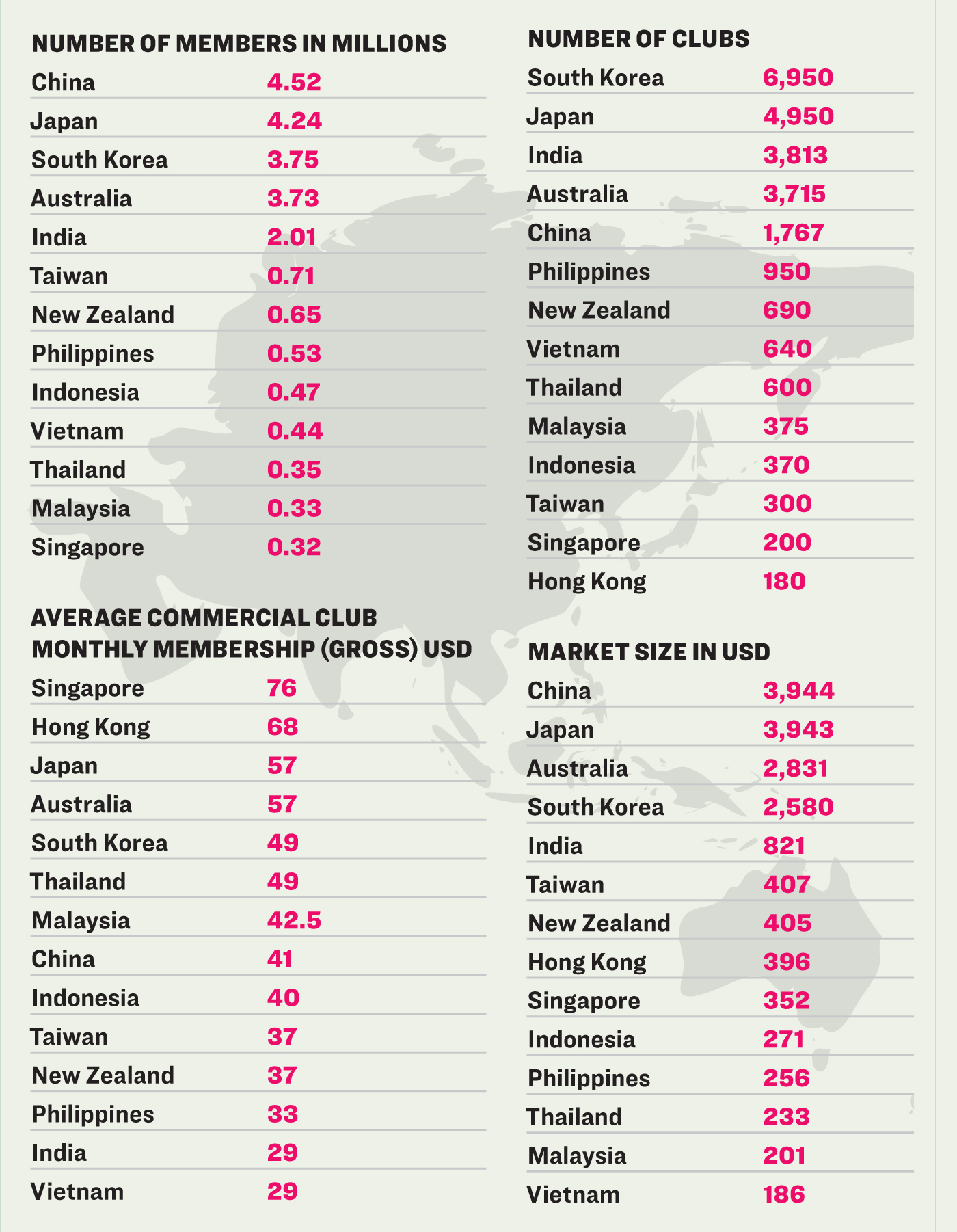
ASIA-PACIFIC IN NUMBERS
Access the report

The full report is available at a price of US$299 for IHRSA members and US$599 for non-members from: www.ihrsa.org/publications

Contact: [email protected] with questions.

Perfect Gym sponsored the report.

KEY TRENDS IN ASIA-PACIFIC

Australia
"The Australian fitness market has experienced rapid expansion in the past three years, led primarily by the growth of fitness franchises. F45 has opened 200 new clubs; Anytime Fitness has added 70; Jetts Fitness has added 60; and Plus Fitness has increased by 45 clubs.”

China
"Independent market research indicates that less than 20 per cent of all clubs in China are profitable, while at least 60 per cent are experiencing losses."

India
"Retention rates are low in the Indian fitness club market. From a cultural standpoint, members treat fitness as a goal to be achieved and have yet to see it as a lifestyle to be maintained or to act on this as an aspiration."

Indonesia
"Because the provision of sidewalks is limited in Jakarta, running outdoors is not a fitness option for people in the city, so fitness centres have become lifestyle destinations for people who want to exercise in safety."

Japan
"The ratio of public to commercial gyms is close to 50:50. In spite of this, public gyms are not seen as competitors to commercial gyms and the two co-exist."

Malaysia
"Fitness activities are typically male-focused in Malaysia, largely for cultural reasons. An estimated 60 per cent of fitness members are male in the capital, Kuala Lumpur, while the level is at least 70 per cent elsewhere."

New Zealand
"Growing awareness of the importance of healthy living has led to an increase in the penetration rate, up from 1.38 per cent in 2014 to 13.6 per cent in 2017. 24-hour gyms are the fastest-growing sector."

The Philippines
"The Philippines has achieved one of the highest increases in fitness club penetration over the past three years, due primarily to the rise of affordable gyms which have opened up the market."

Singapore
"Bulky equipment is being replaced by open space and group exercise is becoming popular. A medium to small gym size suits the cost-saving strategy for operators and also better fits customers’ needs."

South Korea
"Due to high rental costs, fitness clubs are generally smaller in size in South Korea compared to most of the counterparts in other Asia-Pacific countries, excluding Hong Kong and Japan."

Taiwan
"The top five players claim 77 per cent of the overall market in terms of number of gyms."

Thailand
"Most Thais still prefer to exercise in public parks, at home, or not at all."

Vietnam
"The fitness club market was worth US$186m in 2017, and is expected to expand rapidly in the next three years as Vietnamese investors start focusing on the industry."


China has tremendous capacity for growth in both participation and profitability
COMPANY PROFILES
DJW

David & Lynn Willrich started the Company over thirty years ago, from the Audio Visual Department [more...]
QubicaAMF UK

QubicaAMF is the largest and most innovative bowling equipment provider with 600 employees worldwi [more...]
instantprint

We’re a Yorkshire-based online printer, founded in 2009 by Adam Carnell and James Kinsella. [more...]
TechnoAlpin Indoor

TechnoAlpin is the world leader for snowmaking systems. With the Indoor snow division, TechnoAlpin c [more...]
+ More profiles  
FEATURED SUPPLIER

Iconic Liverpool attraction opens door to new operators
An opportunity to reimagine one of the UK’s most recognisable towers has been formally opened by Rivington Hark, as St Johns Beacon invites operators and partners to shape its next phase. [more...]
CATALOGUE GALLERY
 

+ More catalogues  
DIRECTORY
+ More directory  
DIARY


09-11 Jun 2026

World Sauna Forum 2026

Savutuvan Apaja, Haapaniemi, Finland
23-26 Aug 2026

Elevate Spa Riviera Maya Edition

The Riviera Maya Edition Kanai, Playa del Carmen, Mexico
+ More diary  
LATEST ISSUES
+ View Magazine Archive

Attractions Management

2026 issue 1


View issue contents
View on turning pages
Download PDF
FREE digital subscription
Print subscription

Attractions Management

2025 issue 2


View issue contents
View on turning pages
Download PDF
FREE digital subscription
Print subscription

Attractions Management

2025 issue 1


View issue contents
View on turning pages
Download PDF
FREE digital subscription
Print subscription

Attractions Management

2024 issue 4


View issue contents
View on turning pages
Download PDF
FREE digital subscription
Print subscription

Attractions Management News

06 Apr 2020 issue 153


View on turning pages
Download PDF
View archive
FREE digital subscription
Print subscription

Attractions Handbook

2019


View issue contents
View on turning pages
Download PDF
FREE digital subscription
Print subscription
 
ABOUT LEISURE MEDIA
LEISURE MEDIA MAGAZINES
LEISURE MEDIA HANDBOOKS
LEISURE MEDIA WEBSITES
LEISURE MEDIA PRODUCT SEARCH
 
ATTRACTIONS MANAGEMENT
ATTRACTIONS MANAGEMENT NEWS
ATTRACTIONS HANDBOOK
PRINT SUBSCRIPTIONS
FREE DIGITAL SUBSCRIPTIONS
ADVERTISE . CONTACT US

Leisure Media
Tel: +44 (0)1462 431385

©Cybertrek 2026
Get Attractions Management digital magazine FREE
Sign up here ▸
Jobs    News   Products   Magazine   Subscribe
Industry insights
IHRSA: Asia-Pacific

The Asia-Pacific health club market is now worth US$16.8 billion, according to an exceptional new report. IHRSA’s Kristen Walsh shares some of the highlights

By Kristen Walsh | Published in Health Club Handbook 2019 issue 1


The second edition of the IHRSA Asia-Pacific Health Club Report was released recently in collaboration with Deloitte.

It demonstrates that the health and fitness industry in the Asia-Pacific region is in good shape – fueled by growing economies and with significant potential for continued growth.

Deloitte says only two markets in the region are considered mature, these being Australia and New Zealand, which have the highest penetration rates at 15.3 per cent and 13.6 per cent, respectively.

While the fitness market shows signs of rapid growth and professionalisation in terms of penetration rates in Hong Kong (5.85 per cent), Singapore (5.8 per cent), and Japan (3.3 per cent), significant opportunities for growth still remain in less developmed markets, such as the Philippines (0.53 per cent), Thailand (0.5 per cent), Indonesia (0.18 per cent) and India (0.15 per cent).

Along with such growth opportunities come challenges. Real estate costs, limited rental availability, infrastructure underdevelopment, lack of professionalised services and increasing competition are just some of the realities club operators face when working in Asia-Pacific markets. However, a favourable economic outlook, along with increasing health awareness and demand for group exercise and personalised training, are expected to spur expansion.

“Driven by the momentum of economic prosperity, the fitness market in the Asia-Pacific region has shown steady growth, with a positive outlook going forward,” says Alan MacCharles, partner at Deloitte China. “Overall market penetration is on an upward trajectory, reflecting an increasing awareness of the importance of good health and the role a club membership can play in this.”

According to MacCharles, the region’s fitness market remains stratified due to varying stages of development, which can be categorised into three tiers.

Tier 1: Australia & New Zealand
Market penetration rates
Australia: 15.3 per cent
New Zealand: 13.6 per cent

These are relatively established markets, with higher penetration rates than their neighbours. However, the mature and professionalised markets in these countries indicate limited growth potential; labour and real estate costs have also constrained growth here.

Tier 2: Hong Kong, Singapore, Japan & Taiwan
Market penetration rates
Hong Kong: 5.85 per cent
Singapore: 5.8 per cent
Japan: 3.3 per cent
Taiwan: 3.0 per cent

These locations belong to the fast-expanding and maturing second-tier markets. This segment features gradually professionalising services, expanding consumer bases, and a high concentration of leading players.

With room for growth, already fierce competition is expected to continue in future in the Tier 2 region.

Tier 3: Rest of Asia-Pacific
Market penetration rates
Malaysia: 1.04 per cent
China’s top 10 cities: 0.97 per cent
Philippines: 0.53 per cent
Thailand: 0.5 per cent
Vietnam: 0.5 per cent
Indonesia: 0.18 per cent
India: 0.15 per cent

The remaining seven Asia-Pacific markets assessed by Deloitte are still in a comparatively early stage in their lifecycle, as a result of slower economic development and low awareness of personal health as a priority.

The fitness industry in these countries is typically concentrated in the respective capital cities and also the first-tier cities, where markets are mainly led by the larger, commercial fitness club chains.

The markets in second-tier cities are dominated by standalone players; mostly lower-end single site, independently owned operators – due to infrastructure underdevelopment, low purchasing power and low awareness of personalised training.

Underdeveloped regions in these countries demonstrate high growth potential, especially as rapid infrastructure development improves their accessibility and connectivity. Laws relating to the way gym contracts are configured also have an impact on the way each market develops. For example, in New Zealand (Tier 1) up-front payment for a long-term membership is forbidden by law, while in Singapore (Tier 2) some clubs collect one- and two-year contracts up-front.
ASIA-PACIFIC IN NUMBERS
Access the report

The full report is available at a price of US$299 for IHRSA members and US$599 for non-members from: www.ihrsa.org/publications

Contact: [email protected] with questions.

Perfect Gym sponsored the report.

KEY TRENDS IN ASIA-PACIFIC

Australia
"The Australian fitness market has experienced rapid expansion in the past three years, led primarily by the growth of fitness franchises. F45 has opened 200 new clubs; Anytime Fitness has added 70; Jetts Fitness has added 60; and Plus Fitness has increased by 45 clubs.”

China
"Independent market research indicates that less than 20 per cent of all clubs in China are profitable, while at least 60 per cent are experiencing losses."

India
"Retention rates are low in the Indian fitness club market. From a cultural standpoint, members treat fitness as a goal to be achieved and have yet to see it as a lifestyle to be maintained or to act on this as an aspiration."

Indonesia
"Because the provision of sidewalks is limited in Jakarta, running outdoors is not a fitness option for people in the city, so fitness centres have become lifestyle destinations for people who want to exercise in safety."

Japan
"The ratio of public to commercial gyms is close to 50:50. In spite of this, public gyms are not seen as competitors to commercial gyms and the two co-exist."

Malaysia
"Fitness activities are typically male-focused in Malaysia, largely for cultural reasons. An estimated 60 per cent of fitness members are male in the capital, Kuala Lumpur, while the level is at least 70 per cent elsewhere."

New Zealand
"Growing awareness of the importance of healthy living has led to an increase in the penetration rate, up from 1.38 per cent in 2014 to 13.6 per cent in 2017. 24-hour gyms are the fastest-growing sector."

The Philippines
"The Philippines has achieved one of the highest increases in fitness club penetration over the past three years, due primarily to the rise of affordable gyms which have opened up the market."

Singapore
"Bulky equipment is being replaced by open space and group exercise is becoming popular. A medium to small gym size suits the cost-saving strategy for operators and also better fits customers’ needs."

South Korea
"Due to high rental costs, fitness clubs are generally smaller in size in South Korea compared to most of the counterparts in other Asia-Pacific countries, excluding Hong Kong and Japan."

Taiwan
"The top five players claim 77 per cent of the overall market in terms of number of gyms."

Thailand
"Most Thais still prefer to exercise in public parks, at home, or not at all."

Vietnam
"The fitness club market was worth US$186m in 2017, and is expected to expand rapidly in the next three years as Vietnamese investors start focusing on the industry."

China has tremendous capacity for growth in both participation and profitability
LATEST NEWS
Warner Bros Discovery collaborates on upcoming Pompeii attraction
A new immersive attraction designed to transport visitors into the final hours of ancient Pompeii is preparing to open near the world-famous archaeological site in southern Italy.
Bob Rogers hands BRC to long-serving leadership team
Experience design company, BRC Imagination Arts, has completed a transition that sees founder Bob Rogers pass ownership of the business to four long-serving senior executives, while remaining actively involved with the company.
Rainer Maelzer joins Therme Group as chief entertainment officer
Rainer Maelzer, an experiential entertainment innovator, has been appointed chief entertainment officer by Therme Group.
Movie Park Germany reveals new Paramount attraction as part of its 30th anniversary celebrations
Movie Park Germany has opened a new Paramount Pictures-themed attraction as part of its 30th anniversary celebrations, using immersive storytelling and adaptive reuse to reinforce the park’s longstanding “Hollywood in Germany” positioning.
Therme Manchester reveals 90:90 strategy – 90 per cent of the UK population within a 90-minute drive of a Therme
Therme Manchester’s 28-acre development, which will include interconnected glass pavilions that measure 65,000sq m, will be the largest bathing and wellbeing attraction in the world once complete, according to prof David Russell, CEO of Therme UK. 
Efteling expands family offer with new Hooghmoed drop tower
Efteling has opened Hooghmoed, a new family drop tower designed to broaden the appeal of its recently launched Sirene Island themed area and introduce younger visitors to thrill attractions.
Universal and Puy du Fou projects point to rise of Oxford–Cambridge corridor
A proposed Puy du Fou development near Bicester and Universal Destinations and Experiences’ planned resort in Bedford are emerging as part of a wider transformation of the Oxford– Cambridge Growth Corridor into a major centre for UK leisure and tourism inv
Shedd Aquarium upgrades its visitor experience with new Immersion Theater
Shedd Aquarium has opened the Immersion Theater developed in partnership with SimEx- Iwerks, as part of a wider strategy to enhance the guest experience and create additional revenue opportunities.
UK government cuts VAT on attractions to boost summer visitor economy
The UK government has announced a temporary reduction in VAT on visitor attractions and children’s meals as part of a summer cost-of-living support package designed to stimulate the visitor economy and encourage family days out.
Joy as a radical act: Yinka Ilori launches solo exhibition celebrating the rebellious power of spreading happiness
As designer Yinka Ilori prepares for his first solo gallery show in London, he speaks exclusively to CLADmag about his mission to spread joy, the power of play, and his bold approach to using colour (including the colours you won’t see in his work).
Government of Thailand reveals it is courting major theme park operators
The government of Thailand is exploring plans for a THB300bn (£6.3bn, US$8.3bn) entertainment complex in the country’s Eastern Economic Corridor (EEC), with officials proposing a large-scale theme park and sports destination as part of a broader tourism and economic development strategy.
Hainan Science Museum by Ma Yansong, opens in China
A new science museum has opened to the public in Haikou after attracting more than 350,000 visitors during a four-month soft opening period.
+ More news   
 
COMPANY PROFILES
DJW

David & Lynn Willrich started the Company over thirty years ago, from the Audio Visual Department [more...]
QubicaAMF UK

QubicaAMF is the largest and most innovative bowling equipment provider with 600 employees worldwi [more...]
instantprint

We’re a Yorkshire-based online printer, founded in 2009 by Adam Carnell and James Kinsella. [more...]
TechnoAlpin Indoor

TechnoAlpin is the world leader for snowmaking systems. With the Indoor snow division, TechnoAlpin c [more...]
+ More profiles  
FEATURED SUPPLIER

Iconic Liverpool attraction opens door to new operators
An opportunity to reimagine one of the UK’s most recognisable towers has been formally opened by Rivington Hark, as St Johns Beacon invites operators and partners to shape its next phase. [more...]
CATALOGUE GALLERY
+ More catalogues  
DIRECTORY
+ More directory  
DIARY


09-11 Jun 2026

World Sauna Forum 2026

Savutuvan Apaja, Haapaniemi, Finland
23-26 Aug 2026

Elevate Spa Riviera Maya Edition

The Riviera Maya Edition Kanai, Playa del Carmen, Mexico
+ More diary  


ADVERTISE . CONTACT US

Leisure Media
Tel: +44 (0)1462 431385

©Cybertrek 2026

ABOUT LEISURE MEDIA
LEISURE MEDIA MAGAZINES
LEISURE MEDIA HANDBOOKS
LEISURE MEDIA WEBSITES
LEISURE MEDIA PRODUCT SEARCH
ATTRACTIONS MANAGEMENT NEWS
ATTRACTIONS HANDBOOK
PRINT SUBSCRIPTIONS
FREE DIGITAL SUBSCRIPTIONS