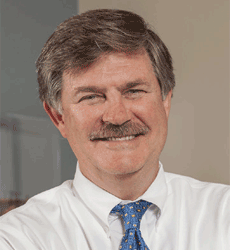
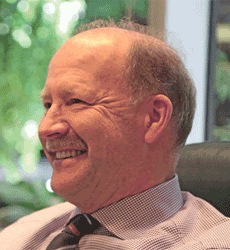
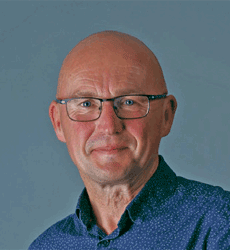
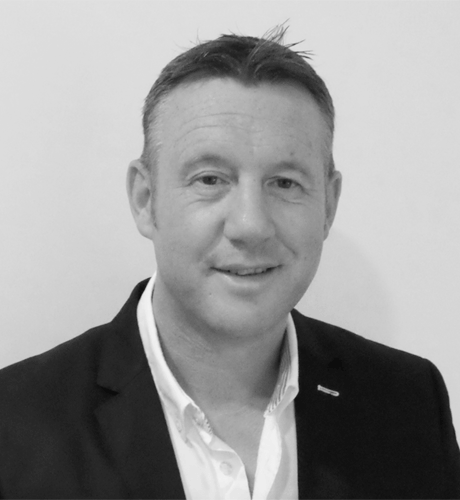
As Everyone Active celebrates its 30th anniversary, CEO Stephen Hulme talks to Leisure Management about how it all started and how he and his team have built one of the most successful operating companies in the UK
How did you end up as CEO of SLM? After school, I decided not to go to university, and instead accepted a training role at Oldham Borough Council: I was a keen swimmer and played waterpolo at national level, which is partly why I chose the industry.
After a series of promotions in local goverment and completing an MBA, I moved to Hinckley and Bosworth council, arriving just as finances were prompting them to start looking at alternative management options.
I approached the chief excutive – who was very supportive – and asked if I could set up my own company to tender for the work. It wasn’t a well thought out plan – more a reactive response.
I’d just moved my family to the area, had an eighteen-month-old daughter and had enjoyed the security of a local government job, so the risks were massive, but with the benefit of hindsight it was absolutely the right decision.
How did it go? It wasn’t a well-planned strategy to move into the sector and running a new business from scratch with next to no financial backing and trying to keep my head above water was the biggest challenge by far. Every time my bank manager phoned me, I wondered if he was going to pull the plug.
Almost overnight, I became responsible for the employment of 55 colleagues and I never underestimated that. It was challenging coming to terms with a completely different role.
I was lifeguarding during the day and cleaning changing rooms until 11.00pm at night.
Looking back, what would you have done differently? I’m sure we made lots of mistakes, but given we had very little time to form the company before commencing operations, I like to think we got more things right than wrong, and in light of that, I probably wouldn’t have done anything differently.
SLM has grown to be one of the biggest operators in the UK. What have been your biggest successes? Whenever we’ve won a contract, we’ve always significantly increased the number of people using the facilities and also enhanced the quality of facilities and services offered.
I’d put this success down to the quality and breadth of facilities we offer – many of our centres surpass those offered by the private sector.
Our centres typically have a pool – 25m or longer – indoor climbing, gyms with over 100 stations and multifunctional studios. We’re also starting to introduce more high-end spa facilities and hot yoga studios.
I’d also say our level of service allows us to create a point of difference when compared with both budget gyms and other leisure operators. We have higher colleague ratios and invest more in colleague development than many of our competitors, this represents significant change from where the local authority sector was 10 or even five years ago.
How has the industry changed? It’s changed beyond recognition. There’s no comparison in terms of the quality and number of facilities.
30 years ago few leisure centres had gyms – mainly swimming pools or sports halls. Today our centres have some of the most diverse facilities you’d find in a leisure centre – from hot yoga to spas – we offer facilities above the 'traditional' local authority offering.
The management challenges have also changed, along with the competition – particularly the growth in private sector provision.
When SLM was formed, if you wanted to go for a swim, you had no choice but to use a local authority facility; there were very few private alternatives, now there are many.
What are the biggest opportunities and threats the sector is facing? The opportunities and threats are inextricably linked. We have an opportunity to demonstrate the correlation between sport and leisure provision and the health and wellbeing of our communities. The challenges are massive, but are recognised and supported by bodies such as ukactive.
You rebranded as Everyone Active in 2007. Why? Everything from swimming lessons and children’s activities to our fitness brand, had a different name – there was no common identity, so we recruited a marketing agency to look at how we could approach this better: we wanted everyone to be active, regardless of gender or age, so Everyone Active was born to communicate that message.
In 2014, SLM launched Everyone Health. How has that been going? There’s a definite link between the health agenda and what we do in sport and leisure. Everyone Health came about in response to changes in policy with regards to commissioning services and the Local Authority responsibilities. We were one of the first companies to establish a dedicated public health division.
It was an obvious diversification for us, particularly given our belief that the two sectors will be increasingly linked. I think it’s a big opportunity for the company and one that’s going to grow over the next five years.
We’ve already seen a significant increase in opportunities. Everyone Health already manages contracts on behalf of Cambridge and Nottingham county councils and Nottingham City Council.
What’s your SWOT analysis of SLM? By far our biggest strength is our people at all levels. If you asked me one reason I’ve been successful, it’s because I’ve been lucky to have such excellent colleagues. Many of them have stayed with us for 10, 15, 20 years.
We value them all – whether they’re directors or lifeguards – it doesn’t matter. Everyone has a pivotal role and that’s in the ethos of the company.
When we take on a contract, the new teams are always pleasantly surprised by the extent to which they’re encouraged to take responsibility and the level of support they get from regional and group colleagues. There’s no doubt in my mind this is what differentiates us from our competitors.
I genuinely believe we haven’t got many weaknesses, but as a business we constantly strive to improve, as we recognise there will always be things we could do better.
There are plenty of opportunities to grow the business in terms of the number of services we manage, and to show the link between the management of those facilities and the health and wellbeing of communities.
The biggest threat comes in the form of the financial pressures that local authorities are continuing to face.
Successive governments have been working to turn “sick care” into “health care” – including making activity a preventative measure available on the NHS. Is enough being done?
Absolutely not. It’s a massive challenge. In conjunction with many of our 45 local authority partners we offer ‘health services’, many of which are free.
Even though services are free, it’s a challenge to fill the number of places we have, so I don’t subscribe to view that the problem is all down to funding.
While there’s a lot of excellent work being done, we have to get better in engaging with our target market.
I don’t think it’s a government thing. There are services being provided to educate communities about the benefits of a healthy lifestyle, but the challenge for those of us managing services is to get enough people engaged with them.
There should be more of this – working to change people’s perception of the benefits and the opportunities – I don’t think providing more free services would necessarily mean more people using them.
What’s the best bit of business advice you’ve ever been given? When I set up SLM, someone told me to never look back. They told me it would be one hell of a challenge and to just look forward.
If you had the power to introduce one law, what would it be? Local authority sport and leisure should be made a statutory service.
What will SLM look like in 30 years’ time, when it celebrates its 60th? I hope SLM will not only be the leading provider of sport and leisure, but also a market leader in the management of the health and wellbeing services, which are primarily being managed by the NHS at present.
Everyone Active Key moments 1988: First contract at Hinckley Leisure Centre awarded to SLM
2002: Tenth contract awarded is Ashfield to manage six leisure centres
2000: Sale of SLM to Castleview
2007: Start of the Everyone Active brand and opening of the 50th site as part of the Bristol contract
2010: Everyone Active wins Leisure Operator of the Year at ukactive’s Flame Awards (and again in 2011, 2012, 2015 and 2017)
2012: Plymouth Life Centre Opening
2013: Commencement of the Ealing, Brent & Harrow contract
2014: SLM sets up Everyone Health
2015: Everyone Active signs leisure joint venture with Sunderland City Council to manage nine sites
2016: • Everyone Active wins’ contract with Westminster City Council to manage eight sites • Everyone Active wins’ contract with Southwark Council to manage eight sites • Everyone Active sets up Sporting Champions programme to support athlete development
2017: Everyone Active wins Leisure Operator of the Year for the fifth time at ukactive’s Flame Awards
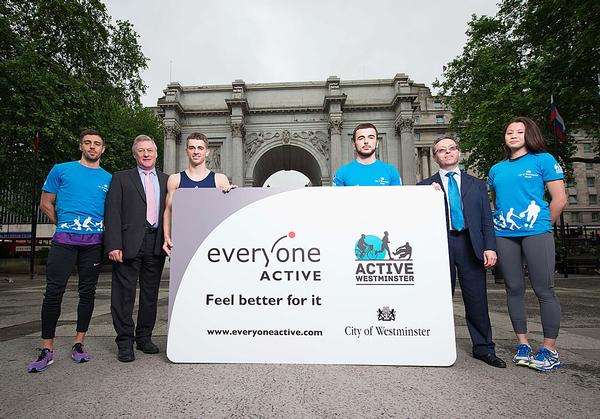
The launch of the Westminster contract
Everyone Active and Alex Danson’s hockey programme
National Fitness Day is an important fixture in the Everyone Active calendar
COMPANY PROFILES
Sally Corporation
Our services include: Dark ride design & build; Redevelopment of existing attractions; High-quality [more...]
An opportunity to reimagine one of the UK’s most recognisable towers has been formally
opened by Rivington Hark, as St Johns Beacon invites operators and partners to shape its
next phase. [more...]
As Everyone Active celebrates its 30th anniversary, CEO Stephen Hulme talks to Leisure Management about how it all started and how he and his team have built one of the most successful operating companies in the UK
How did you end up as CEO of SLM? After school, I decided not to go to university, and instead accepted a training role at Oldham Borough Council: I was a keen swimmer and played waterpolo at national level, which is partly why I chose the industry.
After a series of promotions in local goverment and completing an MBA, I moved to Hinckley and Bosworth council, arriving just as finances were prompting them to start looking at alternative management options.
I approached the chief excutive – who was very supportive – and asked if I could set up my own company to tender for the work. It wasn’t a well thought out plan – more a reactive response.
I’d just moved my family to the area, had an eighteen-month-old daughter and had enjoyed the security of a local government job, so the risks were massive, but with the benefit of hindsight it was absolutely the right decision.
How did it go? It wasn’t a well-planned strategy to move into the sector and running a new business from scratch with next to no financial backing and trying to keep my head above water was the biggest challenge by far. Every time my bank manager phoned me, I wondered if he was going to pull the plug.
Almost overnight, I became responsible for the employment of 55 colleagues and I never underestimated that. It was challenging coming to terms with a completely different role.
I was lifeguarding during the day and cleaning changing rooms until 11.00pm at night.
Looking back, what would you have done differently? I’m sure we made lots of mistakes, but given we had very little time to form the company before commencing operations, I like to think we got more things right than wrong, and in light of that, I probably wouldn’t have done anything differently.
SLM has grown to be one of the biggest operators in the UK. What have been your biggest successes? Whenever we’ve won a contract, we’ve always significantly increased the number of people using the facilities and also enhanced the quality of facilities and services offered.
I’d put this success down to the quality and breadth of facilities we offer – many of our centres surpass those offered by the private sector.
Our centres typically have a pool – 25m or longer – indoor climbing, gyms with over 100 stations and multifunctional studios. We’re also starting to introduce more high-end spa facilities and hot yoga studios.
I’d also say our level of service allows us to create a point of difference when compared with both budget gyms and other leisure operators. We have higher colleague ratios and invest more in colleague development than many of our competitors, this represents significant change from where the local authority sector was 10 or even five years ago.
How has the industry changed? It’s changed beyond recognition. There’s no comparison in terms of the quality and number of facilities.
30 years ago few leisure centres had gyms – mainly swimming pools or sports halls. Today our centres have some of the most diverse facilities you’d find in a leisure centre – from hot yoga to spas – we offer facilities above the 'traditional' local authority offering.
The management challenges have also changed, along with the competition – particularly the growth in private sector provision.
When SLM was formed, if you wanted to go for a swim, you had no choice but to use a local authority facility; there were very few private alternatives, now there are many.
What are the biggest opportunities and threats the sector is facing? The opportunities and threats are inextricably linked. We have an opportunity to demonstrate the correlation between sport and leisure provision and the health and wellbeing of our communities. The challenges are massive, but are recognised and supported by bodies such as ukactive.
You rebranded as Everyone Active in 2007. Why? Everything from swimming lessons and children’s activities to our fitness brand, had a different name – there was no common identity, so we recruited a marketing agency to look at how we could approach this better: we wanted everyone to be active, regardless of gender or age, so Everyone Active was born to communicate that message.
In 2014, SLM launched Everyone Health. How has that been going? There’s a definite link between the health agenda and what we do in sport and leisure. Everyone Health came about in response to changes in policy with regards to commissioning services and the Local Authority responsibilities. We were one of the first companies to establish a dedicated public health division.
It was an obvious diversification for us, particularly given our belief that the two sectors will be increasingly linked. I think it’s a big opportunity for the company and one that’s going to grow over the next five years.
We’ve already seen a significant increase in opportunities. Everyone Health already manages contracts on behalf of Cambridge and Nottingham county councils and Nottingham City Council.
What’s your SWOT analysis of SLM? By far our biggest strength is our people at all levels. If you asked me one reason I’ve been successful, it’s because I’ve been lucky to have such excellent colleagues. Many of them have stayed with us for 10, 15, 20 years.
We value them all – whether they’re directors or lifeguards – it doesn’t matter. Everyone has a pivotal role and that’s in the ethos of the company.
When we take on a contract, the new teams are always pleasantly surprised by the extent to which they’re encouraged to take responsibility and the level of support they get from regional and group colleagues. There’s no doubt in my mind this is what differentiates us from our competitors.
I genuinely believe we haven’t got many weaknesses, but as a business we constantly strive to improve, as we recognise there will always be things we could do better.
There are plenty of opportunities to grow the business in terms of the number of services we manage, and to show the link between the management of those facilities and the health and wellbeing of communities.
The biggest threat comes in the form of the financial pressures that local authorities are continuing to face.
Successive governments have been working to turn “sick care” into “health care” – including making activity a preventative measure available on the NHS. Is enough being done?
Absolutely not. It’s a massive challenge. In conjunction with many of our 45 local authority partners we offer ‘health services’, many of which are free.
Even though services are free, it’s a challenge to fill the number of places we have, so I don’t subscribe to view that the problem is all down to funding.
While there’s a lot of excellent work being done, we have to get better in engaging with our target market.
I don’t think it’s a government thing. There are services being provided to educate communities about the benefits of a healthy lifestyle, but the challenge for those of us managing services is to get enough people engaged with them.
There should be more of this – working to change people’s perception of the benefits and the opportunities – I don’t think providing more free services would necessarily mean more people using them.
What’s the best bit of business advice you’ve ever been given? When I set up SLM, someone told me to never look back. They told me it would be one hell of a challenge and to just look forward.
If you had the power to introduce one law, what would it be? Local authority sport and leisure should be made a statutory service.
What will SLM look like in 30 years’ time, when it celebrates its 60th? I hope SLM will not only be the leading provider of sport and leisure, but also a market leader in the management of the health and wellbeing services, which are primarily being managed by the NHS at present.
Everyone Active Key moments 1988: First contract at Hinckley Leisure Centre awarded to SLM
2002: Tenth contract awarded is Ashfield to manage six leisure centres
2000: Sale of SLM to Castleview
2007: Start of the Everyone Active brand and opening of the 50th site as part of the Bristol contract
2010: Everyone Active wins Leisure Operator of the Year at ukactive’s Flame Awards (and again in 2011, 2012, 2015 and 2017)
2012: Plymouth Life Centre Opening
2013: Commencement of the Ealing, Brent & Harrow contract
2014: SLM sets up Everyone Health
2015: Everyone Active signs leisure joint venture with Sunderland City Council to manage nine sites
2016: • Everyone Active wins’ contract with Westminster City Council to manage eight sites • Everyone Active wins’ contract with Southwark Council to manage eight sites • Everyone Active sets up Sporting Champions programme to support athlete development
2017: Everyone Active wins Leisure Operator of the Year for the fifth time at ukactive’s Flame Awards
The launch of the Westminster contract
Everyone Active and Alex Danson’s hockey programme
National Fitness Day is an important fixture in the Everyone Active calendar
Hotel de France, located on the British Isle of Jersey, has created a wellness retreat package
that includes a hot yoga session that will take place in Jersey Zoo’s butterfly sanctuary.
A new immersive attraction designed to transport visitors into the final hours of ancient Pompeii
is preparing to open near the world-famous archaeological site in southern Italy.
Experience design company, BRC Imagination Arts, has completed a transition that sees founder
Bob Rogers pass ownership of the business to four long-serving senior executives, while
remaining actively involved with the company.
Movie Park Germany has opened a new Paramount Pictures-themed attraction as part of its 30th
anniversary celebrations, using immersive storytelling and adaptive reuse to reinforce the park’s
longstanding “Hollywood in Germany” positioning.
Therme Manchester’s 28-acre development, which will include interconnected glass pavilions
that measure 65,000sq m, will be the largest bathing and wellbeing attraction in the world once
complete, according to prof David Russell, CEO of Therme UK.
Efteling has opened Hooghmoed, a new family drop tower designed to broaden the appeal of its
recently launched Sirene Island themed area and introduce younger visitors to thrill attractions.
A proposed Puy du Fou development near Bicester and Universal Destinations and Experiences’
planned resort in Bedford are emerging as part of a wider transformation of the Oxford–
Cambridge Growth Corridor into a major centre for UK leisure and tourism inv
Shedd Aquarium has opened the Immersion Theater developed in partnership with SimEx-
Iwerks, as part of a wider strategy to enhance the guest experience and create additional
revenue opportunities.
The UK government has announced a temporary reduction in VAT on visitor attractions and
children’s meals as part of a summer cost-of-living support package designed to stimulate the
visitor economy and encourage family days out.
As designer Yinka Ilori prepares for his first solo gallery show in London, he speaks exclusively
to CLADmag about his mission to spread joy, the power of play, and his bold approach to using
colour (including the colours you won’t see in his work).
The government of Thailand is exploring plans for a THB300bn (£6.3bn, US$8.3bn)
entertainment complex in the country’s Eastern Economic Corridor (EEC), with officials
proposing a large-scale theme park and sports destination as part of a broader tourism and
economic development strategy.
+ More news
COMPANY PROFILES
Sally Corporation Our services include: Dark ride design & build; Redevelopment of existing attractions; High-quality [more...]
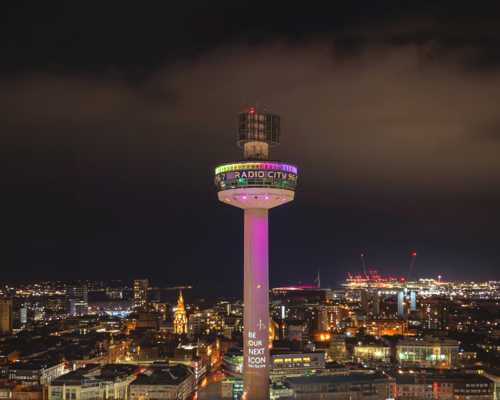
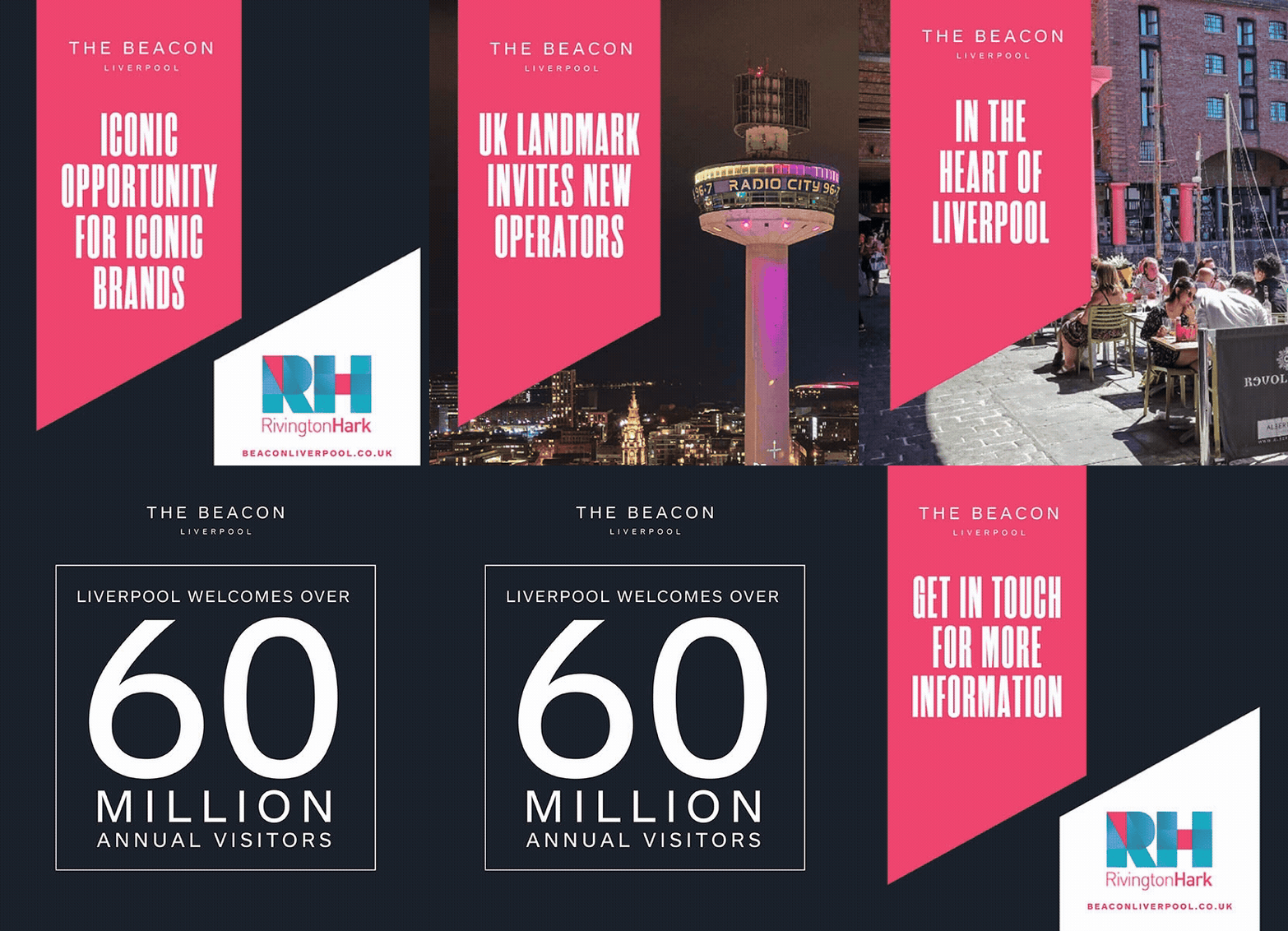
An opportunity to reimagine one of the UK’s most recognisable towers has been formally
opened by Rivington Hark, as St Johns Beacon invites operators and partners to shape its
next phase. [more...]