Developed by an architect, an engineer and a footballer, the Floating Gardens will offer innovative spa treatments on a groundbreaking eco-friendly floating building in the middle of a lake in Amsterdam. Co-founder Michel Kreuger tells Magali Robathan all about it
By Magali Robathan | Published in Leisure Handbook 2014 issue 1
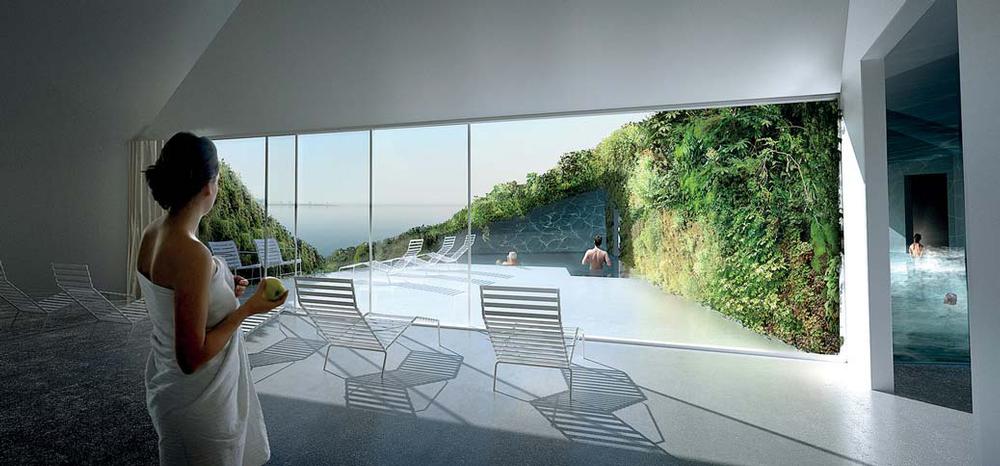
Every room in the spa will have views out over the freshwater lake in which it floats, while living walls will create a green sanctuary
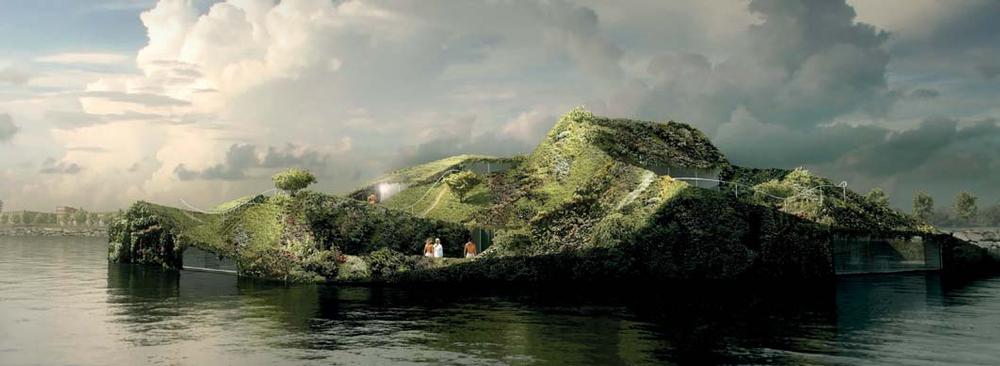
A spa built out of recycled polysty- rene and covered with vegeta- tion, offering treatments that promise to help the brain adapt and heal itself – it’s fair to say the Floating Gardens is not your average spa concept.
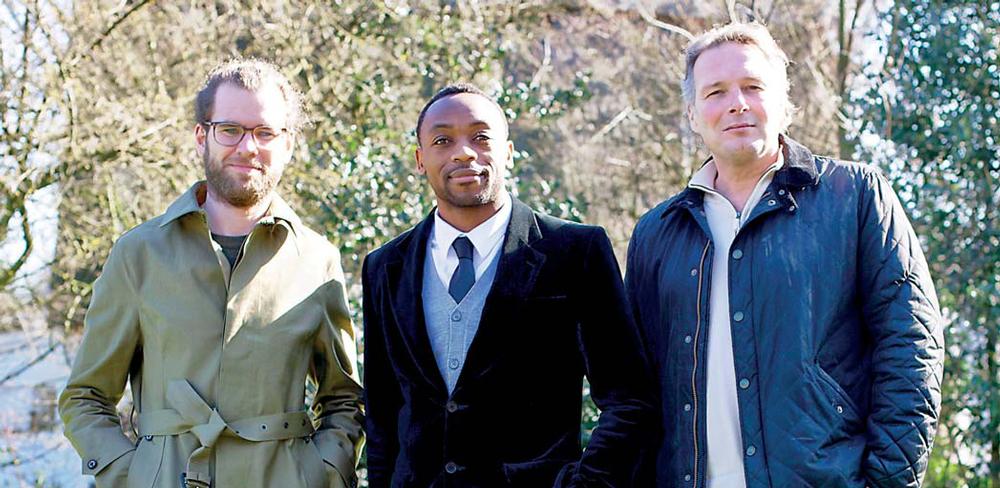
Developed by Michel Kreuger and ex-professional footballer Kizito Musampa, together with architect Anne Holtrop, the Floating Gardens spa will open in 2014.
The two-storey building will be located on a freshwater lake just outside Amster- dam’s city centre. It will feature four pools, two restaurant/bars, five saunas and three treatment rooms and will be covered with a ‘living wall’ of plants designed by botanist Patrick Blanc. Treatments will be offered which are based around concepts such as psychoneuroimmunology – which looks at how emotions and health are linked and how stress leads to disease – and neuroplasticity – a science that studies the brain’s potential for change and ability to adapt and renew itself.
The concept has been presented at various exhibitions since 2010, and has attracted high levels of interest.
Here Michel Kreuger, founder of green technology company Studio Noach, ex- plains how the idea was born.
When was Studio Noach founded? I founded it in 2008 together with my business partner [ex Manchester City and Ajax Amsterdam player] Kizito ‘Kiki’ Musampa. The studio was based on our Green Floating building concept, which uses recycled polystyrene to create floating structures.
The original idea was to build house- boats, but when the housing market stalled we decided to move the business into the wellness sector because it’s a niche market. Even when the housing market dips, there’s still a demand for spas and leisure.
What’s the Green Floating concept? It’s all based on building on a foundation of recycled polystyrene, which is as strong as steel, but can flex by 17 per cent. It’s also very buoyant and provides excellent insulation, which will be important in this exposed location. The structure is coated with fibreglass and covered with a layer of vegetation on top of the building.
We always knew that the carbon footprint of our buildings had to be neutral – we’ve actually gone one step further and made it carbon negative because the vegetation will convert CO2 to oxygen.
How did you choose the location? We’re based in Amsterdam, and we have a freshwater lake right outside of the city centre. It’s a place where you can relax and look over the horizon, while being very close to the city centre and the 17th century canals.
The Amsterdam local government is trying to move the city away from the im- age of the red light district and the coffee shops and encourage more visitors inter- ested in Van Gogh, Rembrandt and the 17th century canals. That sort of audience would be keen to go on a boat trip and come and spend half a day in the spa.
What facilities will the spa have? On the ground floor there will be four pools, including an outdoor infinity pool and a hot tub with views across the lake. There will also be two restaurants/bars (one wet, one dry) and five saunas, includ- ing two with panoramic views of the lake.
The top floor will feature three treatment rooms and a large room for group therapy such as hot yoga. These rooms will all offer views over the lake.
How did you link with Patrick Blanc? The idea of having vegetation on the walls and roof came from the floating gardens created in the 1970s and 1980s by the Dutch artist Robert Jasper Grootveld.
We wanted to create a structure similar to that and when we teamed up with architect Anne Holtrop he said there’s a better way of doing this – a new technique developed by Patrick Blanc [see story left for more information].
Blanc’s technique is based on the idea that you don’t need soil to grow plants – all you need is sunlight, nutrients, minerals and water. He wraps a composite cloth material around buildings, which just needs to be sprinkled with water for a few minutes each day – using this technique you can grow plants on the side of walls.
It wasn’t easy to contact Patrick Blanc, but when we did get hold of him he got very enthusiastic about our idea because what we had created was an ecological loop – normally his vertical gardens use rainwater with added nutrients and min- erals, but our concept building floats on fresh water so the plants can use that.
What will set the Floating Gardens apart from other spas? We are competing with four and five star city centre hotels. In these hotels, the spa facilities tend to consist of a pool and a sauna where the view is of someone else’s genitals! They’re often in the base- ment. In our case you will have beautiful views across the lake and gardens. From the city centre, you could hop on a canal boat and be with us in 15 minutes.
How did Kizito Musampa get involved? I live on the canal close to the red light district, and one day I saw a Lamborghini with a Spanish licence plate stopping.
I thought, ‘typical – a E500,000 car by the canal, probably a guy working in the district’. But then I saw the car again and again, and also saw the owner walking from the car to the parking meter to pay and realised he must be living nearby.
Parking meters in Amsterdam are some of the most expensive in the world, so when I met the owner of the car a few weeks later in a restaurant, I offered him my spare parking permit. I was surprised when he turned out to be the professional footballer Kiki Musampa. Months later we got closer, he got enthusiastic about my plans and he said he’d like to get involved.
Kiki is originally from the Congo. His father is a professor of botanics, so he already had an interest.
How is the project being funded? Kiki Musampa is mainly funding it. We are also currently in the process of negotiating a rollout of the concept to the rest of the world, although I can’t say too much about that yet. We need to get the first spa out, so that we have a flagship.
Who will the spa attract? It will be quite high-end – it will attract four and five star visitors.
What kind of treatments will you offer? Spas shouldn’t just offer relaxation; change is what people are really looking for in order to obtain long-lasting peace of mind. Areas such as psychoneuroimmu- nology (PNI), which looks at how emotions and health are related, and the links be- tween stress and disease, will be explored in the treatments we offer.
I have travelled around the world researching treatment ideas. I met many teachers around the world, but the Tibetan Lamas I met in India and Nepal really opened my eyes. I learned that it’s possi- ble to not only change the mind, but also the structure of the brain.
Today, pioneering experiments in neuroplasticity, a new science studying the brain’s potential for change, reveal that we are capable not only of altering its structure but also of generating new neurons. There is now clear evidence that the brain can adapt, heal and renew itself. Our spa will offer this wealth of knowledge to its customers.
When will the spa open? Towards the middle of 2014.
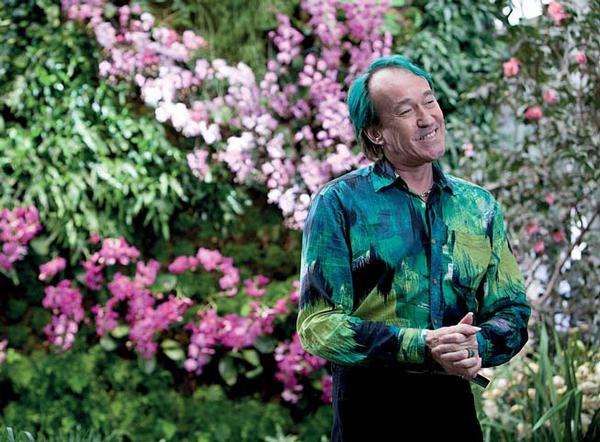
Patrick Blanc Patrick Blanc is a botanist and creator of the Vertical Garden (Mur Vegetal) Blanc’s vertical gardens allow plants to grow up walls without needing soil.
Blanc has created more than 140 verti- cal gardens on buildings across the world, including the Quai Branly Museum in Paris, the Athenaeum Hotel in London, the Aquarium in Genoa and the CaixaForum art gallery in Madrid.
After visiting Malaysia and Thailand aged 19, Paris-born Blanc was inspired by the abundant greenery and by the way plants grew everywhere – on rocks, on walls and up trees. He decided to try to do the same at home, and spent years studying the way plants grow vertically in the wild.
The walls of the buildings are wrapped with a felt polyamode layer which is attached to a thin waterproof layer of PVC, which is in turn attached to a metal frame. The plants are fed with nutrient-enriched water which runs down into a trough. Any excess water is returned to the top of the wall to be used again.
Blanc blends shade and moisture-loving plants at the bottom of his vertical walls with plants that need more light and are more hardy at the top. The plants don’t damage the buildings long as they are given water and nutrients, they spread only super- ficially, and need minimal maintenance.
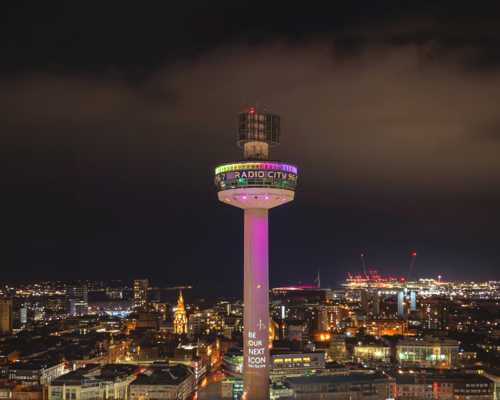
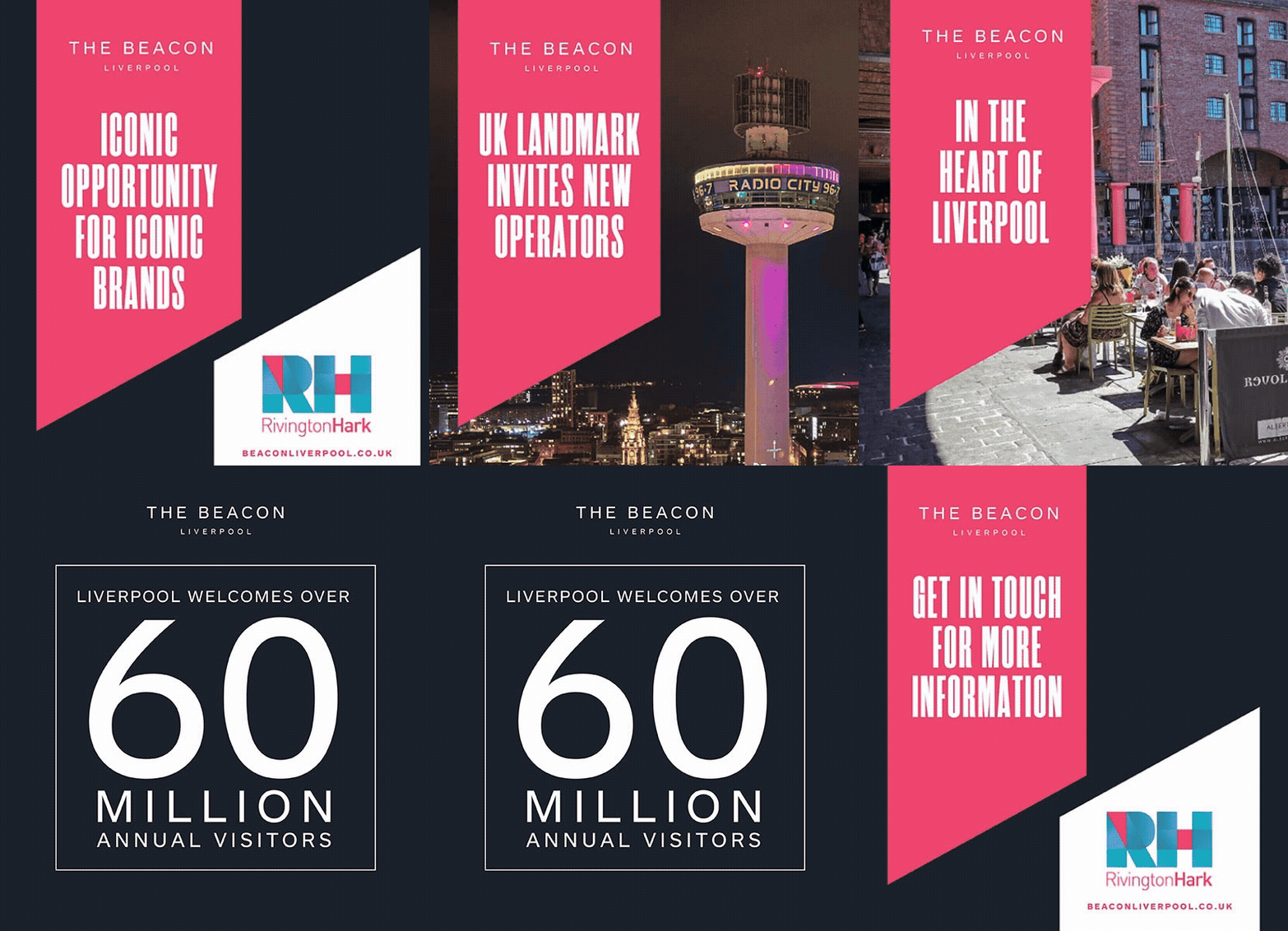
An opportunity to reimagine one of the UK’s most recognisable towers has been formally
opened by Rivington Hark, as St Johns Beacon invites operators and partners to shape its
next phase. [more...]
Developed by an architect, an engineer and a footballer, the Floating Gardens will offer innovative spa treatments on a groundbreaking eco-friendly floating building in the middle of a lake in Amsterdam. Co-founder Michel Kreuger tells Magali Robathan all about it
By Magali Robathan | Published in Leisure Handbook 2014 issue 1
Every room in the spa will have views out over the freshwater lake in which it floats, while living walls will create a green sanctuary
A spa built out of recycled polysty- rene and covered with vegeta- tion, offering treatments that promise to help the brain adapt and heal itself – it’s fair to say the Floating Gardens is not your average spa concept.
Developed by Michel Kreuger and ex-professional footballer Kizito Musampa, together with architect Anne Holtrop, the Floating Gardens spa will open in 2014.
The two-storey building will be located on a freshwater lake just outside Amster- dam’s city centre. It will feature four pools, two restaurant/bars, five saunas and three treatment rooms and will be covered with a ‘living wall’ of plants designed by botanist Patrick Blanc. Treatments will be offered which are based around concepts such as psychoneuroimmunology – which looks at how emotions and health are linked and how stress leads to disease – and neuroplasticity – a science that studies the brain’s potential for change and ability to adapt and renew itself.
The concept has been presented at various exhibitions since 2010, and has attracted high levels of interest.
Here Michel Kreuger, founder of green technology company Studio Noach, ex- plains how the idea was born.
When was Studio Noach founded? I founded it in 2008 together with my business partner [ex Manchester City and Ajax Amsterdam player] Kizito ‘Kiki’ Musampa. The studio was based on our Green Floating building concept, which uses recycled polystyrene to create floating structures.
The original idea was to build house- boats, but when the housing market stalled we decided to move the business into the wellness sector because it’s a niche market. Even when the housing market dips, there’s still a demand for spas and leisure.
What’s the Green Floating concept? It’s all based on building on a foundation of recycled polystyrene, which is as strong as steel, but can flex by 17 per cent. It’s also very buoyant and provides excellent insulation, which will be important in this exposed location. The structure is coated with fibreglass and covered with a layer of vegetation on top of the building.
We always knew that the carbon footprint of our buildings had to be neutral – we’ve actually gone one step further and made it carbon negative because the vegetation will convert CO2 to oxygen.
How did you choose the location? We’re based in Amsterdam, and we have a freshwater lake right outside of the city centre. It’s a place where you can relax and look over the horizon, while being very close to the city centre and the 17th century canals.
The Amsterdam local government is trying to move the city away from the im- age of the red light district and the coffee shops and encourage more visitors inter- ested in Van Gogh, Rembrandt and the 17th century canals. That sort of audience would be keen to go on a boat trip and come and spend half a day in the spa.
What facilities will the spa have? On the ground floor there will be four pools, including an outdoor infinity pool and a hot tub with views across the lake. There will also be two restaurants/bars (one wet, one dry) and five saunas, includ- ing two with panoramic views of the lake.
The top floor will feature three treatment rooms and a large room for group therapy such as hot yoga. These rooms will all offer views over the lake.
How did you link with Patrick Blanc? The idea of having vegetation on the walls and roof came from the floating gardens created in the 1970s and 1980s by the Dutch artist Robert Jasper Grootveld.
We wanted to create a structure similar to that and when we teamed up with architect Anne Holtrop he said there’s a better way of doing this – a new technique developed by Patrick Blanc [see story left for more information].
Blanc’s technique is based on the idea that you don’t need soil to grow plants – all you need is sunlight, nutrients, minerals and water. He wraps a composite cloth material around buildings, which just needs to be sprinkled with water for a few minutes each day – using this technique you can grow plants on the side of walls.
It wasn’t easy to contact Patrick Blanc, but when we did get hold of him he got very enthusiastic about our idea because what we had created was an ecological loop – normally his vertical gardens use rainwater with added nutrients and min- erals, but our concept building floats on fresh water so the plants can use that.
What will set the Floating Gardens apart from other spas? We are competing with four and five star city centre hotels. In these hotels, the spa facilities tend to consist of a pool and a sauna where the view is of someone else’s genitals! They’re often in the base- ment. In our case you will have beautiful views across the lake and gardens. From the city centre, you could hop on a canal boat and be with us in 15 minutes.
How did Kizito Musampa get involved? I live on the canal close to the red light district, and one day I saw a Lamborghini with a Spanish licence plate stopping.
I thought, ‘typical – a E500,000 car by the canal, probably a guy working in the district’. But then I saw the car again and again, and also saw the owner walking from the car to the parking meter to pay and realised he must be living nearby.
Parking meters in Amsterdam are some of the most expensive in the world, so when I met the owner of the car a few weeks later in a restaurant, I offered him my spare parking permit. I was surprised when he turned out to be the professional footballer Kiki Musampa. Months later we got closer, he got enthusiastic about my plans and he said he’d like to get involved.
Kiki is originally from the Congo. His father is a professor of botanics, so he already had an interest.
How is the project being funded? Kiki Musampa is mainly funding it. We are also currently in the process of negotiating a rollout of the concept to the rest of the world, although I can’t say too much about that yet. We need to get the first spa out, so that we have a flagship.
Who will the spa attract? It will be quite high-end – it will attract four and five star visitors.
What kind of treatments will you offer? Spas shouldn’t just offer relaxation; change is what people are really looking for in order to obtain long-lasting peace of mind. Areas such as psychoneuroimmu- nology (PNI), which looks at how emotions and health are related, and the links be- tween stress and disease, will be explored in the treatments we offer.
I have travelled around the world researching treatment ideas. I met many teachers around the world, but the Tibetan Lamas I met in India and Nepal really opened my eyes. I learned that it’s possi- ble to not only change the mind, but also the structure of the brain.
Today, pioneering experiments in neuroplasticity, a new science studying the brain’s potential for change, reveal that we are capable not only of altering its structure but also of generating new neurons. There is now clear evidence that the brain can adapt, heal and renew itself. Our spa will offer this wealth of knowledge to its customers.
When will the spa open? Towards the middle of 2014.
Patrick Blanc Patrick Blanc is a botanist and creator of the Vertical Garden (Mur Vegetal) Blanc’s vertical gardens allow plants to grow up walls without needing soil.
Blanc has created more than 140 verti- cal gardens on buildings across the world, including the Quai Branly Museum in Paris, the Athenaeum Hotel in London, the Aquarium in Genoa and the CaixaForum art gallery in Madrid.
After visiting Malaysia and Thailand aged 19, Paris-born Blanc was inspired by the abundant greenery and by the way plants grew everywhere – on rocks, on walls and up trees. He decided to try to do the same at home, and spent years studying the way plants grow vertically in the wild.
The walls of the buildings are wrapped with a felt polyamode layer which is attached to a thin waterproof layer of PVC, which is in turn attached to a metal frame. The plants are fed with nutrient-enriched water which runs down into a trough. Any excess water is returned to the top of the wall to be used again.
Blanc blends shade and moisture-loving plants at the bottom of his vertical walls with plants that need more light and are more hardy at the top. The plants don’t damage the buildings long as they are given water and nutrients, they spread only super- ficially, and need minimal maintenance.
A new immersive attraction designed to transport visitors into the final hours of ancient Pompeii
is preparing to open near the world-famous archaeological site in southern Italy.
Experience design company, BRC Imagination Arts, has completed a transition that sees founder
Bob Rogers pass ownership of the business to four long-serving senior executives, while
remaining actively involved with the company.
Movie Park Germany has opened a new Paramount Pictures-themed attraction as part of its 30th
anniversary celebrations, using immersive storytelling and adaptive reuse to reinforce the park’s
longstanding “Hollywood in Germany” positioning.
Therme Manchester’s 28-acre development, which will include interconnected glass pavilions
that measure 65,000sq m, will be the largest bathing and wellbeing attraction in the world once
complete, according to prof David Russell, CEO of Therme UK.
Efteling has opened Hooghmoed, a new family drop tower designed to broaden the appeal of its
recently launched Sirene Island themed area and introduce younger visitors to thrill attractions.
A proposed Puy du Fou development near Bicester and Universal Destinations and Experiences’
planned resort in Bedford are emerging as part of a wider transformation of the Oxford–
Cambridge Growth Corridor into a major centre for UK leisure and tourism inv
Shedd Aquarium has opened the Immersion Theater developed in partnership with SimEx-
Iwerks, as part of a wider strategy to enhance the guest experience and create additional
revenue opportunities.
The UK government has announced a temporary reduction in VAT on visitor attractions and
children’s meals as part of a summer cost-of-living support package designed to stimulate the
visitor economy and encourage family days out.
As designer Yinka Ilori prepares for his first solo gallery show in London, he speaks exclusively
to CLADmag about his mission to spread joy, the power of play, and his bold approach to using
colour (including the colours you won’t see in his work).
The government of Thailand is exploring plans for a THB300bn (£6.3bn, US$8.3bn)
entertainment complex in the country’s Eastern Economic Corridor (EEC), with officials
proposing a large-scale theme park and sports destination as part of a broader tourism and
economic development strategy.
An opportunity to reimagine one of the UK’s most recognisable towers has been formally
opened by Rivington Hark, as St Johns Beacon invites operators and partners to shape its
next phase. [more...]