Forty years after the Pompidou Centre opened in Paris, Kim Megson meets one of the architects behind the project to discover how a young and radical design team managed to create a cultural landmark like no other
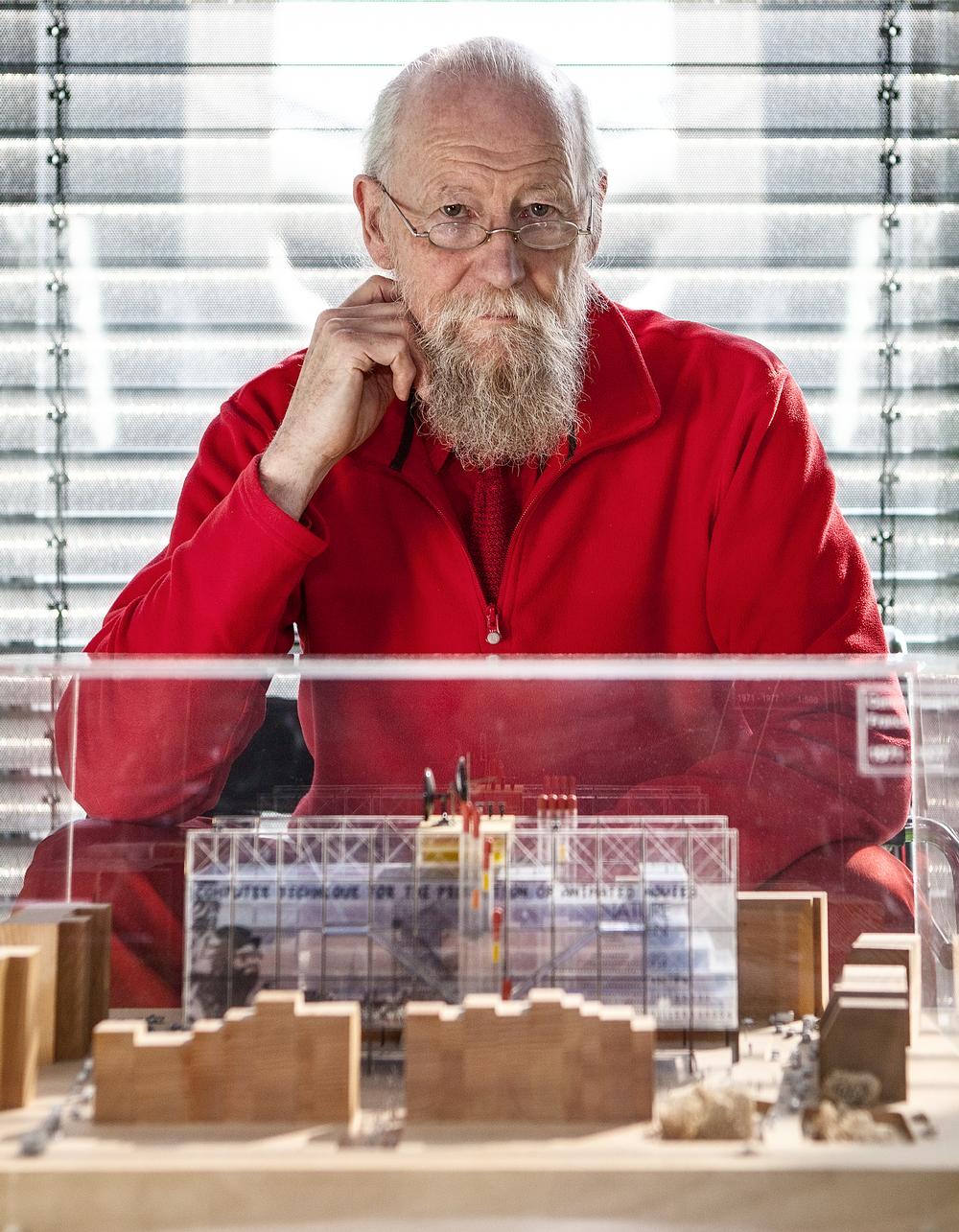
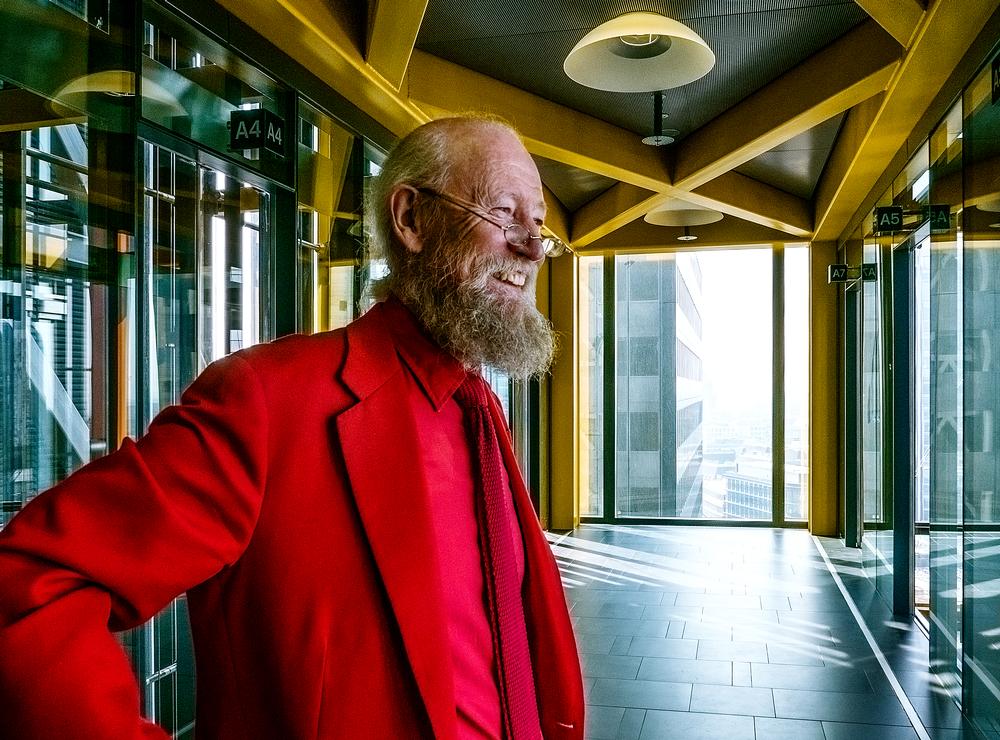
Mike Davies with the original competition model of the Pompidou Centre from the 1970s / Photo: Paul McLaughlin
Back in 1977, a new cultural building caused quite a stir when it opened in Paris. Some of the world’s greatest architects, including Oscar Niemeyer and Philip Johnson, hailed it as a revolutionary piece of work. Critics called it a monstrosity.
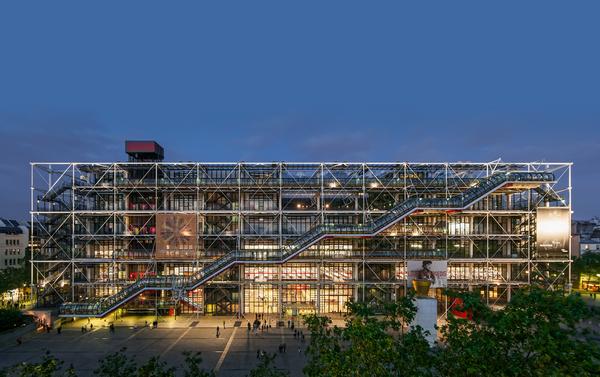
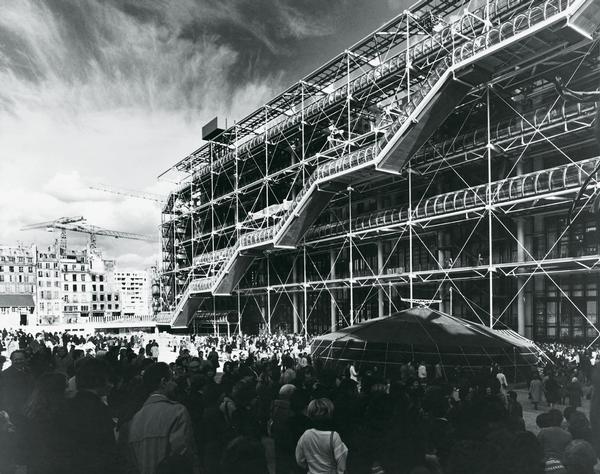
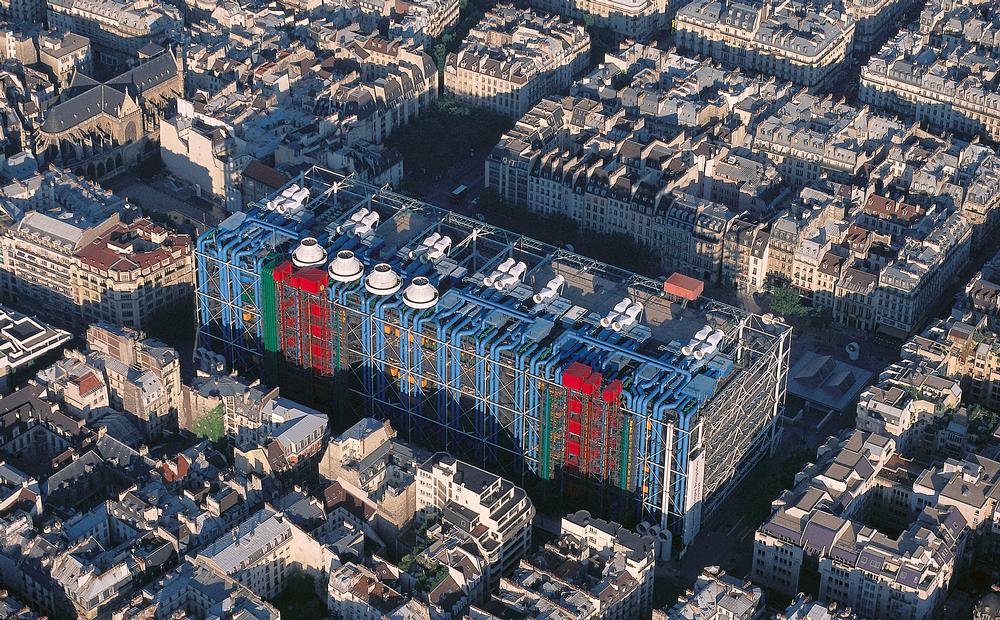
What none of them could have predicted was that, 40 years on, the Centre Georges Pompidou would be one of the world’s most popular cultural buildings – receiving an average of 3.8 million visitors a year. Its famous steel skeleton, ‘inside-out’ configuration, exterior caterpillar escalators and colour-coded utility pipes are recognised by people across the world.
To celebrate the 40th anniversary of this architectural icon – created by Richard Rogers, Renzo Piano and a talented team of architects, designers and engineers – CLAD speaks to Mike Davies, an integral part of the Pompidou story and a founding partner of the Richard Rogers Partnership (now RSH+P).
How did you become involved with the Pompidou Centre project? I had started an architectural practice called Chrysalis with two British friends – Alan Stanton and Chris Dawson – and we had a lightweight structures firm out in Los Angeles. The ethos of America at the time was all about autonomous living, being off grid and not relying on orthodox networks. Our fascination was with inflatables; at the time, the last thing we wanted to do was traditional buildings. We carried out 53 projects in four years, 27 of which were built. Some of them were really way out – including the world’s largest mirror dome.
It was a great time. We used to go and watch Jimmy Hendrix, Janis Joplin, Crosby, Stills and Nash and a radical dodgy group called The Rolling Stones. Everyone and everything in LA was creative and there was a buzz everywhere.
Then one day I got a phone call from someone I’d met in London in Architectural Association circles called Richard Rogers. He’d spoken to me some years before because I had some expertise in inflatables and lightweight structures.
He called at 4.30am – he’d forgotten the time difference – and explained that he and Renzo Piano had won this enormous competition in Paris. ‘The problem is, they think we’re a huge architectural machine, when really it’s three guys and a dog in charge,’ he said. ‘Would you guys be prepared to join us?’
Our visas in the USA were running out, so we all met around the pool to decide if we should leave for Paris. Eventually we thought, ‘what the hell, let’s go for it’.
I arrived in Paris on 19 February 1972; it was -9 degrees. I’d rented an apartment with a stone floor and it was like living in a fridge. When we all met up, I remember us looking at each other and saying, ‘Oh my God, what have we done?’
So our Paris experience started with a shock. In the end it turned into six wonderful years.
Where did the design concept for the Pompidou Centre come from? All our team were wary of building monuments – especially one to a president – because most of the time with projects like this clients wanted something self-consciously grand and iconic, rather than functional and challenging.
Our concept, expressed in Richard and Renzo’s competition drawings, was different. It wasn’t really a building. Instead it was a Meccano set – a machine that could adapt continuously to varying events and uses over time.
Every other art museum at that time was a basilican building with rooms and halls connected to other rooms. Curators were faced with wrestling with the issue of achieving the vision and layout they wanted in a building they were heavily constrained by.
With Pompidou, the basic idea was a loose-fit flexible space where the building did not constrain what you wanted to exhibit. It had to house a permanent collection of modern art – one of the finest in the word – and temporary ones from all over the planet, so adaptability was fundamental. Each open, loose fit floorplate was the size of two football pitches, with no columns. That was a total departure.
We designed the Pompidou Centre on the basis that its users didn’t know what would happen to it in 10 years’ time. So we separated the served and servicing areas to create a clean, neutral user space. The piping and services were all grouped outside on one façade, with the opposite façade being dedicated to feeding people in and out of the huge useable spaces within the building. This ‘served and servant’ approach has been a common characteristic of our practice ever since – for example, with the Lloyd’s of London building in London.
Finally, we were great lovers of Gustave Eiffel and we wanted to make a fine steel building in the great French tradition, which had virtually disappeared, and which we wanted to revive.
How did people respond to the design? There was a terrific fight with the French architectural establishment, who resisted the notion of foreign architects doing a national building. We weren’t registered with the French Architecture Institute, but there we were, designing a grand national project with the French president as our client.
There were incredible diatribes against the Pompidou, funnily enough including one featuring exactly the same words used against the Eiffel Tower when that was first proposed.
The concept was radical, the construction was radical and the design detail was unlike anything else seen in France, so there were lots of professional critics and many sceptical officials. We were menaced with court action.
The obstructive dam broke after nearly three years, when they realised that it was too late to stop us. By then we had created the biggest hole in Paris and steel was rising out the ground.
There was a wonderful government project leader, Robert Bordaz, who was a friend of Georges Pompidou. He was a legendarily safe pair of hands and a master at defending against political attack. He dealt deftly and elegantly with all our opposition. Without him, the Pompidou Centre would never have been built.
What are your memories of the opening day? A few months earlier, Georges Pompidou had died and the budget had been immediately frozen by the new president. We were 86 per cent through the budget when that happened, so we ended up going down to the local hardware shops to buy paint to finish the building.
The opening had a strange atmosphere. The new president, Valéry Giscard d’Estaing, an aloof man of the right, was very unlike the left-leaning Pompidou. He opened the Pompidou Centre with a grand speech, but without mentioning either the building or its architects. That was quite an achievement!
There were huge queues, but nobody was on our wonderful public piazza, which was entirely fenced off and inaccessible. It took six months to get the barriers removed. The attitude was: ‘Mr Rogers, this is a national building, we can’t have the public coming up to the front doors!’
Richard had to go to the top of the political establishment and the police, explaining that the piazza was meant to be open to everyone and the building was consciously designed for the common man – a symbolic manifestation of the new open society in France.
What is your personal view of the Pompidou Centre today? The acid test is if you go ‘wow’ when you go into your own building. I think we did with the Pompidou Centre. I still find the lacy façade and rocker beams spectacular and beautiful.
It’s still radical and young people still love it. The moment it opened it was taken over by students, and that friendly occupation has never really stopped.
For me, the Pompidou Centre is as exciting now as it was when we first built it. It remains true to Richard’s competition-winning vision of a building for all people.
I also still love the underground building I was in charge of that is part of the centre – the Institute for Research and Coordination in Acoustics/Music. I had a wonderful time creating it for the French composer Pierre Boulez, who’d returned to Paris to lead an open research centre for avant-garde musicians. It features the world’s most acoustically flexible studio space – a 400-person experimental studio.
What impact do you think the Pompidou Centre has had? There was popular public acclaim after the centre was built, and at the same time professional art gallery scepticism.
It was more radical than any other art museum on the planet and it looked like a piece of technology. Most people in the art world wanted more cool concrete surfaces, discreet lighting, neutral spaces and discretion. We were the Johnny Rottens of the business, rather than the Simon Rattles.
But the building continues to cope with any curatorial vision and is uplifting and bubbling with life. So it’s been immensely successful. Few venues have significantly exceeded its visitor numbers, apart from the Millennium Dome – now the O2 Arena – the world’s most successful entertainment venue. It’s nice to have been involved with both.
What inspires you, apart from architecture? Anything interesting is a passion. My problem is I’ve got too many passions. I have been an amateur astronomer all my life and in my spare time I build large telescopes and observatories. I love sailing, I rock climbed for many years and I’m an eclipse chaser. My wife and I go where we are told to go to by the movement of our solar system, rather than by a travel agent. The universe says, ‘right, you need to be on this little atoll in the South Pacific for two and a half minutes,’ and that’s where we go.
A total eclipse of the sun is one of the rare moments when a human can actually watch the earth, moon and our solar system visibly moving. You witness this huge eye in the sky staring down on the world.
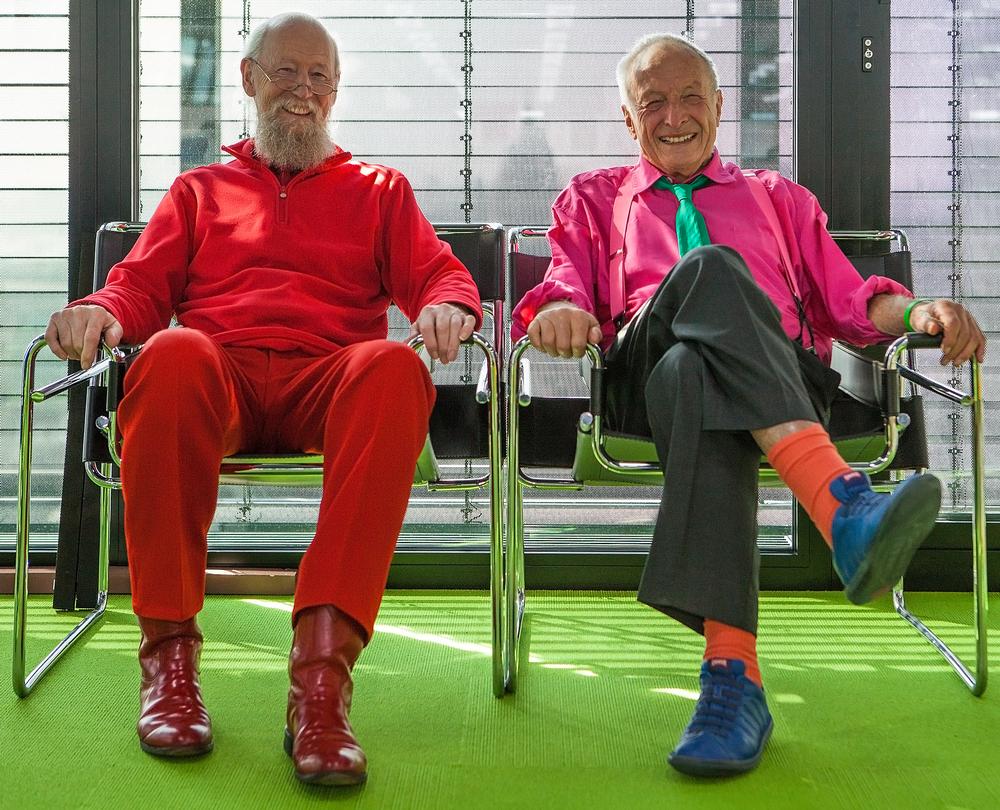
You’re famous for dressing only in red. How did this begin? It started in California in the late 1960s. This was the era of the Beatles – nobody was in grey suits. One day, walking on Hollywood Boulevard, I saw an incredible electric purple velvet suit in a shop window and smitten, I bought it straight away.
In Paris I used to travel from my flat by train to the Pompidou site in my purple suit. I thought the French women were quite bold, because I always got my bottom pinched on the Metro. One day Pierre Boulez said, ‘I admire your courage for wearing this incredible colour – and even more for demonstrating your homosexuality in public.’ I asked him what he meant, and he said: ‘Do you not know this is the code colour for the homosexual community in Paris if you’re incognito?’
So I found out that it wasn’t the ladies who had been pinching my bottom on the Metro, it was the men! Being happily married to a wonderful French lady, to avoid confusion I went to the local sports shop and bought three pairs of bright red golf trousers. That’s when I started wearing all red.
It makes it easy to break the ice at parties, and you waste no time wondering what to wear in the morning. I have a red car, red telescopes and I draw with red pens.
My clothes have started thousands of conversations and they tend to cheer everybody up, including New York immigration officers – which is quite an achievement!
Forty years of performance art in a conservative world have been an unmissable pleasure.
The Pompidou Centre in numbers The building extends over 10 floors of 7,500sq m each
2,210sq m for galleries displaying the collection of the Musée National d’art Moderne
15,900sq m for temporary exhibitions
2 cinemas (315 and 144 seats)
A performance space (384 seats) and a lecture theatre (158 seats)
A 10,400sq m public reading library for 2,200 users
2,600sq m for the museum’s own research library
Photo: Shutterstock
The famed escalator is housed in a glazed tube and offers spectacular views across Paris
The Pompidou Centre A History • In 1969, President Georges Pompidou decided that the vacant site of the Plateau Beaubourg should be used for the construction of a multidisciplinary cultural centre. An international design competition was held, with 681 submissions received.
• The jury, chaired by the architect and engineer Jean Prouvé, chose a design submitted by a team of three: British architect Richard Rogers and the Italians Renzo Piano and Gianfranco Franchini.
• Piano and Rogers alone oversaw the management of the project, with a team including Mike Davies and Arup engineers Edmund Happold and Peter Rice.
• The centre opened on 31 January 1977.
• After 20 years, the centre’s then-president Jean-Jacques Aillagon announced a major state-funded renovation of the Pompidou Centre. The gallery spaces were expanded and the live performance spaces were improved. Around 100,000sq m (1 million sq ft) of floor space was reconfigured by the time the building reopened on 1 January 2000.
• At present, between 3.5 and 3.8 million visitors visit the centre each year. Now, a new US$108m E101m, £88.3m) facelift, overseen by Piano, is planned, including the replacement of the famous exterior escalator.
An opportunity to reimagine one of the UK’s most recognisable towers has been formally
opened by Rivington Hark, as St Johns Beacon invites operators and partners to shape its
next phase. [more...]
Forty years after the Pompidou Centre opened in Paris, Kim Megson meets one of the architects behind the project to discover how a young and radical design team managed to create a cultural landmark like no other
Mike Davies with the original competition model of the Pompidou Centre from the 1970s / Photo: Paul McLaughlin
Back in 1977, a new cultural building caused quite a stir when it opened in Paris. Some of the world’s greatest architects, including Oscar Niemeyer and Philip Johnson, hailed it as a revolutionary piece of work. Critics called it a monstrosity.
What none of them could have predicted was that, 40 years on, the Centre Georges Pompidou would be one of the world’s most popular cultural buildings – receiving an average of 3.8 million visitors a year. Its famous steel skeleton, ‘inside-out’ configuration, exterior caterpillar escalators and colour-coded utility pipes are recognised by people across the world.
To celebrate the 40th anniversary of this architectural icon – created by Richard Rogers, Renzo Piano and a talented team of architects, designers and engineers – CLAD speaks to Mike Davies, an integral part of the Pompidou story and a founding partner of the Richard Rogers Partnership (now RSH+P).
How did you become involved with the Pompidou Centre project? I had started an architectural practice called Chrysalis with two British friends – Alan Stanton and Chris Dawson – and we had a lightweight structures firm out in Los Angeles. The ethos of America at the time was all about autonomous living, being off grid and not relying on orthodox networks. Our fascination was with inflatables; at the time, the last thing we wanted to do was traditional buildings. We carried out 53 projects in four years, 27 of which were built. Some of them were really way out – including the world’s largest mirror dome.
It was a great time. We used to go and watch Jimmy Hendrix, Janis Joplin, Crosby, Stills and Nash and a radical dodgy group called The Rolling Stones. Everyone and everything in LA was creative and there was a buzz everywhere.
Then one day I got a phone call from someone I’d met in London in Architectural Association circles called Richard Rogers. He’d spoken to me some years before because I had some expertise in inflatables and lightweight structures.
He called at 4.30am – he’d forgotten the time difference – and explained that he and Renzo Piano had won this enormous competition in Paris. ‘The problem is, they think we’re a huge architectural machine, when really it’s three guys and a dog in charge,’ he said. ‘Would you guys be prepared to join us?’
Our visas in the USA were running out, so we all met around the pool to decide if we should leave for Paris. Eventually we thought, ‘what the hell, let’s go for it’.
I arrived in Paris on 19 February 1972; it was -9 degrees. I’d rented an apartment with a stone floor and it was like living in a fridge. When we all met up, I remember us looking at each other and saying, ‘Oh my God, what have we done?’
So our Paris experience started with a shock. In the end it turned into six wonderful years.
Where did the design concept for the Pompidou Centre come from? All our team were wary of building monuments – especially one to a president – because most of the time with projects like this clients wanted something self-consciously grand and iconic, rather than functional and challenging.
Our concept, expressed in Richard and Renzo’s competition drawings, was different. It wasn’t really a building. Instead it was a Meccano set – a machine that could adapt continuously to varying events and uses over time.
Every other art museum at that time was a basilican building with rooms and halls connected to other rooms. Curators were faced with wrestling with the issue of achieving the vision and layout they wanted in a building they were heavily constrained by.
With Pompidou, the basic idea was a loose-fit flexible space where the building did not constrain what you wanted to exhibit. It had to house a permanent collection of modern art – one of the finest in the word – and temporary ones from all over the planet, so adaptability was fundamental. Each open, loose fit floorplate was the size of two football pitches, with no columns. That was a total departure.
We designed the Pompidou Centre on the basis that its users didn’t know what would happen to it in 10 years’ time. So we separated the served and servicing areas to create a clean, neutral user space. The piping and services were all grouped outside on one façade, with the opposite façade being dedicated to feeding people in and out of the huge useable spaces within the building. This ‘served and servant’ approach has been a common characteristic of our practice ever since – for example, with the Lloyd’s of London building in London.
Finally, we were great lovers of Gustave Eiffel and we wanted to make a fine steel building in the great French tradition, which had virtually disappeared, and which we wanted to revive.
How did people respond to the design? There was a terrific fight with the French architectural establishment, who resisted the notion of foreign architects doing a national building. We weren’t registered with the French Architecture Institute, but there we were, designing a grand national project with the French president as our client.
There were incredible diatribes against the Pompidou, funnily enough including one featuring exactly the same words used against the Eiffel Tower when that was first proposed.
The concept was radical, the construction was radical and the design detail was unlike anything else seen in France, so there were lots of professional critics and many sceptical officials. We were menaced with court action.
The obstructive dam broke after nearly three years, when they realised that it was too late to stop us. By then we had created the biggest hole in Paris and steel was rising out the ground.
There was a wonderful government project leader, Robert Bordaz, who was a friend of Georges Pompidou. He was a legendarily safe pair of hands and a master at defending against political attack. He dealt deftly and elegantly with all our opposition. Without him, the Pompidou Centre would never have been built.
What are your memories of the opening day? A few months earlier, Georges Pompidou had died and the budget had been immediately frozen by the new president. We were 86 per cent through the budget when that happened, so we ended up going down to the local hardware shops to buy paint to finish the building.
The opening had a strange atmosphere. The new president, Valéry Giscard d’Estaing, an aloof man of the right, was very unlike the left-leaning Pompidou. He opened the Pompidou Centre with a grand speech, but without mentioning either the building or its architects. That was quite an achievement!
There were huge queues, but nobody was on our wonderful public piazza, which was entirely fenced off and inaccessible. It took six months to get the barriers removed. The attitude was: ‘Mr Rogers, this is a national building, we can’t have the public coming up to the front doors!’
Richard had to go to the top of the political establishment and the police, explaining that the piazza was meant to be open to everyone and the building was consciously designed for the common man – a symbolic manifestation of the new open society in France.
What is your personal view of the Pompidou Centre today? The acid test is if you go ‘wow’ when you go into your own building. I think we did with the Pompidou Centre. I still find the lacy façade and rocker beams spectacular and beautiful.
It’s still radical and young people still love it. The moment it opened it was taken over by students, and that friendly occupation has never really stopped.
For me, the Pompidou Centre is as exciting now as it was when we first built it. It remains true to Richard’s competition-winning vision of a building for all people.
I also still love the underground building I was in charge of that is part of the centre – the Institute for Research and Coordination in Acoustics/Music. I had a wonderful time creating it for the French composer Pierre Boulez, who’d returned to Paris to lead an open research centre for avant-garde musicians. It features the world’s most acoustically flexible studio space – a 400-person experimental studio.
What impact do you think the Pompidou Centre has had? There was popular public acclaim after the centre was built, and at the same time professional art gallery scepticism.
It was more radical than any other art museum on the planet and it looked like a piece of technology. Most people in the art world wanted more cool concrete surfaces, discreet lighting, neutral spaces and discretion. We were the Johnny Rottens of the business, rather than the Simon Rattles.
But the building continues to cope with any curatorial vision and is uplifting and bubbling with life. So it’s been immensely successful. Few venues have significantly exceeded its visitor numbers, apart from the Millennium Dome – now the O2 Arena – the world’s most successful entertainment venue. It’s nice to have been involved with both.
What inspires you, apart from architecture? Anything interesting is a passion. My problem is I’ve got too many passions. I have been an amateur astronomer all my life and in my spare time I build large telescopes and observatories. I love sailing, I rock climbed for many years and I’m an eclipse chaser. My wife and I go where we are told to go to by the movement of our solar system, rather than by a travel agent. The universe says, ‘right, you need to be on this little atoll in the South Pacific for two and a half minutes,’ and that’s where we go.
A total eclipse of the sun is one of the rare moments when a human can actually watch the earth, moon and our solar system visibly moving. You witness this huge eye in the sky staring down on the world.
You’re famous for dressing only in red. How did this begin? It started in California in the late 1960s. This was the era of the Beatles – nobody was in grey suits. One day, walking on Hollywood Boulevard, I saw an incredible electric purple velvet suit in a shop window and smitten, I bought it straight away.
In Paris I used to travel from my flat by train to the Pompidou site in my purple suit. I thought the French women were quite bold, because I always got my bottom pinched on the Metro. One day Pierre Boulez said, ‘I admire your courage for wearing this incredible colour – and even more for demonstrating your homosexuality in public.’ I asked him what he meant, and he said: ‘Do you not know this is the code colour for the homosexual community in Paris if you’re incognito?’
So I found out that it wasn’t the ladies who had been pinching my bottom on the Metro, it was the men! Being happily married to a wonderful French lady, to avoid confusion I went to the local sports shop and bought three pairs of bright red golf trousers. That’s when I started wearing all red.
It makes it easy to break the ice at parties, and you waste no time wondering what to wear in the morning. I have a red car, red telescopes and I draw with red pens.
My clothes have started thousands of conversations and they tend to cheer everybody up, including New York immigration officers – which is quite an achievement!
Forty years of performance art in a conservative world have been an unmissable pleasure.
The Pompidou Centre in numbers The building extends over 10 floors of 7,500sq m each
2,210sq m for galleries displaying the collection of the Musée National d’art Moderne
15,900sq m for temporary exhibitions
2 cinemas (315 and 144 seats)
A performance space (384 seats) and a lecture theatre (158 seats)
A 10,400sq m public reading library for 2,200 users
2,600sq m for the museum’s own research library
Photo: Shutterstock
The famed escalator is housed in a glazed tube and offers spectacular views across Paris
The Pompidou Centre A History • In 1969, President Georges Pompidou decided that the vacant site of the Plateau Beaubourg should be used for the construction of a multidisciplinary cultural centre. An international design competition was held, with 681 submissions received.
• The jury, chaired by the architect and engineer Jean Prouvé, chose a design submitted by a team of three: British architect Richard Rogers and the Italians Renzo Piano and Gianfranco Franchini.
• Piano and Rogers alone oversaw the management of the project, with a team including Mike Davies and Arup engineers Edmund Happold and Peter Rice.
• The centre opened on 31 January 1977.
• After 20 years, the centre’s then-president Jean-Jacques Aillagon announced a major state-funded renovation of the Pompidou Centre. The gallery spaces were expanded and the live performance spaces were improved. Around 100,000sq m (1 million sq ft) of floor space was reconfigured by the time the building reopened on 1 January 2000.
• At present, between 3.5 and 3.8 million visitors visit the centre each year. Now, a new US$108m E101m, £88.3m) facelift, overseen by Piano, is planned, including the replacement of the famous exterior escalator.
A new immersive attraction designed to transport visitors into the final hours of ancient Pompeii
is preparing to open near the world-famous archaeological site in southern Italy.
Experience design company, BRC Imagination Arts, has completed a transition that sees founder
Bob Rogers pass ownership of the business to four long-serving senior executives, while
remaining actively involved with the company.
Movie Park Germany has opened a new Paramount Pictures-themed attraction as part of its 30th
anniversary celebrations, using immersive storytelling and adaptive reuse to reinforce the park’s
longstanding “Hollywood in Germany” positioning.
Therme Manchester’s 28-acre development, which will include interconnected glass pavilions
that measure 65,000sq m, will be the largest bathing and wellbeing attraction in the world once
complete, according to prof David Russell, CEO of Therme UK.
Efteling has opened Hooghmoed, a new family drop tower designed to broaden the appeal of its
recently launched Sirene Island themed area and introduce younger visitors to thrill attractions.
A proposed Puy du Fou development near Bicester and Universal Destinations and Experiences’
planned resort in Bedford are emerging as part of a wider transformation of the Oxford–
Cambridge Growth Corridor into a major centre for UK leisure and tourism inv
Shedd Aquarium has opened the Immersion Theater developed in partnership with SimEx-
Iwerks, as part of a wider strategy to enhance the guest experience and create additional
revenue opportunities.
The UK government has announced a temporary reduction in VAT on visitor attractions and
children’s meals as part of a summer cost-of-living support package designed to stimulate the
visitor economy and encourage family days out.
As designer Yinka Ilori prepares for his first solo gallery show in London, he speaks exclusively
to CLADmag about his mission to spread joy, the power of play, and his bold approach to using
colour (including the colours you won’t see in his work).
The government of Thailand is exploring plans for a THB300bn (£6.3bn, US$8.3bn)
entertainment complex in the country’s Eastern Economic Corridor (EEC), with officials
proposing a large-scale theme park and sports destination as part of a broader tourism and
economic development strategy.
An opportunity to reimagine one of the UK’s most recognisable towers has been formally
opened by Rivington Hark, as St Johns Beacon invites operators and partners to shape its
next phase. [more...]