Latest
issue
Get Attractions Management digital magazine FREE
Sign up here ▸
Jobs   News   Features   Products   Company profilesProfiles   Magazine   Handbook   Advertise    Subscribe  
NEWS
Global wellness economy reaches record-breaking $5.6trn – predicted to hit $8.5trn by 2027
POSTED 07 Nov 2023 . BY Megan Whitby
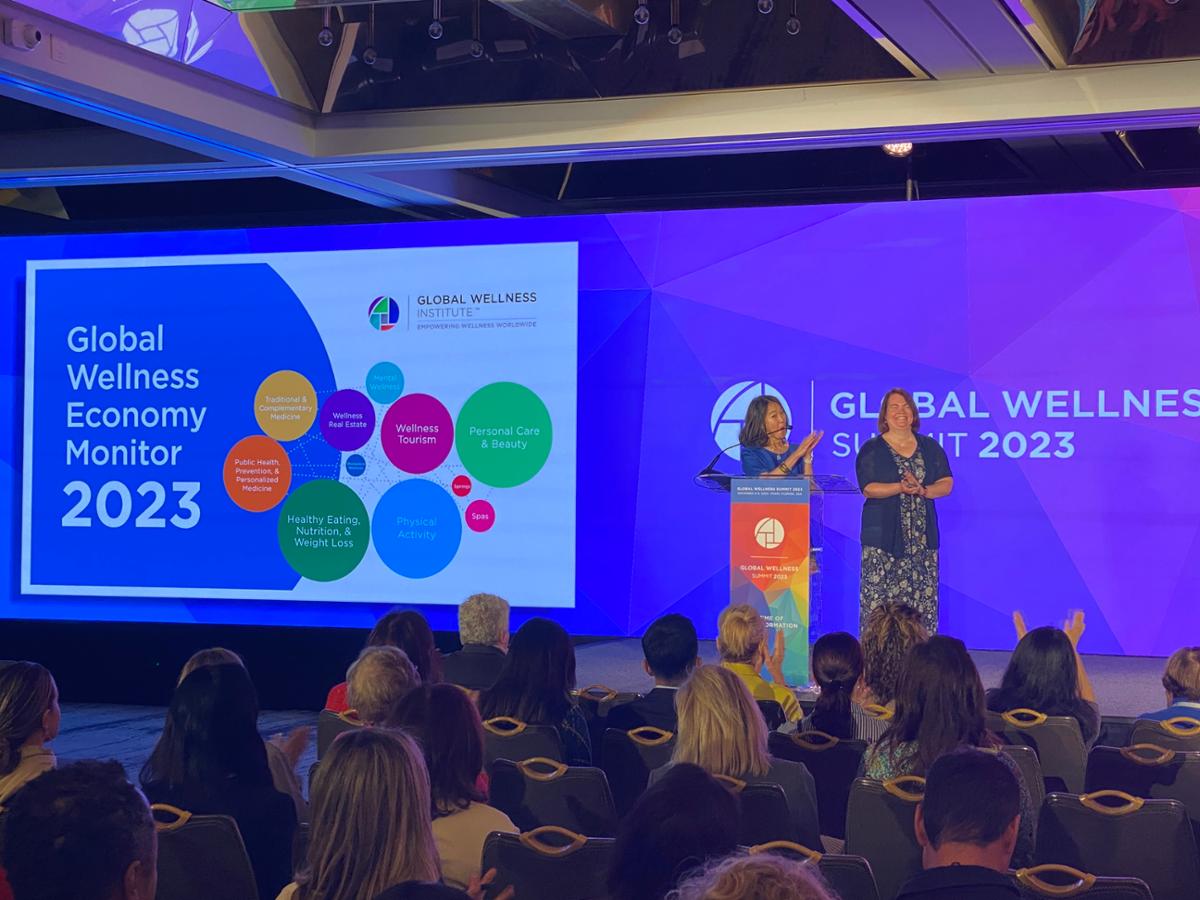
Report co-authors Katherine Johnston, Ophelia Yeung and Tonia Callendar presented the figures live on stage Credit: Liz Terry

Credit: GWI
The global wellness economy has a strong current under its wings
– Ophelia Yeung
GWI reveals the global wellness economy has grown 12 per cent annually since 2020, surpassing the record-breaking 2019 results by 14 per cent
It's forecast to grow another 52 per cent by 2027 and reach US$8.5 trillion – representing 6.6 per cent of global GDP
North America, Asia-Pacific and Europe now make up 90 per cent of the entire wellness market
The GWI will release a Global Wellness Economy Report at every annual GWS going forward
The global wellness economy will be worth US$8.5 trillion by 2027, according to new research unveiled by the Global Wellness Institute (GWI).

Called The Global Wellness Economy 2023, the report was unveiled today on the first day of the 17th annual Global Wellness Summit (GWS), hosted in Miami, Florida.

It is the 10th edition of its kind and illustrates how the market has fared since the massive economic shocks of the pandemic.

It provides numbers and analysis for all 11 wellness sectors, regional data and the top 20 national markets for each wellness sector while exploring the major shifts and trends that will impact each wellness market in the future.

The journey so far
Between 2019 and 2020, the wellness market shrank from US$4.9 trillion to US$4.4 trillion (11 per cent).

It has since grown 27 per cent to reach a record-breaking US$5.6 trillion in 2022, where seven of the 11 wellness sectors now surpass their 2019, pre-pandemic values.

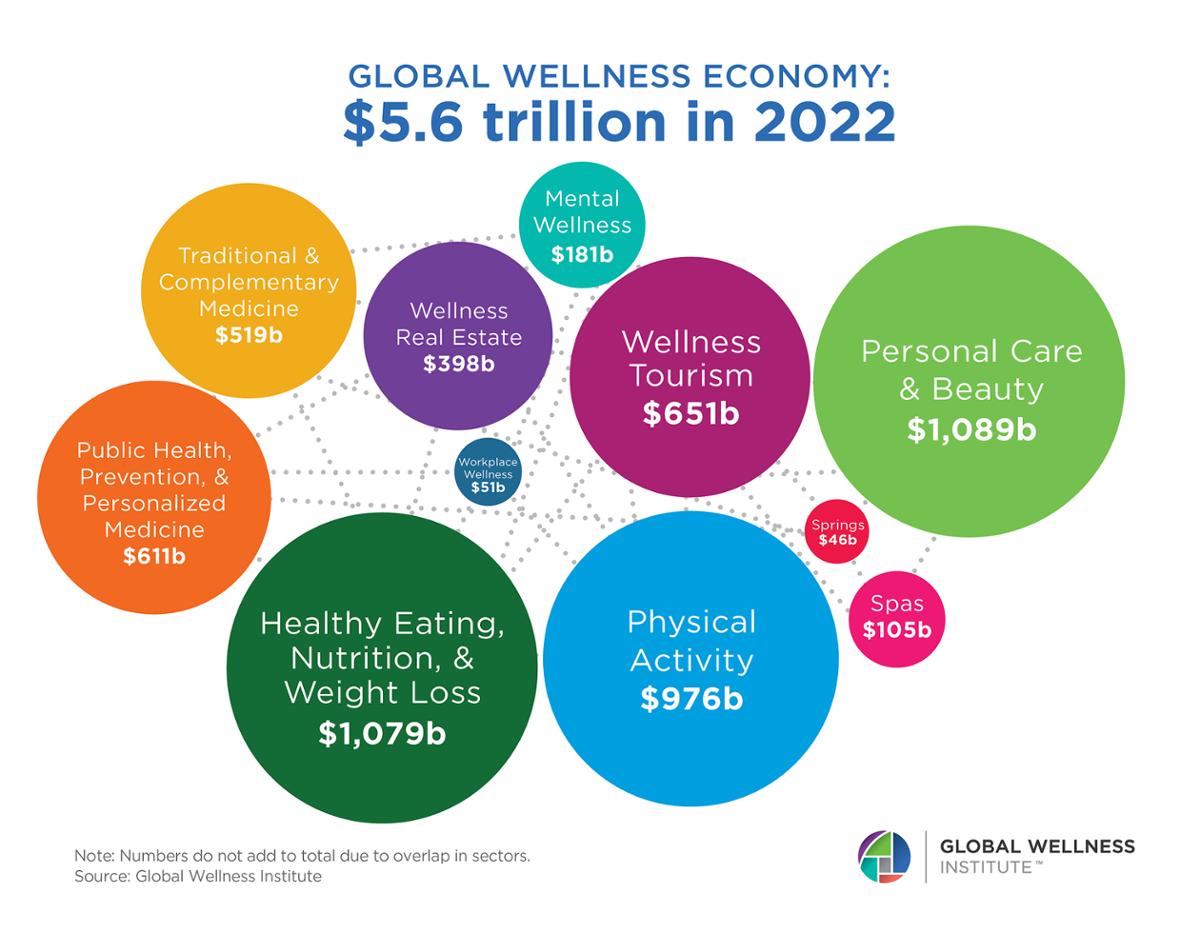
The GWI’s 2022 figures for the 11 sectors are as follows (in ascending order):

• Personal Care and Beauty – US$1.089 trillion (+102 per cent on 2019)

• Healthy Eating, Nutrition and Weight Loss – US$1.079 trillion (+118 per cent on 2019)

• Physical Activity – US$976 billion (+111 per cent on 2019)

• Wellness Tourism – US$651 billion (+90 per cent on 2019)

• Public Health, Prevention and Personalised Medicine – US$611 billion (+171 per cent on 2019)

• Traditional and Complementary Medicine – US$519 billion (+107 per cent on 2019)

• Wellness Real Estate – US$398 billion (+177 per cent on 2019)

• Mental Wellness – US$181 billion (+139 per cent on 2019)

• Spas – US$105 billion (+92 per cent on 2019)

• Workplace Wellness – US$51 billion (+97 per cent on 2019)

• Thermal / Mineral Springs – US$46 billion (+71 per cent on 2019)

“We’re surprised by the resiliency of the global wellness economy, and how quickly it has bounced back from the pandemic,” said Katherine Johnston, GWI senior research fellow and co-author of the report.

“If the pandemic disrupted industry momentum in the short term, it has simultaneously created a dramatic shift in the long-term opportunities and trajectory for wellness.”

The GWI predicts that full recovery for the slightly lagging sectors of Wellness Tourism, Spas and Thermal / Mineral Springs will be swift given pent-up demand, anticipating that the first two categories will surpass their 2019 value by year-end 2023 and the latter by 2024.

Maintaining momentum
The GWI forecasts that the wellness economy will only expand its share of consumer spending and the global economy over the next five years – growing at an annual rate of 8.6 per cent, higher than the projected global GDP growth of 5.1 per cent (IMF forecasts).

The market is slated to reach US$6.3 trillion by the end of 2023 and US$7.4 trillion in 2025, on its march toward US$8.5 trillion in 2027, when it will represent 6.6 per cent of global GDP (vs. 5.6 per cent in 2022).

The biggest projected wellness growth leaders through 2027 are:
• Wellness Real Estate (17.4 per cent annually)
• Wellness Tourism (16.6 per cent annually)
• Thermal/Mineral Springs (14.3 per cent annually)
• Mental Wellness (12.8 per cent annually)

The unusually high future growth rates for Wellness Tourism and Thermal / Mineral Springs reflect a period of continued recovery from 2023-2025.

Regional analysis
Wellness markets in all global regions have fully recovered from the pandemic, but North America (123 per cent of 2019), Middle East-North Africa (119 per cent of 2019) and Europe (114 per cent of 2019) have shown the most powerful growth rates.

In 2022, as countries in Asia suffered prolonged disruptions and lockdowns, the North American market (US$1.9 trillion) surpassed Asia-Pacific (US$1.7 trillion) as the largest regional wellness economy.

These two regions, along with Europe (US$1.5 trillion market), now make up 90 per cent of the entire wellness market.

The report also states that per capita spending on wellness is highest in North America (US$5,108) and Europe (US$1,596).

What’s next for the 11 sectors?
Four wellness sectors – Personal Care & Beauty, Healthy Eating, Nutrition and Weight Loss, Physical Activity, and Wellness Tourism – will exceed US$1 trillion in market size by 2024.

Three sectors are expected to surpass half a trillion dollars in 2024: Wellness Real Estate, Traditional & Complementary Medicine, and Public Health, Prevention and Personalized Medicine.

Healthy Eating, Nutrition and Weight Loss is also expected to leapfrog Personal Care & Beauty to become the largest wellness market by 2025.

Meanwhile, Wellness Real Estate will enter the top five sectors in 2025, and explode from a US$398 billion market in 2022 to US$887.5 billion in 2027.

“The global wellness economy has a strong current under its wings, based on global trends that are only accelerating: an ageing population, rising chronic diseases and mental unwellness, and a shift in consumer values,” said Ophelia Yeung, GWI senior research fellow and paper co-author.

“But it’s also facing some challenging macro conditions like widening wealth gaps, consumer confidence in uncertain economic conditions and rapidly changing geopolitics that will affect the flow of people, capital, technology and ideas. How the wellness economy will do will depend on the interplay of all of these factors.”

To read the full version of the report, click here.

Going forward, the GWI will release a Global Wellness Economy Report at each annual GWS.

The institute will also release Its Country Rankings Report companion research providing market size, rankings, analysis, and per capita wellness spending for 150 nations, on 30 January 2024.

The GWI forecasts that the wellness economy will only expand its share of consumer spending and the global economy over the next five years Credit: GWI
RELATED STORIES
MORE NEWS
Rainer Maelzer joins Therme Group as chief entertainment officer
Rainer Maelzer, an experiential entertainment innovator, has been appointed chief entertainment officer by Therme Group.
Movie Park Germany reveals new Paramount attraction as part of its 30th anniversary celebrations
Movie Park Germany has opened a new Paramount Pictures-themed attraction as part of its 30th anniversary celebrations, using immersive storytelling and adaptive reuse to reinforce the park’s longstanding “Hollywood in Germany” positioning.
Therme Manchester reveals 90:90 strategy – 90 per cent of the UK population within a 90-minute drive of a Therme
Therme Manchester’s 28-acre development, which will include interconnected glass pavilions that measure 65,000sq m, will be the largest bathing and wellbeing attraction in the world once complete, according to prof David Russell, CEO of Therme UK. 
Efteling expands family offer with new Hooghmoed drop tower
Efteling has opened Hooghmoed, a new family drop tower designed to broaden the appeal of its recently launched Sirene Island themed area and introduce younger visitors to thrill attractions.
+ More news   

COMPANY PROFILES
Simworx Ltd

The company was initially established in 1997. Terry Monkton and Andrew Roberts are the key stakeh [more...]
Taylor Made Designs

Founded in 1993, Taylor Made Designs supply corporate clothing and brand-enhancing merchandise to [more...]
Clip 'n Climb

Clip ‘n Climb currently offers facility owners and investors more than 40 colourful and unique Cha [more...]
IAAPA EMEA

IAAPA Expo Europe was established in 2006 and has grown to the largest international conference and [more...]
+ More profiles  
FEATURED SUPPLIER

Iconic Liverpool attraction opens door to new operators
An opportunity to reimagine one of the UK’s most recognisable towers has been formally opened by Rivington Hark, as St Johns Beacon invites operators and partners to shape its next phase. [more...]
CATALOGUE GALLERY
 

+ More catalogues  
DIRECTORY
+ More directory  
DIARY


09-11 Jun 2026

World Sauna Forum 2026

Savutuvan Apaja, Haapaniemi, Finland
23-26 Aug 2026

Elevate Spa Riviera Maya Edition

The Riviera Maya Edition Kanai, Playa del Carmen, Mexico
+ More diary  
LATEST ISSUES
+ View Magazine Archive

Attractions Management

2026 issue 1


View issue contents
View on turning pages
Download PDF
FREE digital subscription
Print subscription

Attractions Management

2025 issue 2


View issue contents
View on turning pages
Download PDF
FREE digital subscription
Print subscription

Attractions Management

2025 issue 1


View issue contents
View on turning pages
Download PDF
FREE digital subscription
Print subscription

Attractions Management

2024 issue 4


View issue contents
View on turning pages
Download PDF
FREE digital subscription
Print subscription

Attractions Management News

06 Apr 2020 issue 153


View on turning pages
Download PDF
View archive
FREE digital subscription
Print subscription

Attractions Handbook

2019


View issue contents
View on turning pages
Download PDF
FREE digital subscription
Print subscription
 
ABOUT LEISURE MEDIA
LEISURE MEDIA MAGAZINES
LEISURE MEDIA HANDBOOKS
LEISURE MEDIA WEBSITES
LEISURE MEDIA PRODUCT SEARCH
 
ATTRACTIONS MANAGEMENT
ATTRACTIONS MANAGEMENT NEWS
ATTRACTIONS HANDBOOK
PRINT SUBSCRIPTIONS
FREE DIGITAL SUBSCRIPTIONS
ADVERTISE . CONTACT US

Leisure Media
Tel: +44 (0)1462 431385

©Cybertrek 2026
Get Attractions Management digital magazine FREE
Sign up here ▸
Jobs    News   Products   Magazine   Subscribe
NEWS
Global wellness economy reaches record-breaking $5.6trn – predicted to hit $8.5trn by 2027
POSTED 07 Nov 2023 . BY Megan Whitby
Report co-authors Katherine Johnston, Ophelia Yeung and Tonia Callendar presented the figures live on stage Credit: Liz Terry
Credit: GWI
The global wellness economy has a strong current under its wings
– Ophelia Yeung
GWI reveals the global wellness economy has grown 12 per cent annually since 2020, surpassing the record-breaking 2019 results by 14 per cent
It's forecast to grow another 52 per cent by 2027 and reach US$8.5 trillion – representing 6.6 per cent of global GDP
North America, Asia-Pacific and Europe now make up 90 per cent of the entire wellness market
The GWI will release a Global Wellness Economy Report at every annual GWS going forward
The global wellness economy will be worth US$8.5 trillion by 2027, according to new research unveiled by the Global Wellness Institute (GWI).

Called The Global Wellness Economy 2023, the report was unveiled today on the first day of the 17th annual Global Wellness Summit (GWS), hosted in Miami, Florida.

It is the 10th edition of its kind and illustrates how the market has fared since the massive economic shocks of the pandemic.

It provides numbers and analysis for all 11 wellness sectors, regional data and the top 20 national markets for each wellness sector while exploring the major shifts and trends that will impact each wellness market in the future.

The journey so far
Between 2019 and 2020, the wellness market shrank from US$4.9 trillion to US$4.4 trillion (11 per cent).

It has since grown 27 per cent to reach a record-breaking US$5.6 trillion in 2022, where seven of the 11 wellness sectors now surpass their 2019, pre-pandemic values.

The GWI’s 2022 figures for the 11 sectors are as follows (in ascending order):

• Personal Care and Beauty – US$1.089 trillion (+102 per cent on 2019)

• Healthy Eating, Nutrition and Weight Loss – US$1.079 trillion (+118 per cent on 2019)

• Physical Activity – US$976 billion (+111 per cent on 2019)

• Wellness Tourism – US$651 billion (+90 per cent on 2019)

• Public Health, Prevention and Personalised Medicine – US$611 billion (+171 per cent on 2019)

• Traditional and Complementary Medicine – US$519 billion (+107 per cent on 2019)

• Wellness Real Estate – US$398 billion (+177 per cent on 2019)

• Mental Wellness – US$181 billion (+139 per cent on 2019)

• Spas – US$105 billion (+92 per cent on 2019)

• Workplace Wellness – US$51 billion (+97 per cent on 2019)

• Thermal / Mineral Springs – US$46 billion (+71 per cent on 2019)

“We’re surprised by the resiliency of the global wellness economy, and how quickly it has bounced back from the pandemic,” said Katherine Johnston, GWI senior research fellow and co-author of the report.

“If the pandemic disrupted industry momentum in the short term, it has simultaneously created a dramatic shift in the long-term opportunities and trajectory for wellness.”

The GWI predicts that full recovery for the slightly lagging sectors of Wellness Tourism, Spas and Thermal / Mineral Springs will be swift given pent-up demand, anticipating that the first two categories will surpass their 2019 value by year-end 2023 and the latter by 2024.

Maintaining momentum
The GWI forecasts that the wellness economy will only expand its share of consumer spending and the global economy over the next five years – growing at an annual rate of 8.6 per cent, higher than the projected global GDP growth of 5.1 per cent (IMF forecasts).

The market is slated to reach US$6.3 trillion by the end of 2023 and US$7.4 trillion in 2025, on its march toward US$8.5 trillion in 2027, when it will represent 6.6 per cent of global GDP (vs. 5.6 per cent in 2022).

The biggest projected wellness growth leaders through 2027 are:
• Wellness Real Estate (17.4 per cent annually)
• Wellness Tourism (16.6 per cent annually)
• Thermal/Mineral Springs (14.3 per cent annually)
• Mental Wellness (12.8 per cent annually)

The unusually high future growth rates for Wellness Tourism and Thermal / Mineral Springs reflect a period of continued recovery from 2023-2025.

Regional analysis
Wellness markets in all global regions have fully recovered from the pandemic, but North America (123 per cent of 2019), Middle East-North Africa (119 per cent of 2019) and Europe (114 per cent of 2019) have shown the most powerful growth rates.

In 2022, as countries in Asia suffered prolonged disruptions and lockdowns, the North American market (US$1.9 trillion) surpassed Asia-Pacific (US$1.7 trillion) as the largest regional wellness economy.

These two regions, along with Europe (US$1.5 trillion market), now make up 90 per cent of the entire wellness market.

The report also states that per capita spending on wellness is highest in North America (US$5,108) and Europe (US$1,596).

What’s next for the 11 sectors?
Four wellness sectors – Personal Care & Beauty, Healthy Eating, Nutrition and Weight Loss, Physical Activity, and Wellness Tourism – will exceed US$1 trillion in market size by 2024.

Three sectors are expected to surpass half a trillion dollars in 2024: Wellness Real Estate, Traditional & Complementary Medicine, and Public Health, Prevention and Personalized Medicine.

Healthy Eating, Nutrition and Weight Loss is also expected to leapfrog Personal Care & Beauty to become the largest wellness market by 2025.

Meanwhile, Wellness Real Estate will enter the top five sectors in 2025, and explode from a US$398 billion market in 2022 to US$887.5 billion in 2027.

“The global wellness economy has a strong current under its wings, based on global trends that are only accelerating: an ageing population, rising chronic diseases and mental unwellness, and a shift in consumer values,” said Ophelia Yeung, GWI senior research fellow and paper co-author.

“But it’s also facing some challenging macro conditions like widening wealth gaps, consumer confidence in uncertain economic conditions and rapidly changing geopolitics that will affect the flow of people, capital, technology and ideas. How the wellness economy will do will depend on the interplay of all of these factors.”

To read the full version of the report, click here.

Going forward, the GWI will release a Global Wellness Economy Report at each annual GWS.

The institute will also release Its Country Rankings Report companion research providing market size, rankings, analysis, and per capita wellness spending for 150 nations, on 30 January 2024.

The GWI forecasts that the wellness economy will only expand its share of consumer spending and the global economy over the next five years Credit: GWI
RELATED STORIES
MORE NEWS
Rainer Maelzer joins Therme Group as chief entertainment officer
Rainer Maelzer, an experiential entertainment innovator, has been appointed chief entertainment officer by Therme Group.
Movie Park Germany reveals new Paramount attraction as part of its 30th anniversary celebrations
Movie Park Germany has opened a new Paramount Pictures-themed attraction as part of its 30th anniversary celebrations, using immersive storytelling and adaptive reuse to reinforce the park’s longstanding “Hollywood in Germany” positioning.
Therme Manchester reveals 90:90 strategy – 90 per cent of the UK population within a 90-minute drive of a Therme
Therme Manchester’s 28-acre development, which will include interconnected glass pavilions that measure 65,000sq m, will be the largest bathing and wellbeing attraction in the world once complete, according to prof David Russell, CEO of Therme UK. 
Efteling expands family offer with new Hooghmoed drop tower
Efteling has opened Hooghmoed, a new family drop tower designed to broaden the appeal of its recently launched Sirene Island themed area and introduce younger visitors to thrill attractions.
Universal and Puy du Fou projects point to rise of Oxford–Cambridge corridor
A proposed Puy du Fou development near Bicester and Universal Destinations and Experiences’ planned resort in Bedford are emerging as part of a wider transformation of the Oxford– Cambridge Growth Corridor into a major centre for UK leisure and tourism inv
Shedd Aquarium upgrades its visitor experience with new Immersion Theater
Shedd Aquarium has opened the Immersion Theater developed in partnership with SimEx- Iwerks, as part of a wider strategy to enhance the guest experience and create additional revenue opportunities.
+ More news   
 
COMPANY PROFILES
Simworx Ltd

The company was initially established in 1997. Terry Monkton and Andrew Roberts are the key stakeh [more...]
Taylor Made Designs

Founded in 1993, Taylor Made Designs supply corporate clothing and brand-enhancing merchandise to [more...]
Clip 'n Climb

Clip ‘n Climb currently offers facility owners and investors more than 40 colourful and unique Cha [more...]
IAAPA EMEA

IAAPA Expo Europe was established in 2006 and has grown to the largest international conference and [more...]
+ More profiles  
FEATURED SUPPLIER

Iconic Liverpool attraction opens door to new operators
An opportunity to reimagine one of the UK’s most recognisable towers has been formally opened by Rivington Hark, as St Johns Beacon invites operators and partners to shape its next phase. [more...]
CATALOGUE GALLERY
+ More catalogues  
DIRECTORY
+ More directory  
DIARY


09-11 Jun 2026

World Sauna Forum 2026

Savutuvan Apaja, Haapaniemi, Finland
23-26 Aug 2026

Elevate Spa Riviera Maya Edition

The Riviera Maya Edition Kanai, Playa del Carmen, Mexico
+ More diary  


ADVERTISE . CONTACT US

Leisure Media
Tel: +44 (0)1462 431385

©Cybertrek 2026

ABOUT LEISURE MEDIA
LEISURE MEDIA MAGAZINES
LEISURE MEDIA HANDBOOKS
LEISURE MEDIA WEBSITES
LEISURE MEDIA PRODUCT SEARCH
ATTRACTIONS MANAGEMENT NEWS
ATTRACTIONS HANDBOOK
PRINT SUBSCRIPTIONS
FREE DIGITAL SUBSCRIPTIONS