Public monument or postmodern pastiche? Towering Dubai Frame opens to public
POSTED 03 Jan 2018 . BY Kim Megson
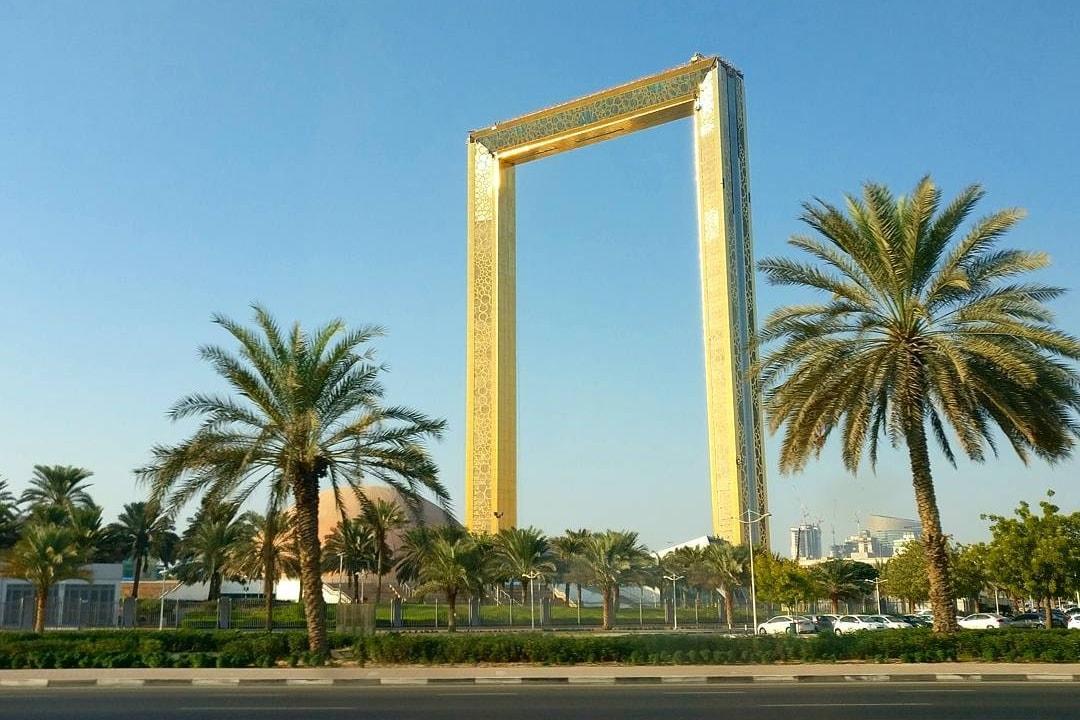
The attraction opened to the public in Dubai at the beginning of January 2018 Credit: Dubai Municipality
The world’s largest frame has opened in Dubai, offering a surreal and symbolic perspective of the emirate’s architectural landmarks.
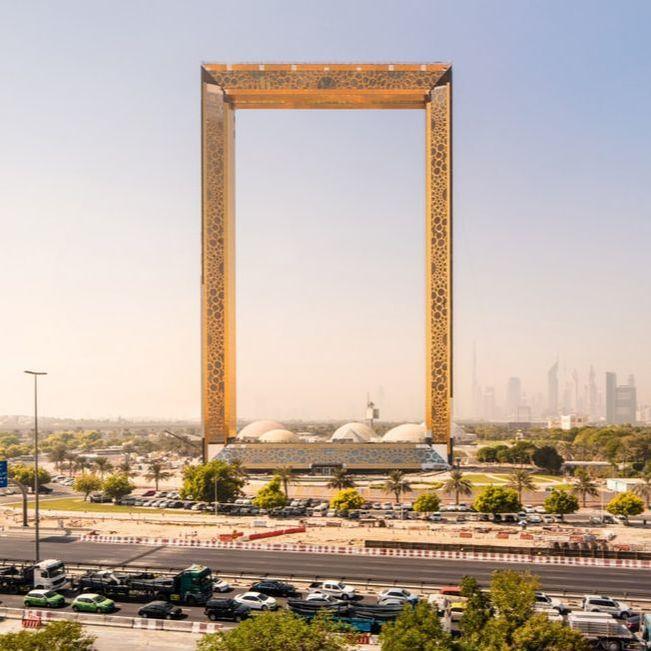
The structure, which measures 150m (492ft) high and 93m (305ft) wide, is formed of two towers in Zabeel Park. The towers are connected by a 100sq m (1,076sq ft) bridge located 48 storeys above the ground, from which visitors can observe the surrounding cityscape. At ground level, the resultant rectangle frames towers including the Burj Khalifa – the world's tallest building.
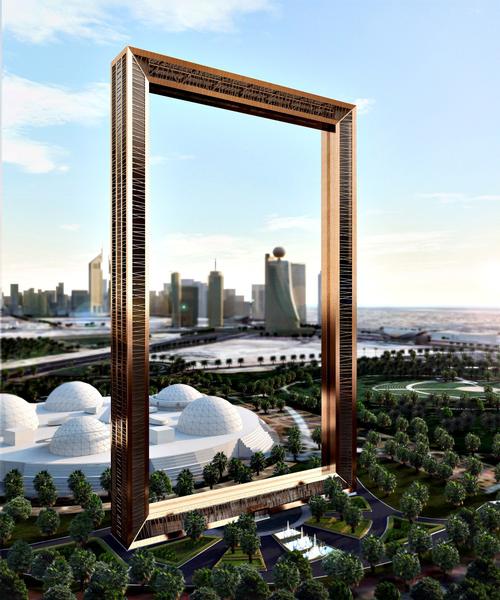
The Dhs160m (US$43.5m, €36.2m, £32.3m) project, called the Dubai Frame, was originally designed by Mexican architect Fernando Donis following an international competition in 2009 – although he has claimed he was pushed aside following the win, with the building redesigned without him.
Elements incorporated since then include the golden-hued exterior, inspired by the logo of the Dubai Expo 2020.
In 2014, Donis warned in an open letter that “the project is being transformed from being non-figurative architecture to an overscale figurative photo frame... That is, from being a modern, public monument to a postmodern pastiche”.
In a recent interview with the Guardian, he said: “They took my project, changed the design and built it without me”, adding “[I] would like it to have been much more subtle, with less décor.”
However, he conceded in the same interview that the result “does precisely what I wanted” and “seems to work on the skyline exactly as we proposed”.
“It is fantastic to see it materialised,” he said.
The Dubai Municipality has previously claimed the Frame will attract as many as two million tourists a year, and a museum on the ground floor has opened showcasing Dubai’s transformation from fishing village to metropolis.
Starting from the mezzanine level, projections, mist effects, smells and motion evoke the feeling of being in old Dubai.
Visitors are taken up to the bridge’s partially glass-floored Sky deck to experience 360-degree views of the present Dubai, with augmented reality activated screens identifying buildings and landmarks.
Finally, they exit via the elevator onto the mezzanine floor and pass through a swirl tunnel with special audio and visual effects designed to create an illusion of time travel taking them into the city 50 years in the future.
A video tour of the new attraction can be viewed below:
There is a museum on the mezzanine level and a Sky deck on the bridge level, 48 storeys above the ground Credit: Dubai Municipality
The Dubai Frame has been designed to create a new perspective of the emirate's architectural landmarks, such as the Burj Khalifa Credit: Dubai Frame Facebook
RELATED STORIES
Architect upset over Dubai Frame design POSTED 06 Jun 2014. BY Katie Buckley Dubai city officials and architect Fernando Donis are at loggerheads following
the unveiling of plans for a unique new attraction in Dubai.
London Museum will open four new food and drink destinations when it launches its new home
at Smithfield on 28 November, making hospitality a central part of the visitor experience at one
of the capital's biggest cultural openings of the year.
OMA has completed a major transformation of New York's New Museum, creating a larger
cultural campus that combines expanded exhibition spaces with learning, performance,
hospitality and public programming.
A US$50 million (£44.2 million, €51.2 million) transformation of Chicago's historic McCormick
Mansion has created a new destination that combines live magic, immersive theatre, dining and
private membership under one roof.
The Montana Historical Society has officially celebrated the opening of its new Montana
Heritage
Center, a US$107 million (£79 million, €92 million) destination that combines immersive
storytelling with cutting-edge audiovisual technology to bring the sta
Public monument or postmodern pastiche? Towering Dubai Frame opens to public
POSTED 03 Jan 2018 . BY Kim Megson
The attraction opened to the public in Dubai at the beginning of January 2018 Credit: Dubai Municipality
The world’s largest frame has opened in Dubai, offering a surreal and symbolic perspective of the emirate’s architectural landmarks.
The structure, which measures 150m (492ft) high and 93m (305ft) wide, is formed of two towers in Zabeel Park. The towers are connected by a 100sq m (1,076sq ft) bridge located 48 storeys above the ground, from which visitors can observe the surrounding cityscape. At ground level, the resultant rectangle frames towers including the Burj Khalifa – the world's tallest building.
The Dhs160m (US$43.5m, €36.2m, £32.3m) project, called the Dubai Frame, was originally designed by Mexican architect Fernando Donis following an international competition in 2009 – although he has claimed he was pushed aside following the win, with the building redesigned without him.
Elements incorporated since then include the golden-hued exterior, inspired by the logo of the Dubai Expo 2020.
In 2014, Donis warned in an open letter that “the project is being transformed from being non-figurative architecture to an overscale figurative photo frame... That is, from being a modern, public monument to a postmodern pastiche”.
In a recent interview with the Guardian, he said: “They took my project, changed the design and built it without me”, adding “[I] would like it to have been much more subtle, with less décor.”
However, he conceded in the same interview that the result “does precisely what I wanted” and “seems to work on the skyline exactly as we proposed”.
“It is fantastic to see it materialised,” he said.
The Dubai Municipality has previously claimed the Frame will attract as many as two million tourists a year, and a museum on the ground floor has opened showcasing Dubai’s transformation from fishing village to metropolis.
Starting from the mezzanine level, projections, mist effects, smells and motion evoke the feeling of being in old Dubai.
Visitors are taken up to the bridge’s partially glass-floored Sky deck to experience 360-degree views of the present Dubai, with augmented reality activated screens identifying buildings and landmarks.
Finally, they exit via the elevator onto the mezzanine floor and pass through a swirl tunnel with special audio and visual effects designed to create an illusion of time travel taking them into the city 50 years in the future.
A video tour of the new attraction can be viewed below:
There is a museum on the mezzanine level and a Sky deck on the bridge level, 48 storeys above the ground Credit: Dubai Municipality
The Dubai Frame has been designed to create a new perspective of the emirate's architectural landmarks, such as the Burj Khalifa Credit: Dubai Frame Facebook
RELATED STORIES
Architect upset over Dubai Frame design POSTED 06 Jun 2014. BY Katie Buckley Dubai city officials and architect Fernando Donis are at loggerheads following
the unveiling of plans for a unique new attraction in Dubai.
London Museum will open four new food and drink destinations when it launches its new home
at Smithfield on 28 November, making hospitality a central part of the visitor experience at one
of the capital's biggest cultural openings of the year.
OMA has completed a major transformation of New York's New Museum, creating a larger
cultural campus that combines expanded exhibition spaces with learning, performance,
hospitality and public programming.
A US$50 million (£44.2 million, €51.2 million) transformation of Chicago's historic McCormick
Mansion has created a new destination that combines live magic, immersive theatre, dining and
private membership under one roof.
The Montana Historical Society has officially celebrated the opening of its new Montana
Heritage
Center, a US$107 million (£79 million, €92 million) destination that combines immersive
storytelling with cutting-edge audiovisual technology to bring the sta
San Antonio Zoo has reported a US$283 million economic impact for 2025, following a decade-
long transformation programme that has seen almost US$200 million invested into the Texas
attraction.