At new children’s museum Eureka! Science + Discovery,
visitors can climb inside a cat, become a bathroom DJ
and get up close with the journey from chew to poo.
Working closely with kids and industry was key to
injecting a real sense of fun, says Yvonne Golds
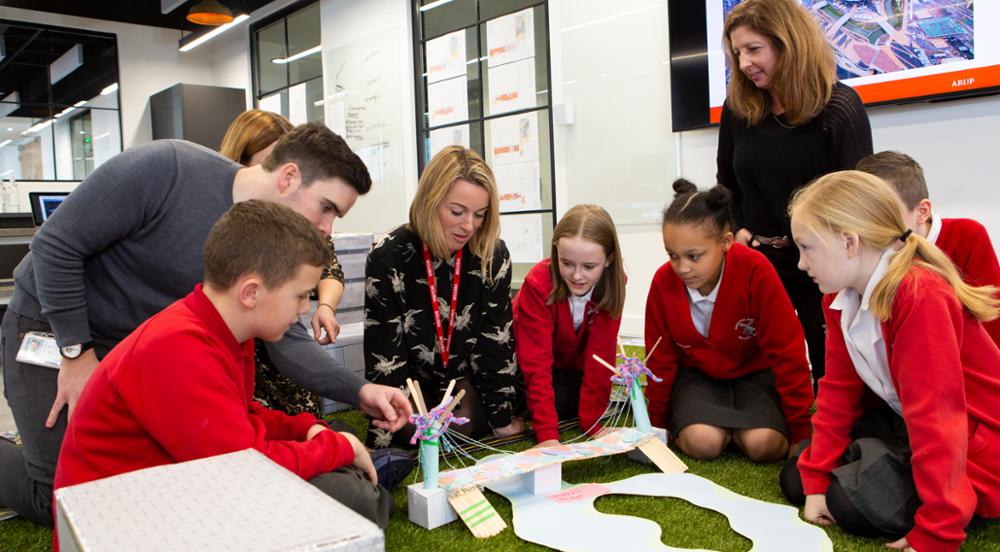
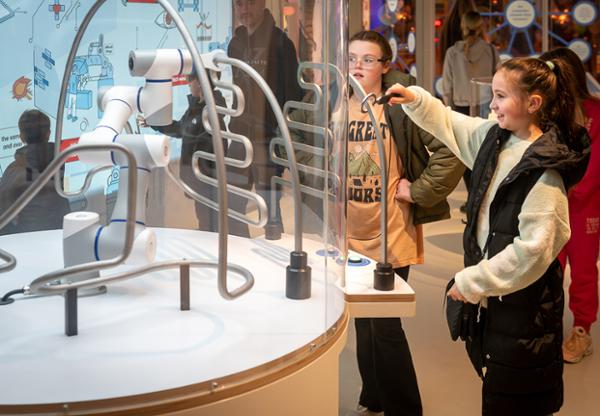
Young people were invited to workshops with industry partners, including Arup / Photo: Eureka Science + Discovery
Opened just before Christmas, Alice in Wonderland-esque children’s museum Eureka! Science + Discovery in Wallasey, Merseyside, UK, aims to bring STEAM subjects to life in a fun, immersive and engaging way.
Sister attraction to the much loved Eureka! The National Children’s Museum in Halifax, which opened in 1992, the new Eureka! Science + Discovery is aimed at six- to 14-year-olds. The attraction’s internal designs were created by K2 Architects, with Real Studios responsible for exhibition design.
The designers didn’t want to try and guess what young people might want from the museum; instead they asked them directly, engaging in a series of workshops between local schoolchildren and industry partners to find out their big questions about STEAM. Partners include Unilever, Sci-tech Daresbury, Arup, Alder Hey Children’s Hospital and Liverpool John Moores University.
Eureka! Science + Discovery’s founding partner is renewable energy company Ørsted.
Real Studios’ Yvonne Golds talks Attractions Management through the highs and lows of this unique project.
How would you sum up Eureka! Science + Discovery? What makes it special? We feel we’ve hit the sweet spot where play and learning intersect. Eureka! Science + Discovery is about engaging children in an exploration of STEAM subjects (science, technology, engineering, arts and mathematics) in a way that’s rigorous, authentic and relevant, while also being visually, mentally and physically immersive.
How did you approach this project? We were brought in four years ago to undertake the interpretive masterplanning and then the design. In the early stages, the process was very much about engaging in workshops and co-creation exercises between the client and various stakeholder groups, including local primary and secondary schools, Liverpool youth group the Hive, and local industry partners.
Our brief was to create a play-based experiential design that delivered on STEAM subjects through three narrative environments – homes, bodies and nature. The experience needed to work undirected without recourse to objects and traditional graphics; it needed to be intuitive, fun and should have no loose parts. It’s an older sibling to the hugely successful Halifax Eureka! where self-guided play-based exploration is at the heart of the centre.
The industry partners – Orsted, ARUP, Sci-Tech Daresbury, Alder Hey, Liverpool John Moores University and Unilever – played an important role in the co-creation process and helped to create and participate in workshops with children and young people; this fed directly into some key exhibits.
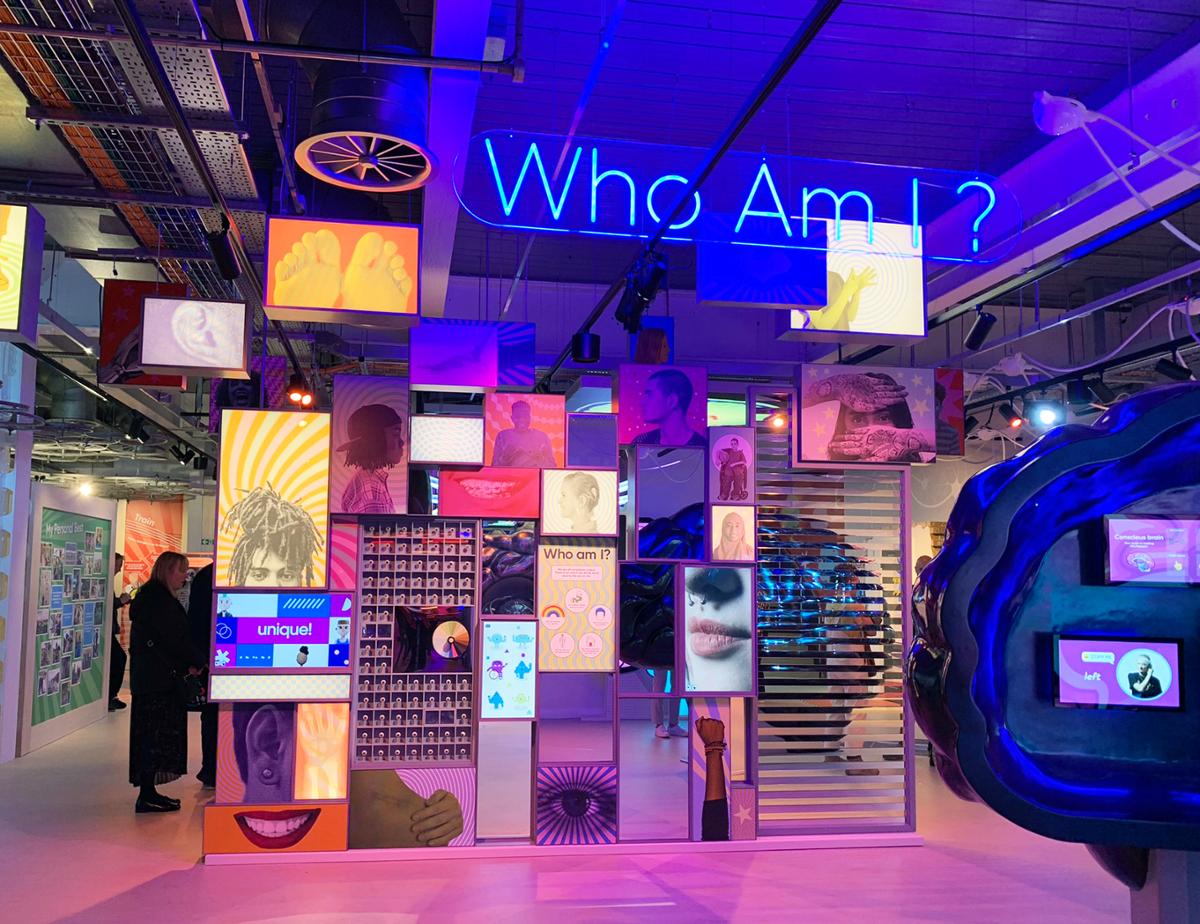
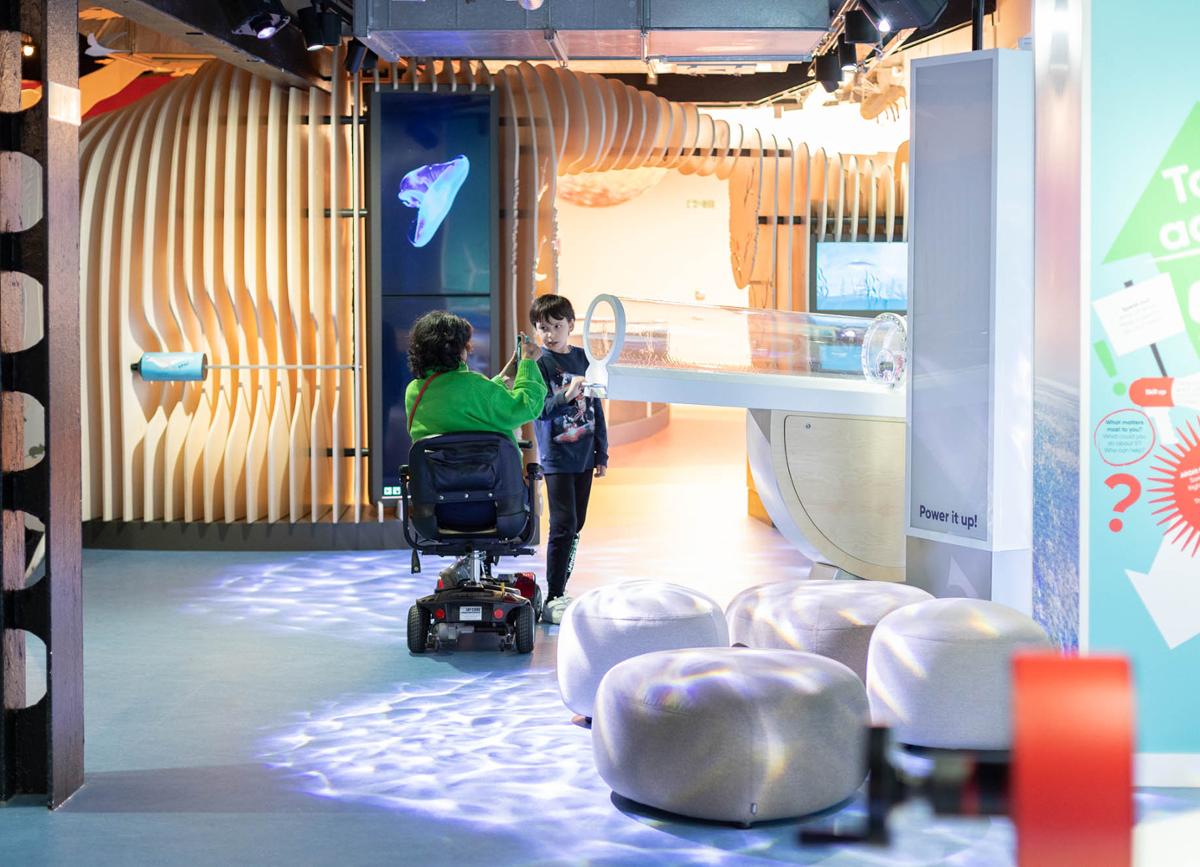
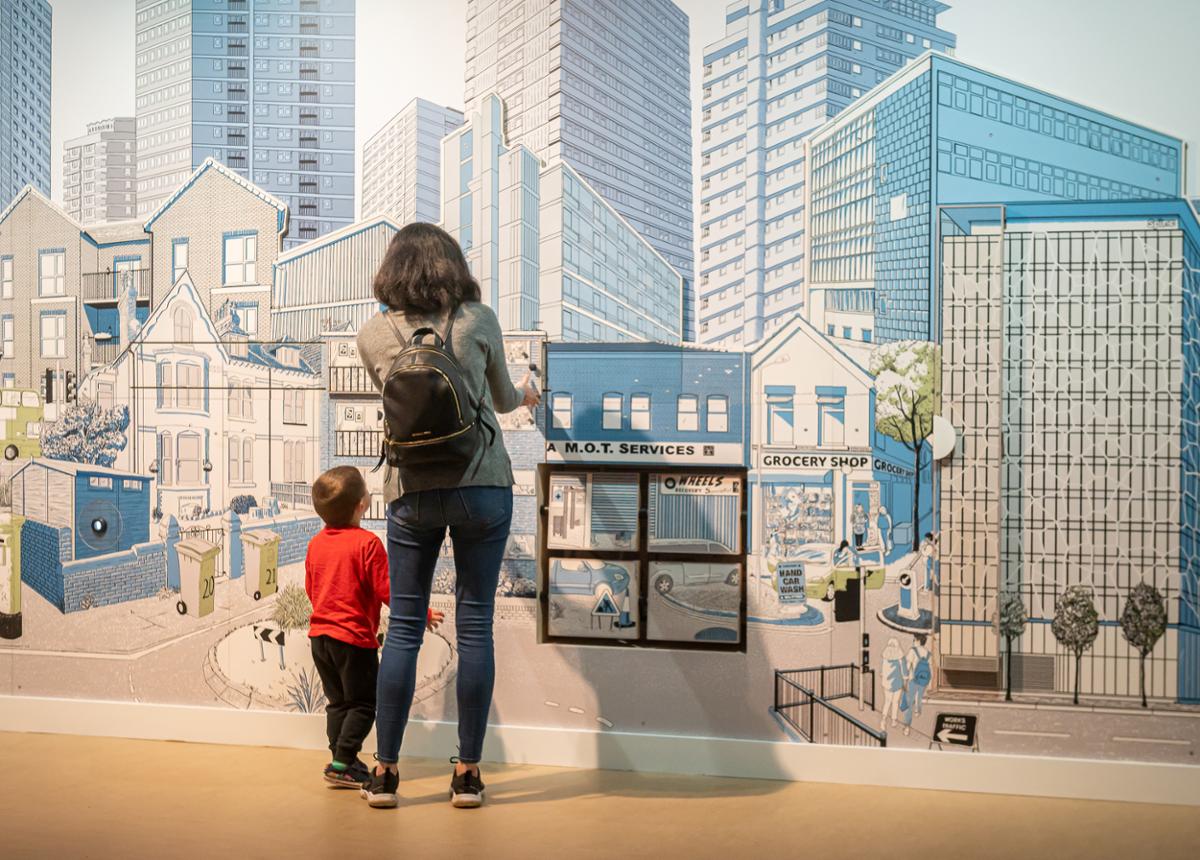
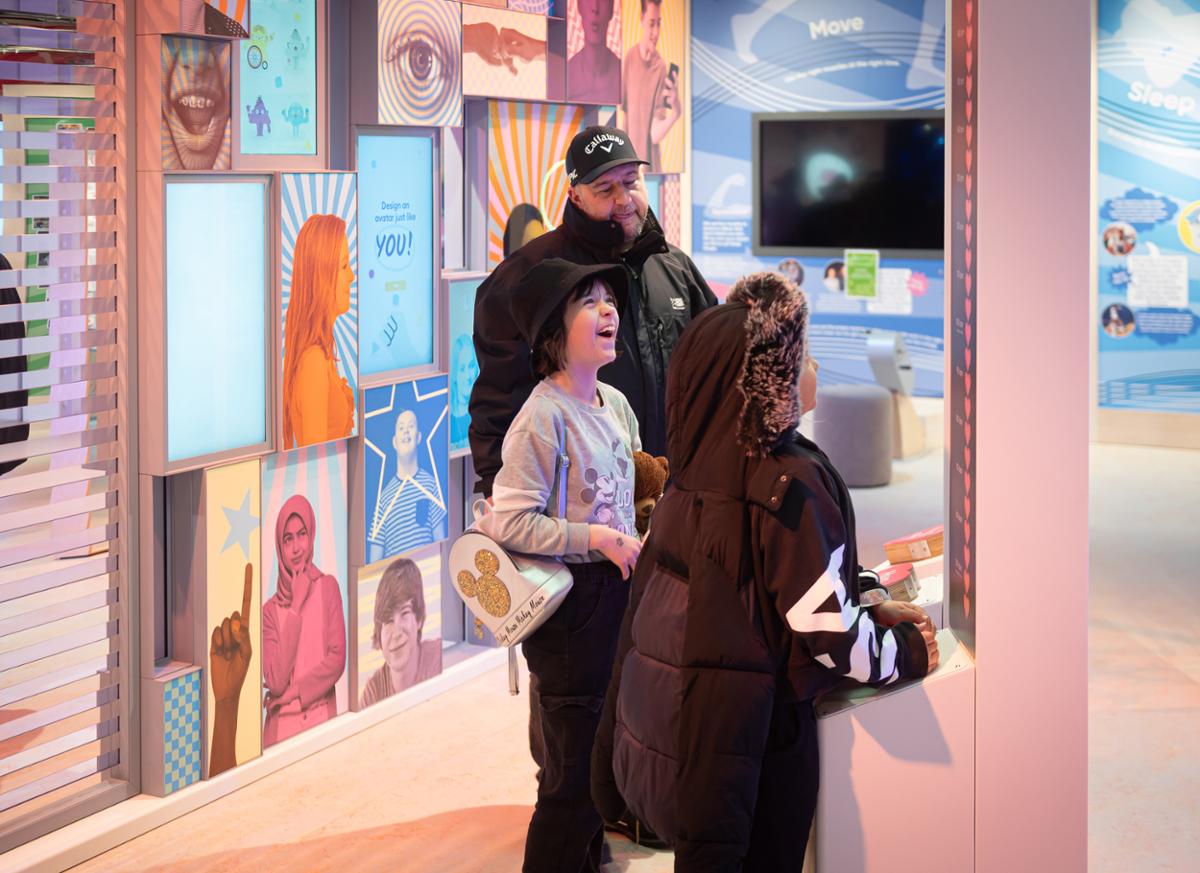
Talk us through the attraction Eureka! Science + Discovery is filled with colourful, hyperreal and overscaled exhibits themed around the three key narratives. To establish each theme, key exhibits act as locators – for the ground floor area exploring the body there’s a huge, full-body MRI scan revealed on overhead lightboxes.
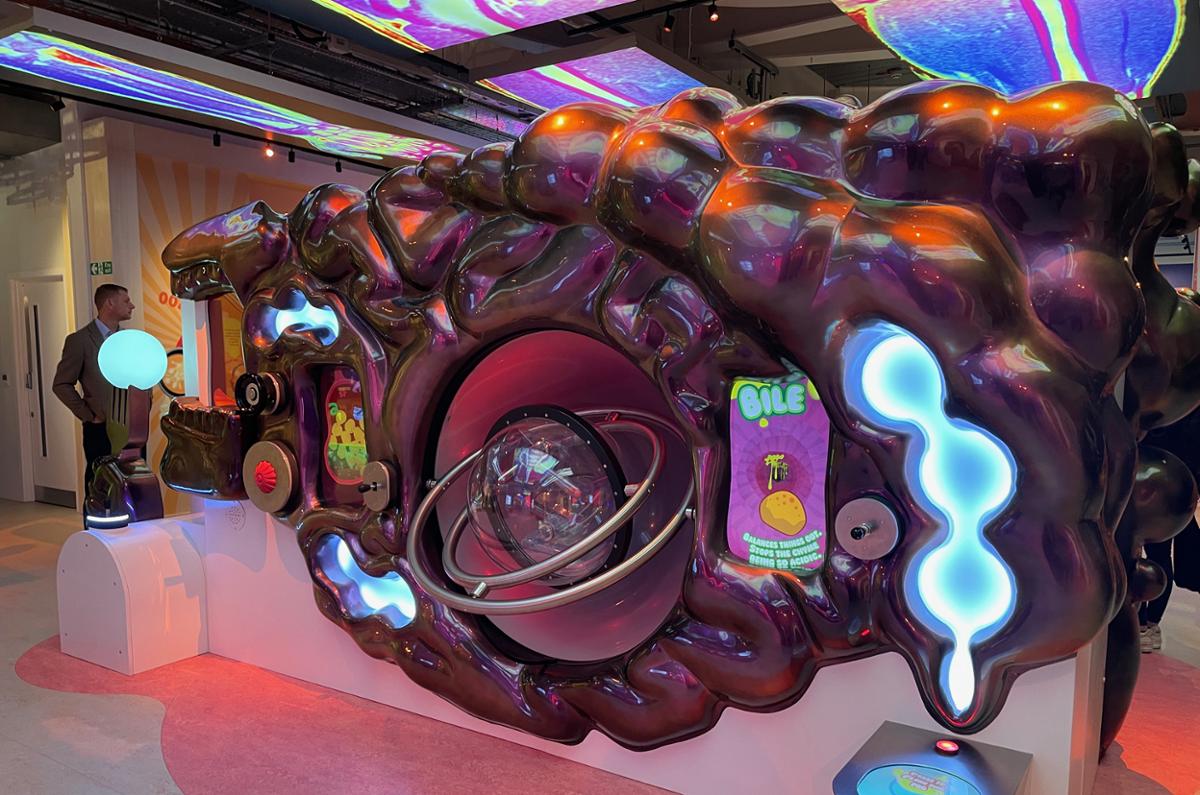
There’s a strong sense of fun, too. In the Body zone, the Chew to Poo exhibit is a supersized display of sculpted digestive organs revealing the complete digestive journey, allowing visitors to feed a giant mouth and see how food is broken down and processed before it emerges at the other end.
Home is a series of recognisable room sets designed to encourage exploration and play, and features a giant pet cat named Luna, whose body you can physically enter in order to see the world as a cat and test your reflexes against those of a typical feline.
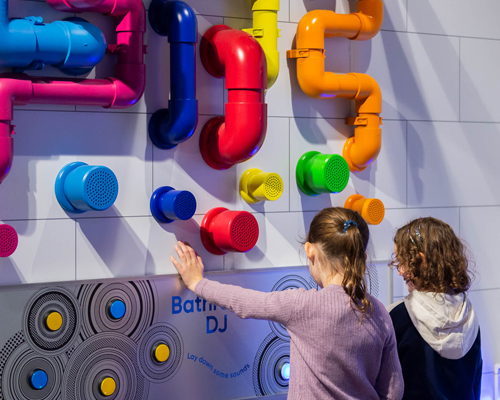
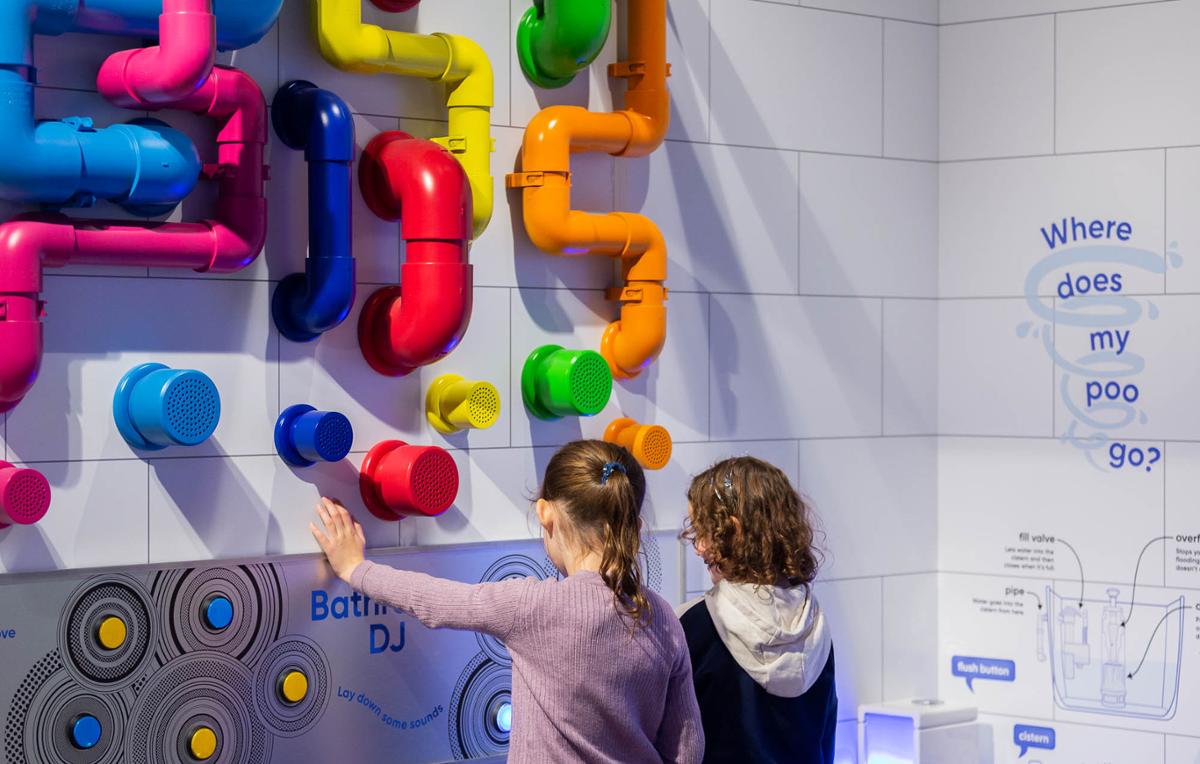
Other highlights in the Home area are an energy game where visitors adjust a series of supersized mechanical devices that ‘use energy’ in the living room to see the impact on overall usage, all viewed on a supersized phone screen, as well as DJ ‘decks’ in the bathroom where you can create music using bathrooms sounds.
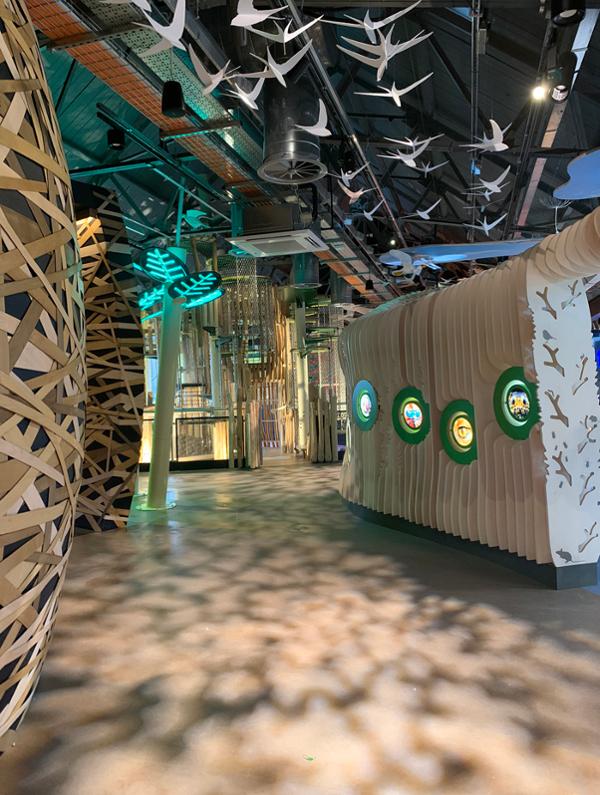
The Nature zone features a woodland walk, bounded by a sculptural, undulating ‘hedge’. Set into the hedge are numerous interactives exploring aspects of nature and those that live there. This section also includes a giant nest structure, housing an immersive film space, and a climbing tree inviting visitors to clamber up several different levels.
What were the biggest challenges? Challenges come in all shapes and sizes; our task is to turn them into opportunities. The co-creation process meant that, for the first year or so of us working on the project, we effectively had a moving brief.
As more data came in we had to review and adjust how we were approaching each topic, but ultimately this was a very rewarding process and has allowed us to design something with real integrity that’s hopefully in tune with the young people visiting.
Delivering an attraction with no loose parts was another challenge – especially for an interactive science and discovery centre; it meant we had to be more creative.
And of course, working through the pandemic brought a whole slew of challenges that we had to navigate as a team.
One of the aims is to get more girls into STEAM subjects – how did you address this? This was a key consideration when putting together co-creation groups. The client team recruited groups of female students as well as other mixed gender groups to gather any specific perspectives that they had.
We also asked STEAM partners to ensure there were female role models participating in the co-creation workshops, including scientists and engineers. And when it came to producing exhibition AV assets, graphics and illustrations, these were delivered to reflect both women and men, as well as gender neutral people.
What did you learn from working with the various partners? Eureka! Science + Discovery’s co-creation model explores the intersection between the lives and interests of the co-creators: the young people from the community; STEAM partners from local growth industries and the education sector – and the Eureka! team.
The programme began with a series of meetings in which young people explored their big questions about STEAM, and local STEAM partners explored four questions relating to their business: Who works here? What are the big local projects you’re working on? What are the significant global projects you’re working on? What are the big challenges or important questions you want to answer through your work?
Following the development meetings, STEAM partners were paired with groups of children and young people and worked together on a series of enquiry-based learning projects, supported and co-ordinated by Eureka! The exhibition content, design and visitor experience at the new attraction all have their origins in the ideas collectively generated and developed through this iterative process of co-creation over several years.
The process was an invaluable experience and very real in terms of these young people having a say in what content we included in the spaces.
There are no introductory panels and very few objects in cases. Why was that important? Eureka!’s DNA is very different from most of the other clients we’ve worked with. It doesn’t hold a collection, but rather explore topics through experiential spaces and the it does this is by enabling the children to engage in playful interactions.
This project gave us an opportunity to put aside any form of didactic approach and think outside the box when it came to drawing people in, getting them engaged and allowing them to determine their own outcomes.
A good example of this is the design of three pinball machines showing ways the body defends itself against infection. Each demonstrates a different defence mechanism, including tears and sneezing, nose hairs, scabs and white blood cells.
How is technology used? We wanted to use technology in a way that doesn’t just entertain but really adds insight and engagement in real-world topics. The industry partners were a real asset and brought valuable knowledge.
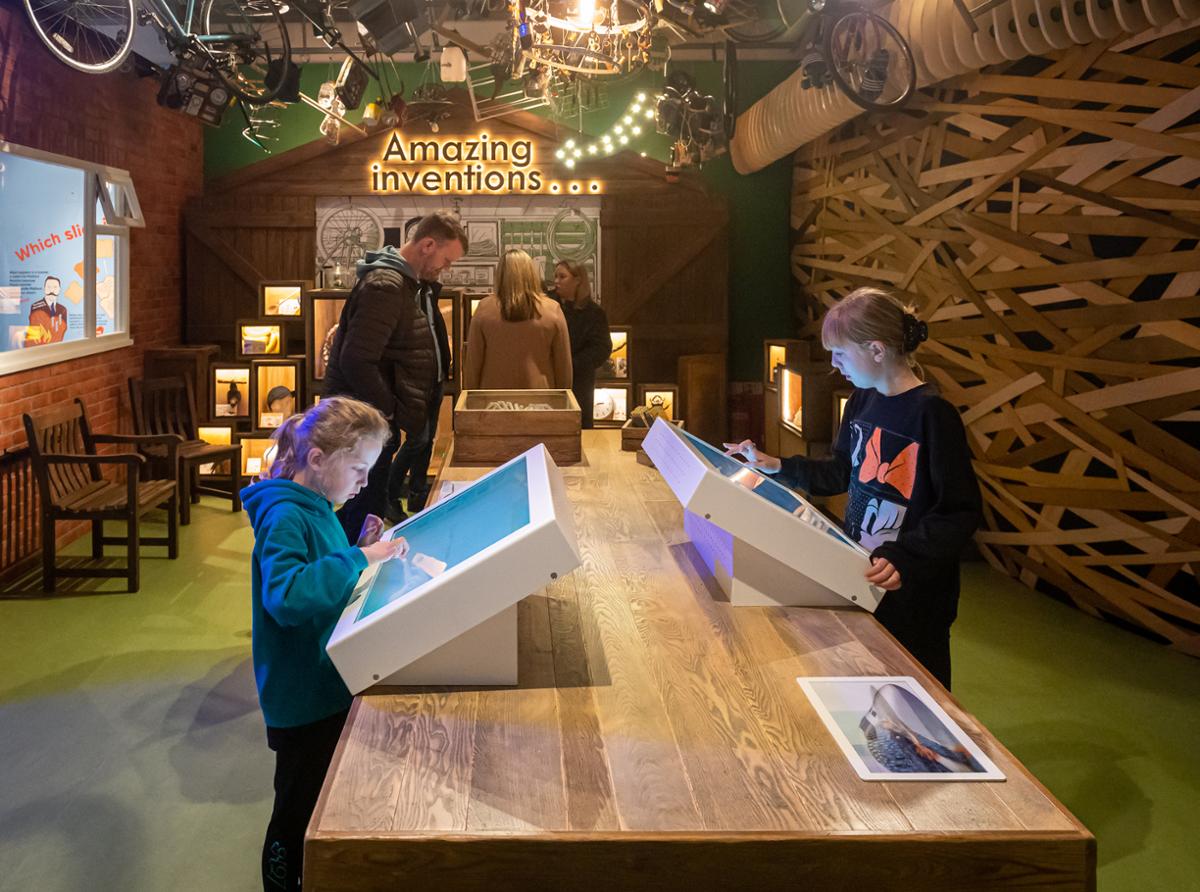
In the Home area there’s a staircase with a workstation tucked underneath it. Here visitors can play a video game that encourages them to design a staircase. We developed this with Arup so the actual engineering aspects are authentic.
To make it fun, we also brought in software designers to make the whole story of staircase construction more interesting, developing different narratives and avatars – for example, in one scenario you need to build a staircase to cross a field of lava and make it back to your space rocket.
How do you design an immersive experience? Essentially we’re transporting you to another place. At Eureka! Science + Discovery we drop people into an immersive experience right from the get-go with worlds ranging from being inside you own body to chasing through the forest with your dog.
It’s about believability and skilful use of everything in our toolkit, seamlessly knitting together the 3D aspects with graphics and software. It’s also about how you move from one area to the next and in this project, we played with a choreography of scales and activities to emphasise the sense of zooming in and out of subjects.
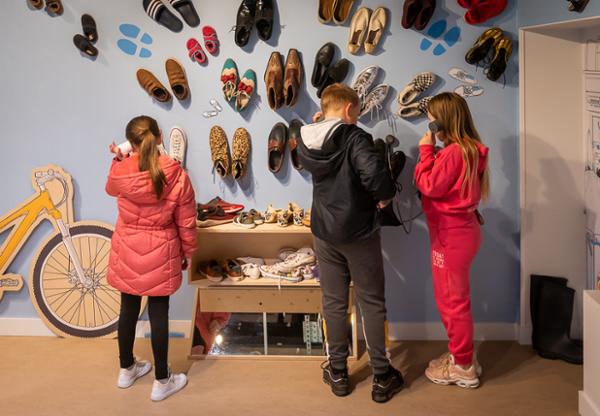
In the home zone bathroom, after you’ve composed a track from bathroom sounds as a bathroom DJ, you can hop into a lab-style inventors’ area inside a giant bathroom cabinet and create your own toothpaste. Next is an over-scaled, 3D mouth and a ‘smile wall’, with video showing how to clean your teeth.
We also wanted to offer photo opportunities. The hope is that social-media-savvy young people will have a blast interacting with each area and their friends.
We tried to put ourselves in young people’s shoes, never patronising them and avoiding obvious childish tropes such as primary colours and anthropomorphised animals. And of course, remembering to have a sense of humour.
What else are you working on? Opening in 2023 are new displays at The Portland Collection and the Sands of Speed museum, both in the UK and F1 The Exhibition, a touring exhibition opening in Madrid in March.
"We tried to put ourselves in the young people’s shoes, never patronising them and avoiding obvious childish tropes, such as primary colours and anthropomorphised animals" – Yvonne Golds, creative director at Real Studios
Read more from this issue of Attractions Management magazine
View contents of Attractions Management 2023 issue 1
Editor's letter: The power of stories
We think we understand the value of storytelling, but do we really? It’s important to be clear on what it contributes to our industry, says Magali Robathan
People: Simon Daniels
The director of the Handel & Hendrix in London attraction on the £3m revamp aiming to bring visitors closer to the musicians
People: Jacqueline Stewart
The president of the Academy Museum of Motion Pictures on honouring the stars of Black cinema
Interview: Tom Lochtefeld
The ‘father of artificial surf parks’ changed the industry with his pioneering sheet waves. Now he’s back to shake things up again with new deep water wave technology
Talking point: Storytime
How can we use the power of story to connect to guests and create better attractions? We ask the experts
Interview: Brian Zimmerman
The world’s fifth biggest zoo closed its doors in September 2022. We go behind the scenes of the Bristol Zoological Society to find out what happens next
Sponsored: No matter the venue aquatic play delivers
Aquatic play helps keep kids happy,
resulting in higher spend from families.
WhiteWater’s Cassidy Newman shares some
of the attractions using aquatic play to
bring in more visitors and increase spend
Science centre: Eureka!
How the new science centre consulted with young people and industry to bring a quirky sense of fun to STEAM
Museums: New museums
From a Bangalore photography and art museum to the Grand Egyptian Museum in Cairo, we review some exciting openings for 2023
Marketing: Screaming for screening
With its edgy brand and young visitor base, Merlin’s London Dungeon was a natural choice for an innovative marketing campaign aiming to take the stigma out of STI testing
Research: On the right track
After a rollercoaster ride, US theme parks are bouncing back, with opportunities for growth driven by gaming IPs, says Mintel
Visitor centre: Fish tale
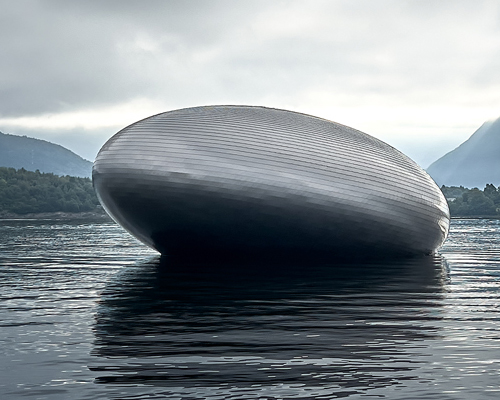
A floating visitor attraction in Norway has been designed to promote fish farming, as Magali Robathan discovered
At new children’s museum Eureka! Science + Discovery,
visitors can climb inside a cat, become a bathroom DJ
and get up close with the journey from chew to poo.
Working closely with kids and industry was key to
injecting a real sense of fun, says Yvonne Golds
Young people were invited to workshops with industry partners, including Arup / Photo: Eureka Science + Discovery
Opened just before Christmas, Alice in Wonderland-esque children’s museum Eureka! Science + Discovery in Wallasey, Merseyside, UK, aims to bring STEAM subjects to life in a fun, immersive and engaging way.
Sister attraction to the much loved Eureka! The National Children’s Museum in Halifax, which opened in 1992, the new Eureka! Science + Discovery is aimed at six- to 14-year-olds. The attraction’s internal designs were created by K2 Architects, with Real Studios responsible for exhibition design.
The designers didn’t want to try and guess what young people might want from the museum; instead they asked them directly, engaging in a series of workshops between local schoolchildren and industry partners to find out their big questions about STEAM. Partners include Unilever, Sci-tech Daresbury, Arup, Alder Hey Children’s Hospital and Liverpool John Moores University.
Eureka! Science + Discovery’s founding partner is renewable energy company Ørsted.
Real Studios’ Yvonne Golds talks Attractions Management through the highs and lows of this unique project.
How would you sum up Eureka! Science + Discovery? What makes it special? We feel we’ve hit the sweet spot where play and learning intersect. Eureka! Science + Discovery is about engaging children in an exploration of STEAM subjects (science, technology, engineering, arts and mathematics) in a way that’s rigorous, authentic and relevant, while also being visually, mentally and physically immersive.
How did you approach this project? We were brought in four years ago to undertake the interpretive masterplanning and then the design. In the early stages, the process was very much about engaging in workshops and co-creation exercises between the client and various stakeholder groups, including local primary and secondary schools, Liverpool youth group the Hive, and local industry partners.
Our brief was to create a play-based experiential design that delivered on STEAM subjects through three narrative environments – homes, bodies and nature. The experience needed to work undirected without recourse to objects and traditional graphics; it needed to be intuitive, fun and should have no loose parts. It’s an older sibling to the hugely successful Halifax Eureka! where self-guided play-based exploration is at the heart of the centre.
The industry partners – Orsted, ARUP, Sci-Tech Daresbury, Alder Hey, Liverpool John Moores University and Unilever – played an important role in the co-creation process and helped to create and participate in workshops with children and young people; this fed directly into some key exhibits.
Talk us through the attraction Eureka! Science + Discovery is filled with colourful, hyperreal and overscaled exhibits themed around the three key narratives. To establish each theme, key exhibits act as locators – for the ground floor area exploring the body there’s a huge, full-body MRI scan revealed on overhead lightboxes.
There’s a strong sense of fun, too. In the Body zone, the Chew to Poo exhibit is a supersized display of sculpted digestive organs revealing the complete digestive journey, allowing visitors to feed a giant mouth and see how food is broken down and processed before it emerges at the other end.
Home is a series of recognisable room sets designed to encourage exploration and play, and features a giant pet cat named Luna, whose body you can physically enter in order to see the world as a cat and test your reflexes against those of a typical feline.
Other highlights in the Home area are an energy game where visitors adjust a series of supersized mechanical devices that ‘use energy’ in the living room to see the impact on overall usage, all viewed on a supersized phone screen, as well as DJ ‘decks’ in the bathroom where you can create music using bathrooms sounds.
The Nature zone features a woodland walk, bounded by a sculptural, undulating ‘hedge’. Set into the hedge are numerous interactives exploring aspects of nature and those that live there. This section also includes a giant nest structure, housing an immersive film space, and a climbing tree inviting visitors to clamber up several different levels.
What were the biggest challenges? Challenges come in all shapes and sizes; our task is to turn them into opportunities. The co-creation process meant that, for the first year or so of us working on the project, we effectively had a moving brief.
As more data came in we had to review and adjust how we were approaching each topic, but ultimately this was a very rewarding process and has allowed us to design something with real integrity that’s hopefully in tune with the young people visiting.
Delivering an attraction with no loose parts was another challenge – especially for an interactive science and discovery centre; it meant we had to be more creative.
And of course, working through the pandemic brought a whole slew of challenges that we had to navigate as a team.
One of the aims is to get more girls into STEAM subjects – how did you address this? This was a key consideration when putting together co-creation groups. The client team recruited groups of female students as well as other mixed gender groups to gather any specific perspectives that they had.
We also asked STEAM partners to ensure there were female role models participating in the co-creation workshops, including scientists and engineers. And when it came to producing exhibition AV assets, graphics and illustrations, these were delivered to reflect both women and men, as well as gender neutral people.
What did you learn from working with the various partners? Eureka! Science + Discovery’s co-creation model explores the intersection between the lives and interests of the co-creators: the young people from the community; STEAM partners from local growth industries and the education sector – and the Eureka! team.
The programme began with a series of meetings in which young people explored their big questions about STEAM, and local STEAM partners explored four questions relating to their business: Who works here? What are the big local projects you’re working on? What are the significant global projects you’re working on? What are the big challenges or important questions you want to answer through your work?
Following the development meetings, STEAM partners were paired with groups of children and young people and worked together on a series of enquiry-based learning projects, supported and co-ordinated by Eureka! The exhibition content, design and visitor experience at the new attraction all have their origins in the ideas collectively generated and developed through this iterative process of co-creation over several years.
The process was an invaluable experience and very real in terms of these young people having a say in what content we included in the spaces.
There are no introductory panels and very few objects in cases. Why was that important? Eureka!’s DNA is very different from most of the other clients we’ve worked with. It doesn’t hold a collection, but rather explore topics through experiential spaces and the it does this is by enabling the children to engage in playful interactions.
This project gave us an opportunity to put aside any form of didactic approach and think outside the box when it came to drawing people in, getting them engaged and allowing them to determine their own outcomes.
A good example of this is the design of three pinball machines showing ways the body defends itself against infection. Each demonstrates a different defence mechanism, including tears and sneezing, nose hairs, scabs and white blood cells.
How is technology used? We wanted to use technology in a way that doesn’t just entertain but really adds insight and engagement in real-world topics. The industry partners were a real asset and brought valuable knowledge.
In the Home area there’s a staircase with a workstation tucked underneath it. Here visitors can play a video game that encourages them to design a staircase. We developed this with Arup so the actual engineering aspects are authentic.
To make it fun, we also brought in software designers to make the whole story of staircase construction more interesting, developing different narratives and avatars – for example, in one scenario you need to build a staircase to cross a field of lava and make it back to your space rocket.
How do you design an immersive experience? Essentially we’re transporting you to another place. At Eureka! Science + Discovery we drop people into an immersive experience right from the get-go with worlds ranging from being inside you own body to chasing through the forest with your dog.
It’s about believability and skilful use of everything in our toolkit, seamlessly knitting together the 3D aspects with graphics and software. It’s also about how you move from one area to the next and in this project, we played with a choreography of scales and activities to emphasise the sense of zooming in and out of subjects.
In the home zone bathroom, after you’ve composed a track from bathroom sounds as a bathroom DJ, you can hop into a lab-style inventors’ area inside a giant bathroom cabinet and create your own toothpaste. Next is an over-scaled, 3D mouth and a ‘smile wall’, with video showing how to clean your teeth.
We also wanted to offer photo opportunities. The hope is that social-media-savvy young people will have a blast interacting with each area and their friends.
We tried to put ourselves in young people’s shoes, never patronising them and avoiding obvious childish tropes such as primary colours and anthropomorphised animals. And of course, remembering to have a sense of humour.
What else are you working on? Opening in 2023 are new displays at The Portland Collection and the Sands of Speed museum, both in the UK and F1 The Exhibition, a touring exhibition opening in Madrid in March.
"We tried to put ourselves in the young people’s shoes, never patronising them and avoiding obvious childish tropes, such as primary colours and anthropomorphised animals" – Yvonne Golds, creative director at Real Studios
Read more from this issue of Attractions Management magazine
View contents of Attractions Management 2023 issue 1
Editor's letter: The power of stories
We think we understand the value of storytelling, but do we really? It’s important to be clear on what it contributes to our industry, says Magali Robathan
People: Simon Daniels
The director of the Handel & Hendrix in London attraction on the £3m revamp aiming to bring visitors closer to the musicians
People: Jacqueline Stewart
The president of the Academy Museum of Motion Pictures on honouring the stars of Black cinema
Interview: Tom Lochtefeld
The ‘father of artificial surf parks’ changed the industry with his pioneering sheet waves. Now he’s back to shake things up again with new deep water wave technology
Talking point: Storytime
How can we use the power of story to connect to guests and create better attractions? We ask the experts
Interview: Brian Zimmerman
The world’s fifth biggest zoo closed its doors in September 2022. We go behind the scenes of the Bristol Zoological Society to find out what happens next
Sponsored: No matter the venue aquatic play delivers
Aquatic play helps keep kids happy,
resulting in higher spend from families.
WhiteWater’s Cassidy Newman shares some
of the attractions using aquatic play to
bring in more visitors and increase spend
Science centre: Eureka!
How the new science centre consulted with young people and industry to bring a quirky sense of fun to STEAM
Museums: New museums
From a Bangalore photography and art museum to the Grand Egyptian Museum in Cairo, we review some exciting openings for 2023
Marketing: Screaming for screening
With its edgy brand and young visitor base, Merlin’s London Dungeon was a natural choice for an innovative marketing campaign aiming to take the stigma out of STI testing
Research: On the right track
After a rollercoaster ride, US theme parks are bouncing back, with opportunities for growth driven by gaming IPs, says Mintel
Visitor centre: Fish tale
A floating visitor attraction in Norway has been designed to promote fish farming, as Magali Robathan discovered
London Museum will open four new food and drink destinations when it launches its new home
at Smithfield on 28 November, making hospitality a central part of the visitor experience at one
of the capital's biggest cultural openings of the year.
OMA has completed a major transformation of New York's New Museum, creating a larger
cultural campus that combines expanded exhibition spaces with learning, performance,
hospitality and public programming.
A US$50 million (£44.2 million, €51.2 million) transformation of Chicago's historic McCormick
Mansion has created a new destination that combines live magic, immersive theatre, dining and
private membership under one roof.
The Montana Historical Society has officially celebrated the opening of its new Montana
Heritage
Center, a US$107 million (£79 million, €92 million) destination that combines immersive
storytelling with cutting-edge audiovisual technology to bring the sta
San Antonio Zoo has reported a US$283 million economic impact for 2025, following a decade-
long transformation programme that has seen almost US$200 million invested into the Texas
attraction.
Plans for the AU$180 million redevelopment of Reef HQ Aquarium in Townsville, Australia, are
progressing, with the project set to transform the attraction into a global centre for reef
education and conservation.
Abu Dhabi-based investment firm Mubadala Capital has made a binding, fully financed
€1 billion
offer to acquire Pierre and Vacances SA, the European holiday resort operator behind the
continental European Center Parcs business.
Disney has reaffirmed its commitment to investing US$30 billion in its US parks and cruise
business by 2033, using new America250 celebrations to underline the role its attractions play
in supporting jobs, tourism and economic growth.
Expo 2030 Riyadh is being planned as a permanent visitor destination, with organisers
confirming the six-million-square-metre site will become a Global Village after the event closes.
The owner of one of Australia's best-known waterparks has acquired a major competitor,
creating a new attractions business spanning two of the country's largest visitor destinations.