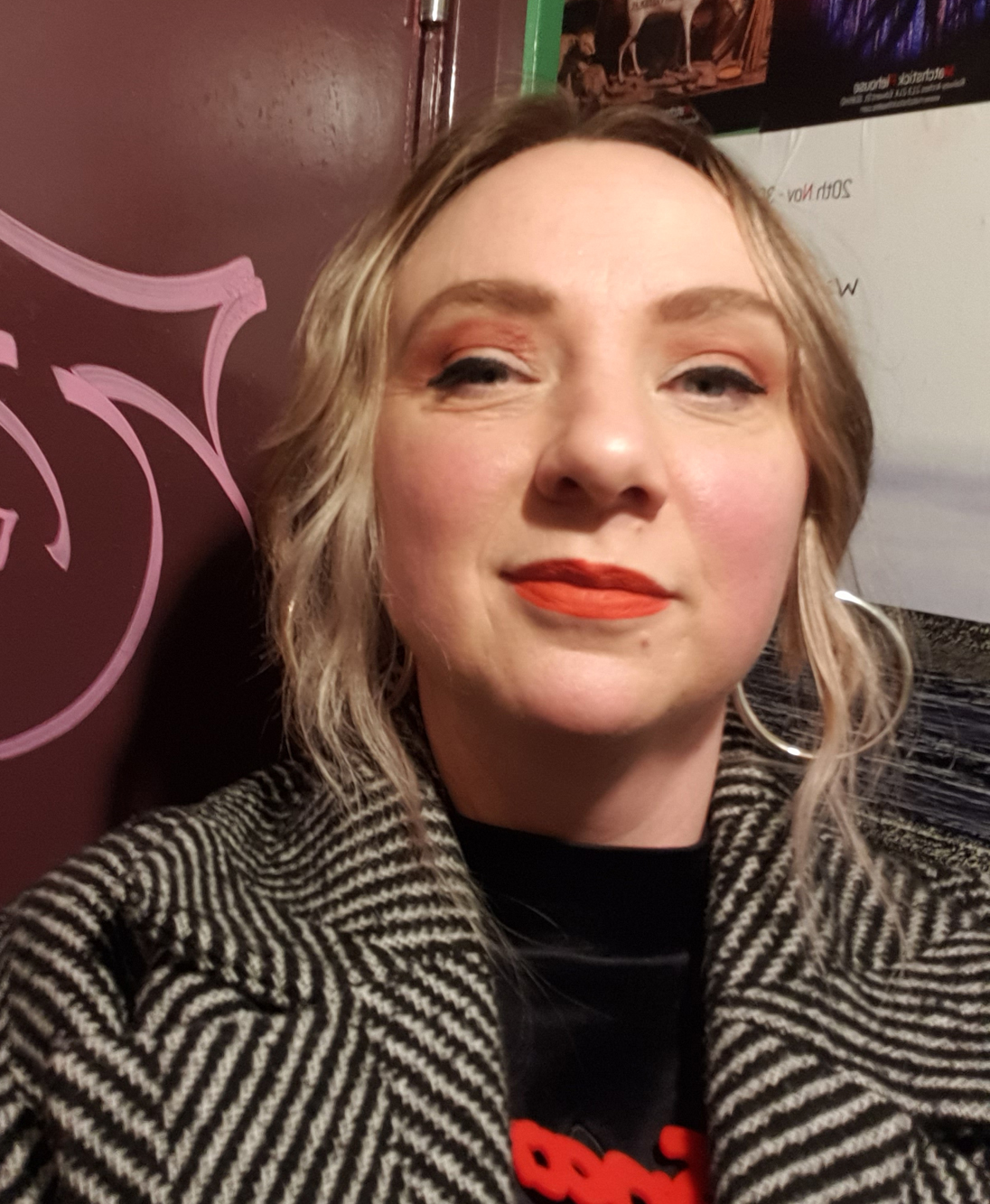
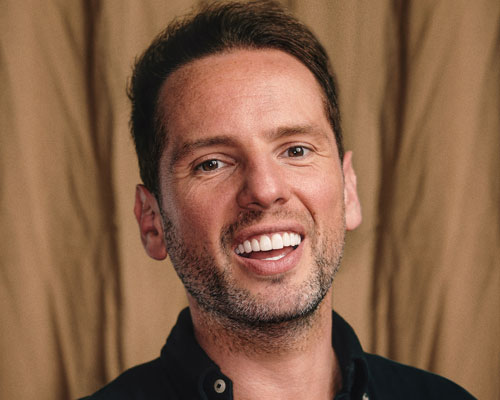
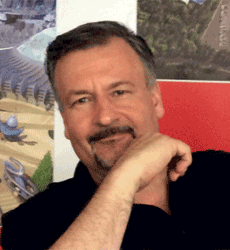
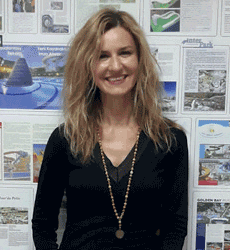
Husband and wife team Jess and Matt Turtle founded the Museum of Homelessness in 2014 / Photo: Anthony Luvera
A decade after it launched, the Museum of Homelessness (MoH) is opening its first physical location in a former gatekeeper’s cottage in Finsbury Park, London, with an exhibition titled How to Survive the Apocalypse.
The exhibition is described as an ‘immersive experience drawing on the museum’s front-line action over the course of a decade that has included record levels of homelessness, widening inequality, Brexit, a climate emergency, a pandemic, and a series of ongoing social and political crises.’
Visitors should expect something very different to a traditional museum visit, according to the organisers – there will be no glass cases or labels. Instead objects will be presented via performance, poetry, conversations and object handling.
Launched in 2014 by Jess and Matt Turtle, the MoH is a community-driven social justice museum and outreach charity. Jess Turtle grew up in a grassroots community of homeless people in Cardiff, Wales, set up by her parents following her father’s experience of sleeping rough.
The museum aims to change perceptions of homelessness via artistic events, exhibitions, workshops and campaigns. MoH’s pandemic exhibition, Secret Museum, won Best Temporary Exhibition at the 2022 Museum and Heritage Awards, with the judges describing it as a “project which courageously redefines what exhibitions can be. It is truly ground-breaking and is creative, thoughtful and raw. The judges felt that it paves the way and shows what can be done by being proactive and disruptive.”
The exhibition involved a search for a hidden location (underneath the arches of Waterloo Station), performances where actors narrated stories collected from people who had slept rough during the COVID-19 pandemic and a debrief afterwards. Every show was different – featuring objects presented by the actors, people on bikes, neon pink spray-painted flamingos, tea drinking, bubbles and an impromptu memorial service – and the run was sold out before it opened.
As well as its exhibition and event work, the MoH supports people affected by homelessness though mutual aid, direct action, investigations and campaigning.
Here Jess Turtle tells us about the aims of MoH, why it rejects labels and what it means to have a permanent site at last.
What were your aims when you launched the Museum of Homelessness? We had the idea in 2014 and our aims were to make a museum where people with experience of homelessness, like myself, could be our authentic selves. We felt that there was a need for a museum created by people experiencing homelessness in order to change perceptions and battle stigma.
We soon realised that telling stories was not enough and around 2017 the community set about making a museum that could take radical action, campaign and run our own investigations into things like deaths of people experiencing homelessness and racism and homelessness.
How did your own backgrounds influence your work with the museum? Both co-directors have a professional background in arts and heritage. Between us we have worked for the Royal Academy of Arts, the Design Museum and Garden Museum in London. This has helped us shape the museum’s work with the community and we’re not afraid to throw away the rulebook.
I was born into a homeless community in Cardiff and this has given me the personal drive to make the museum happen.
Can you highlight some of the events you’ve run since the MoH launched? We had our public launch State of the Nation at Tate Modern in 2017. Since then we‘ve run the neuroscience-based exhibition Objectified at Manchester Art Gallery in 2018, Truths of the Last Ten Years in London in 2020 and Secret Museum in London in 2021, which won Temporary exhibition of the Year at the Museum and Heritage Awards. We’ve also put on exhibitions in squats and even outside the Home Office in protest at government policy hatred towards migrants.
What do you see as your biggest achievements so far? Winning Temporary Exhibition of the Year of course was fabulous for us as a small grassroots museum. We’re also proud to have led the campaigning that ended up with 37,000 people being housed in the lockdown as part of the government’s Everyone In programme.
Our biggest achievement though is having the honour and privilege of working with the community to come up with solutions to society’s problems, gather the resources and make it happen. Our community are creative, tenacious survivors and as survivors, we know how to get through hard times. It’s this that we like to share through our work.
What does it mean to finally have a permanent site? We’ve been so lucky over the last 10 years to be offered temporary space by our grassroots partners Streets Kitchen and The Outside Project. Together we’ve operated from abandoned fire stations, community centres, shop fronts and on the streets. But it was important for our community to be able to put down roots and really be able to settle in somewhere. As our community members say ‘I stay in this hostel, but the museum is my home.’
What are your plans? The coming year will see us opening the museum and trial running our first season. Over the longer term we’ll keep developing the museum as a site of healing and justice.
During the summer we’ll welcome the public to site and in the winter months we’ll close down and focus on rapid response emergency work on the streets and in other homelessness settings as well as at the museum.
We’re coming up with new solutions to problems all the time. We’re currently training four members of our crew as trauma informed coaches, so that we can run mental health support on the museum’s site. We also have ideas for setting up a creative campaign collective, running street legal clinics with our colleagues at Streets Kitchen and Liberty and much more. While we do have strategic aims, we’re very much focused on responding to crises in the moment and the museum does whatever the community needs it to.
The Museum of Homelessness: how it works
Jess Turtle, co-founder, Museum of Homelessness / Photo: Museum of Homelessness
• The museum’s first open season will run 24 May - 30 November 2024
• During the open season, How to Survive the Apocalypse will usually run two days per week - Fridays and Saturdays - with three shows a day
• MoH will also have a wider programme during the season. People can expect talks, workshops, and events throughout the open season
• How to Survive the Apocalypse and some of the other public programme will be ticketed. The museum’s cast and crew are all paid at MoH’s flat pay rate which is the UK national average wage for museums (£34,800). Ticket income directly enables people with experience of homelessness to do meaningful, creative work. Any surplus will be put towards the museum’s Emergency Winter Fund which supplies tents, sleeping bags, socks, and other essentials throughout the colder months
• No one will be turned away from an MoH event or show – there will always be at least five free places available for people who can’t afford to buy a ticket
• MoH will not have general drop-in visiting hours for the wider public because the site is geared towards not only producing cultural content but also providing much-needed resources and connection for the community
• Throughout the week they also provide community focused art, gardening, community meals, sexual health drop-ins, legal rights clinics, trauma informed coaching, radical archiving, recovery groups, and much more
Read more from this issue of Attractions Management magazine
View contents of Attractions Management 2024 issue 2
Interview: Sabrina de Carvalho
Changes are coming for Italian theme park Gardaland, with the launch of a major new attraction and an upcoming milestone. Its CEO lets us into the plans
Theme parks: Adventure unleashed
Some seriously exciting new rides and theme parks are taking shape across the globe. We highlight a few of our favourites
Immersive attractions: Sam Bompas
From fireworks displays that you can taste to a breathable cocktail cloud, Bompas & Parr redefine immersive experiences. We hear about their latest project
Technology: Beyond the rides
How can holographic technology be used to wow visitors and connect with audiences? We get an expert opinion
Talking point: Peak experiences
People are increasingly searching for experiences that transcend their daily lives. How can attractions create environments that spark joy and transformation?
Immersive attractions: Tom Lionetti-Maguire
In 2015, an unemployed actor caught the public mood when he launched the Crystal Maze Live Experience. Now the CEO of Little Lion is moving into the world of live video games
First person: Mastering the magic
When it comes to using architecture to evoke emotion in theme park design, none do it better than Disney, argues Justyn Smith. Here’s what we can learn from the magic-makers
Husband and wife team Jess and Matt Turtle founded the Museum of Homelessness in 2014 / Photo: Anthony Luvera
A decade after it launched, the Museum of Homelessness (MoH) is opening its first physical location in a former gatekeeper’s cottage in Finsbury Park, London, with an exhibition titled How to Survive the Apocalypse.
The exhibition is described as an ‘immersive experience drawing on the museum’s front-line action over the course of a decade that has included record levels of homelessness, widening inequality, Brexit, a climate emergency, a pandemic, and a series of ongoing social and political crises.’
Visitors should expect something very different to a traditional museum visit, according to the organisers – there will be no glass cases or labels. Instead objects will be presented via performance, poetry, conversations and object handling.
Launched in 2014 by Jess and Matt Turtle, the MoH is a community-driven social justice museum and outreach charity. Jess Turtle grew up in a grassroots community of homeless people in Cardiff, Wales, set up by her parents following her father’s experience of sleeping rough.
The museum aims to change perceptions of homelessness via artistic events, exhibitions, workshops and campaigns. MoH’s pandemic exhibition, Secret Museum, won Best Temporary Exhibition at the 2022 Museum and Heritage Awards, with the judges describing it as a “project which courageously redefines what exhibitions can be. It is truly ground-breaking and is creative, thoughtful and raw. The judges felt that it paves the way and shows what can be done by being proactive and disruptive.”
The exhibition involved a search for a hidden location (underneath the arches of Waterloo Station), performances where actors narrated stories collected from people who had slept rough during the COVID-19 pandemic and a debrief afterwards. Every show was different – featuring objects presented by the actors, people on bikes, neon pink spray-painted flamingos, tea drinking, bubbles and an impromptu memorial service – and the run was sold out before it opened.
As well as its exhibition and event work, the MoH supports people affected by homelessness though mutual aid, direct action, investigations and campaigning.
Here Jess Turtle tells us about the aims of MoH, why it rejects labels and what it means to have a permanent site at last.
What were your aims when you launched the Museum of Homelessness? We had the idea in 2014 and our aims were to make a museum where people with experience of homelessness, like myself, could be our authentic selves. We felt that there was a need for a museum created by people experiencing homelessness in order to change perceptions and battle stigma.
We soon realised that telling stories was not enough and around 2017 the community set about making a museum that could take radical action, campaign and run our own investigations into things like deaths of people experiencing homelessness and racism and homelessness.
How did your own backgrounds influence your work with the museum? Both co-directors have a professional background in arts and heritage. Between us we have worked for the Royal Academy of Arts, the Design Museum and Garden Museum in London. This has helped us shape the museum’s work with the community and we’re not afraid to throw away the rulebook.
I was born into a homeless community in Cardiff and this has given me the personal drive to make the museum happen.
Can you highlight some of the events you’ve run since the MoH launched? We had our public launch State of the Nation at Tate Modern in 2017. Since then we‘ve run the neuroscience-based exhibition Objectified at Manchester Art Gallery in 2018, Truths of the Last Ten Years in London in 2020 and Secret Museum in London in 2021, which won Temporary exhibition of the Year at the Museum and Heritage Awards. We’ve also put on exhibitions in squats and even outside the Home Office in protest at government policy hatred towards migrants.
What do you see as your biggest achievements so far? Winning Temporary Exhibition of the Year of course was fabulous for us as a small grassroots museum. We’re also proud to have led the campaigning that ended up with 37,000 people being housed in the lockdown as part of the government’s Everyone In programme.
Our biggest achievement though is having the honour and privilege of working with the community to come up with solutions to society’s problems, gather the resources and make it happen. Our community are creative, tenacious survivors and as survivors, we know how to get through hard times. It’s this that we like to share through our work.
What does it mean to finally have a permanent site? We’ve been so lucky over the last 10 years to be offered temporary space by our grassroots partners Streets Kitchen and The Outside Project. Together we’ve operated from abandoned fire stations, community centres, shop fronts and on the streets. But it was important for our community to be able to put down roots and really be able to settle in somewhere. As our community members say ‘I stay in this hostel, but the museum is my home.’
What are your plans? The coming year will see us opening the museum and trial running our first season. Over the longer term we’ll keep developing the museum as a site of healing and justice.
During the summer we’ll welcome the public to site and in the winter months we’ll close down and focus on rapid response emergency work on the streets and in other homelessness settings as well as at the museum.
We’re coming up with new solutions to problems all the time. We’re currently training four members of our crew as trauma informed coaches, so that we can run mental health support on the museum’s site. We also have ideas for setting up a creative campaign collective, running street legal clinics with our colleagues at Streets Kitchen and Liberty and much more. While we do have strategic aims, we’re very much focused on responding to crises in the moment and the museum does whatever the community needs it to.
The Museum of Homelessness: how it works
Jess Turtle, co-founder, Museum of Homelessness / Photo: Museum of Homelessness
• The museum’s first open season will run 24 May - 30 November 2024
• During the open season, How to Survive the Apocalypse will usually run two days per week - Fridays and Saturdays - with three shows a day
• MoH will also have a wider programme during the season. People can expect talks, workshops, and events throughout the open season
• How to Survive the Apocalypse and some of the other public programme will be ticketed. The museum’s cast and crew are all paid at MoH’s flat pay rate which is the UK national average wage for museums (£34,800). Ticket income directly enables people with experience of homelessness to do meaningful, creative work. Any surplus will be put towards the museum’s Emergency Winter Fund which supplies tents, sleeping bags, socks, and other essentials throughout the colder months
• No one will be turned away from an MoH event or show – there will always be at least five free places available for people who can’t afford to buy a ticket
• MoH will not have general drop-in visiting hours for the wider public because the site is geared towards not only producing cultural content but also providing much-needed resources and connection for the community
• Throughout the week they also provide community focused art, gardening, community meals, sexual health drop-ins, legal rights clinics, trauma informed coaching, radical archiving, recovery groups, and much more
Read more from this issue of Attractions Management magazine
View contents of Attractions Management 2024 issue 2
Interview: Sabrina de Carvalho
Changes are coming for Italian theme park Gardaland, with the launch of a major new attraction and an upcoming milestone. Its CEO lets us into the plans
Theme parks: Adventure unleashed
Some seriously exciting new rides and theme parks are taking shape across the globe. We highlight a few of our favourites
Immersive attractions: Sam Bompas
From fireworks displays that you can taste to a breathable cocktail cloud, Bompas & Parr redefine immersive experiences. We hear about their latest project
Technology: Beyond the rides
How can holographic technology be used to wow visitors and connect with audiences? We get an expert opinion
Talking point: Peak experiences
People are increasingly searching for experiences that transcend their daily lives. How can attractions create environments that spark joy and transformation?
Immersive attractions: Tom Lionetti-Maguire
In 2015, an unemployed actor caught the public mood when he launched the Crystal Maze Live Experience. Now the CEO of Little Lion is moving into the world of live video games
First person: Mastering the magic
When it comes to using architecture to evoke emotion in theme park design, none do it better than Disney, argues Justyn Smith. Here’s what we can learn from the magic-makers
OMA has completed a major transformation of New York's New Museum, creating a larger
cultural campus that combines expanded exhibition spaces with learning, performance,
hospitality and public programming.
A US$50 million (£44.2 million, €51.2 million) transformation of Chicago's historic McCormick
Mansion has created a new destination that combines live magic, immersive theatre, dining and
private membership under one roof.
The Montana Historical Society has officially celebrated the opening of its new Montana
Heritage
Center, a US$107 million (£79 million, €92 million) destination that combines immersive
storytelling with cutting-edge audiovisual technology to bring the sta
San Antonio Zoo has reported a US$283 million economic impact for 2025, following a decade-
long transformation programme that has seen almost US$200 million invested into the Texas
attraction.
Plans for the AU$180 million redevelopment of Reef HQ Aquarium in Townsville, Australia, are
progressing, with the project set to transform the attraction into a global centre for reef
education and conservation.
Abu Dhabi-based investment firm Mubadala Capital has made a binding, fully financed
€1 billion
offer to acquire Pierre and Vacances SA, the European holiday resort operator behind the
continental European Center Parcs business.
Disney has reaffirmed its commitment to investing US$30 billion in its US parks and cruise
business by 2033, using new America250 celebrations to underline the role its attractions play
in supporting jobs, tourism and economic growth.
Expo 2030 Riyadh is being planned as a permanent visitor destination, with organisers
confirming the six-million-square-metre site will become a Global Village after the event closes.
The owner of one of Australia's best-known waterparks has acquired a major competitor,
creating a new attractions business spanning two of the country's largest visitor destinations.
The Toverland theme park in the Netherlands has announced a €98m expansion programme
that will add a resort, new attractions and staff facilities as it pursues plans to become a multi-
day destination.
+ More news
COMPANY PROFILES
IDEATTACK IDEATTACK is a full-service planning and
design company with headquarters in
Los Angeles. [more...]
Polin Waterparks Polin was founded in Istanbul in 1976. Polin
has since grown into a leading company in
the waterpa [more...]
Clip 'n Climb Clip ‘n Climb currently offers facility owners and
investors more than 40 colourful and unique
Cha [more...]
instantprint We’re a Yorkshire-based online printer, founded
in 2009 by Adam Carnell and James Kinsella. [more...]