Mexican architect Frida Escobedo runs a practice in Mexico City / IMAGE: ANNA HOP
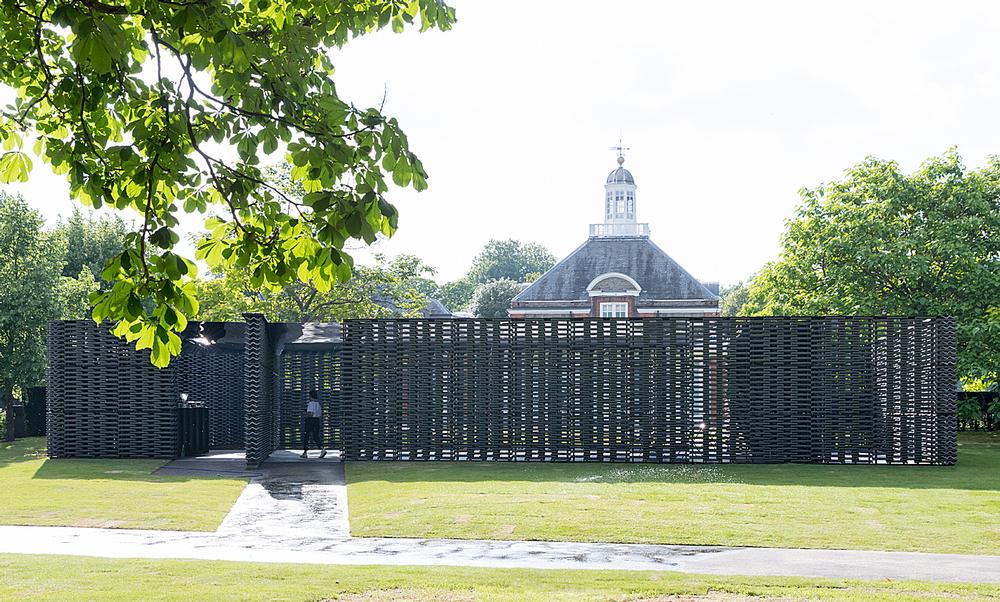
Mexican architect Frida Escobedo’s Serpentine Pavilion has launched in Kensington Gardens, London.
Escobedo’s courtyard-based design harnesses a “subtle interplay of light, water and geometry” and is inspired in part by the domestic architecture of Mexico, the Prime Meridian line at London’s Royal Observatory in Greenwich, and British materials and history. Born in 1979, Escobedo is the youngest architect to have participated in the Serpentine Pavilion programme.
Serpentine Galleries artistic director Hans Ulrich Obrist and CEO Yana Peel selected Escobedo, the 18th designer for the structure.
The architect’s prize-winning work in urban reactivation ranges from housing and community centres to hotels and galleries. In 2006, she founded her practice in Mexico City, with significant national projects including the Librería del Fondo Octavio Paz and an extension of La Tallera Siqueiros gallery in Cuernavaca.
Her designs have featured at the Venice Architecture Biennale (2012 and 2014) and the Lisbon Architecture Triennale (2013).
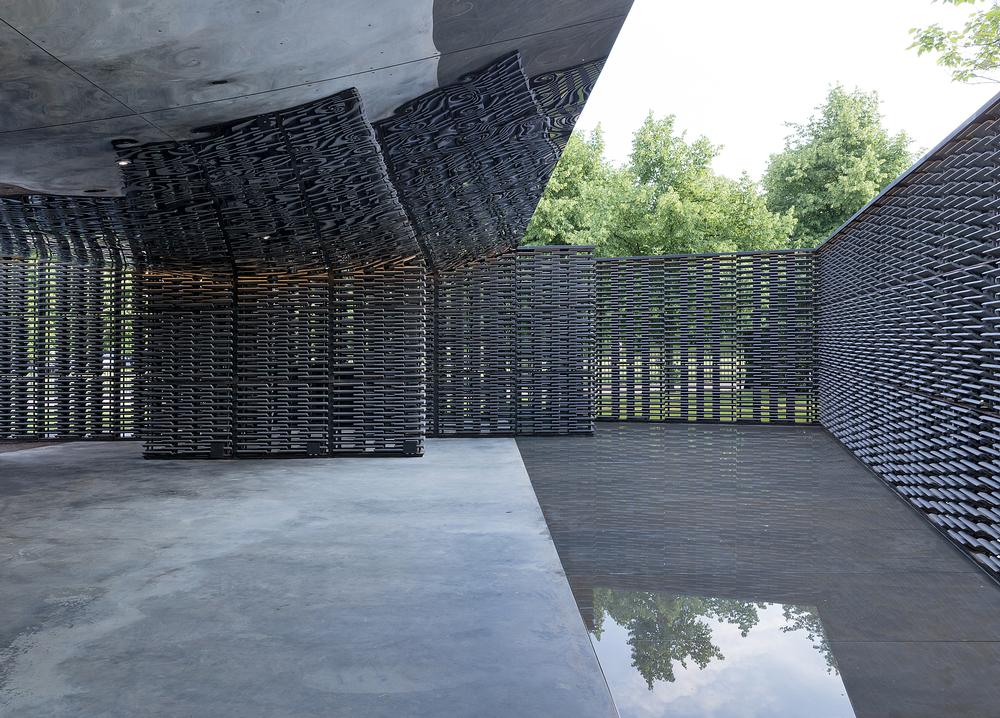
Escobedo has used a black steel frame, with stacks of cement roof tiles making up the walls of the structure and a dark concrete floor. These allow the visitor to focus on what she describes as the most important materials of the pavilion: “The reflections of the sky and trees, distorted by the curve of the canopy or the shifting surface of the pool, the dissolving perspective of the surrounding park through the celosia, and the unpredictable play of light and shadow throughout the pavilion”.
“My design for the Serpentine Pavilion 2018 is a meeting of material and historical inspirations inseparable from the city of London itself and an idea which has been central to our practice from the beginning: the expression of time in architecture through inventive use of everyday materials and simple forms,” she added.
“I hope visitors will find a space in which the passage of time feels a bit hazy — fun yet meditative, and hopefully engaging the senses in unexpected ways. On a more practical level, I envision it as a good space for conversation, for getting out of the sun, for splashing around in the water a little bit.”
The pavilion opened on 15 June 2018 and will close on 7 October 2018. Constructed in collaboration with AECOM, technical advisor David Glover and construction firm Stage One, who previously worked on Wolfgang Buttress’ Hive and Thomas Heatherwick’s 2012 Olympic cauldron. Goldman Sachs is the headline sponsor.
It was recently announced that the Serpentine Pavilion programme is being expanded to Beijing in 2018, after a major international agreement was struck between Chinese retail giant WF Central and the Serpentine Galleries. The inaugural pavilion has been designed by Chinese firm JIAKUN Architects, and is set to open in May on the lawns of The Green at WF Central – a 150,000sq m (1.6 million sq ft) hospitality hub in Wangfujing, Dongcheng District.
An opportunity to reimagine one of the UK’s most recognisable towers has been formally
opened by Rivington Hark, as St Johns Beacon invites operators and partners to shape its
next phase. [more...]
Mexican architect Frida Escobedo runs a practice in Mexico City / IMAGE: ANNA HOP
Mexican architect Frida Escobedo’s Serpentine Pavilion has launched in Kensington Gardens, London.
Escobedo’s courtyard-based design harnesses a “subtle interplay of light, water and geometry” and is inspired in part by the domestic architecture of Mexico, the Prime Meridian line at London’s Royal Observatory in Greenwich, and British materials and history. Born in 1979, Escobedo is the youngest architect to have participated in the Serpentine Pavilion programme.
Serpentine Galleries artistic director Hans Ulrich Obrist and CEO Yana Peel selected Escobedo, the 18th designer for the structure.
The architect’s prize-winning work in urban reactivation ranges from housing and community centres to hotels and galleries. In 2006, she founded her practice in Mexico City, with significant national projects including the Librería del Fondo Octavio Paz and an extension of La Tallera Siqueiros gallery in Cuernavaca.
Her designs have featured at the Venice Architecture Biennale (2012 and 2014) and the Lisbon Architecture Triennale (2013).
Escobedo has used a black steel frame, with stacks of cement roof tiles making up the walls of the structure and a dark concrete floor. These allow the visitor to focus on what she describes as the most important materials of the pavilion: “The reflections of the sky and trees, distorted by the curve of the canopy or the shifting surface of the pool, the dissolving perspective of the surrounding park through the celosia, and the unpredictable play of light and shadow throughout the pavilion”.
“My design for the Serpentine Pavilion 2018 is a meeting of material and historical inspirations inseparable from the city of London itself and an idea which has been central to our practice from the beginning: the expression of time in architecture through inventive use of everyday materials and simple forms,” she added.
“I hope visitors will find a space in which the passage of time feels a bit hazy — fun yet meditative, and hopefully engaging the senses in unexpected ways. On a more practical level, I envision it as a good space for conversation, for getting out of the sun, for splashing around in the water a little bit.”
The pavilion opened on 15 June 2018 and will close on 7 October 2018. Constructed in collaboration with AECOM, technical advisor David Glover and construction firm Stage One, who previously worked on Wolfgang Buttress’ Hive and Thomas Heatherwick’s 2012 Olympic cauldron. Goldman Sachs is the headline sponsor.
It was recently announced that the Serpentine Pavilion programme is being expanded to Beijing in 2018, after a major international agreement was struck between Chinese retail giant WF Central and the Serpentine Galleries. The inaugural pavilion has been designed by Chinese firm JIAKUN Architects, and is set to open in May on the lawns of The Green at WF Central – a 150,000sq m (1.6 million sq ft) hospitality hub in Wangfujing, Dongcheng District.
Experience design company, BRC Imagination Arts, has completed a transition that sees founder
Bob Rogers pass ownership of the business to four long-serving senior executives, while
remaining actively involved with the company.
Movie Park Germany has opened a new Paramount Pictures-themed attraction as part of its 30th
anniversary celebrations, using immersive storytelling and adaptive reuse to reinforce the park’s
longstanding “Hollywood in Germany” positioning.
Therme Manchester’s 28-acre development, which will include interconnected glass pavilions
that measure 65,000sq m, will be the largest bathing and wellbeing attraction in the world once
complete, according to prof David Russell, CEO of Therme UK.
Efteling has opened Hooghmoed, a new family drop tower designed to broaden the appeal of its
recently launched Sirene Island themed area and introduce younger visitors to thrill attractions.
A proposed Puy du Fou development near Bicester and Universal Destinations and Experiences’
planned resort in Bedford are emerging as part of a wider transformation of the Oxford–
Cambridge Growth Corridor into a major centre for UK leisure and tourism inv
Shedd Aquarium has opened the Immersion Theater developed in partnership with SimEx-
Iwerks, as part of a wider strategy to enhance the guest experience and create additional
revenue opportunities.
The UK government has announced a temporary reduction in VAT on visitor attractions and
children’s meals as part of a summer cost-of-living support package designed to stimulate the
visitor economy and encourage family days out.
As designer Yinka Ilori prepares for his first solo gallery show in London, he speaks exclusively
to CLADmag about his mission to spread joy, the power of play, and his bold approach to using
colour (including the colours you won’t see in his work).
The government of Thailand is exploring plans for a THB300bn (£6.3bn, US$8.3bn)
entertainment complex in the country’s Eastern Economic Corridor (EEC), with officials
proposing a large-scale theme park and sports destination as part of a broader tourism and
economic development strategy.
Royal Caribbean has revealed its Hero of the Seas cruise ship, home to the most pools at sea
(nine), and a record-breaking 28 dining venues, as well as attractions including a waterpark
with two new family raft slides.
+ More news
COMPANY PROFILES
DJW David & Lynn Willrich started the Company
over thirty years ago, from the Audio Visual
Department [more...]
Simworx Ltd The company was initially established
in 1997. Terry Monkton and Andrew
Roberts are the key stakeh [more...]
Clip 'n Climb Clip ‘n Climb currently offers facility owners and
investors more than 40 colourful and unique
Cha [more...]
Painting With Light By combining lighting, video, scenic and architectural elements, sound and special effects we tell s [more...]
An opportunity to reimagine one of the UK’s most recognisable towers has been formally
opened by Rivington Hark, as St Johns Beacon invites operators and partners to shape its
next phase. [more...]